Hi, what do you want to do?





Practical Money Skills
Visa: Practical Money Skills for Life: Financial Football
Football-themed game tests your consumer-finance aptitude regarding interest, banking, credit, budgeting, saving, and spending.

Other
Federal Reserve Education: Money Resources
A collection of lesson plans for teaching students about money.

California Digital Library
University of California: Money Talks
Money Talks is a hands-on, interactive, on-line program that increases the financial literacy capability of youth and young adults by giving them applied experiences that encourage fiscally sound decision-making in marketplace transactions.
Other
Bank of America: 8 Simple Ways to Save Money
This site discusses eight way to save money including recording spending, saving for a goal, making a budget, plan on saving, choose something to save for, and pick the right tools.
Texas Education Agency
Texas Gateway: Chapter 13: Money and Banking: Defining Money by Its Functions
By the end of this section, you will be able to do the following: Explain the various functions of money and contrast commodity money and fiat money.
Federal Reserve Bank
Federal Reserve Bank of Atlanta: Fractional Reserve Banking
This module looks into the inner workings of fractional reserve banking and answers these questions: What role does the Federal Reserve play in the U.S. banking system? What is the money creation potential of deposits? What is the money...
Federal Reserve Bank
Federal Reserve Bank of San Francisco: American Currency Exhibit
The Federal Reserve Bank of San Francisco's American Currency Exhibit includes a Showcase of Bills, a Tour of Exhibits by Era, Historical Context, Artistry and Imagery, and an Index of Bills.
Curated OER
Cbc: Bank Profits: 2008
Even though there has been a downturn in the Canadian economy, banks have still made billions of dollars. Explore Canada's six big banks to find out how they made their money.
Federal Reserve Bank
Federal Reserve Bank of St. Louis: The Piggy Bank Primer [Pdf]
A workbook for children on how to save and manage their money, and how to create a budget.
University of Groningen
American History: Essays: National Bank Acts of 1863 and 1864
This essay describes the purposes and effects of the National Bank Acts of 1863 and 1864.
Federal Reserve Bank
Federal Reserve Bank of Atlanta: Classroom Economist: History of Central Banking
Explores the early history of central banking in the United States, describing the evolution of banking from the late 1700s through the Great Depression, with a special focus on the Fed's role in the Depression.
Independence Hall Association
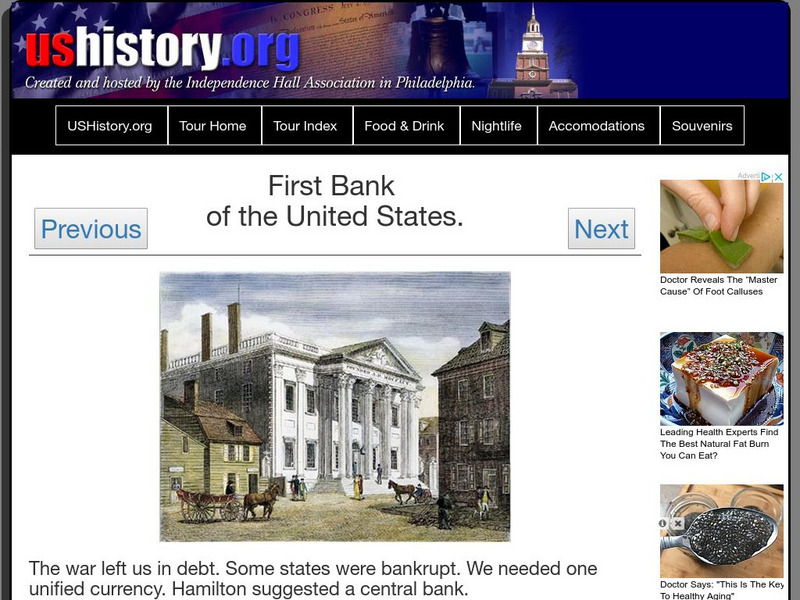
U.s. History: First Bank of the United States
This page from the IHA provides the history of and facts about the First Bank of the United States.
Other
Washington State Department of Financial Institutions: Right on the Money
[PDF] Booklet provides practical advice on topics such as banking, creating a spending plan, and finding college money.
Texas Education Agency
Texas Gateway: Ch. 13: Money and Banking: How Banks Create Money
By the end of this section, you will be able to do the following: Utilize the money multiplier formulate to determine how banks create money, analyze and create T-account balance sheets, evaluate the risks and benefits of money and banks.

Khan Academy
Khan Academy: Lesson Summary: Banking and the Expansion of the Money Supply
This lesson summary from Khan Academy is intended for students who are taking the AP Macroeconomics course. For this lesson summary will review key terms and calculations related to fractional reserve banking, required reserves, excess...
Council for Economic Education
Econ Ed Link: Big Banks, Piggy Banks
Use this informative economics lesson plan. Find out how to save your money. "You will read about safe places for keeping money; you also will learn about places where money can earn money."
Federal Reserve Bank
Federal Reserve Bank of Minneapolis: The History of Money
The Federal Reserve Bank of Minneapolis traces the history of money up from coins in ancient times to modern paper, currency, and e-money.
PBS
Pbs: Count on It!: Episode 205 Blossom and Snappy Go to the Bank, Part I
Blossom and Snappy learn about money and banking. The puppets want to buy something for Robbie for her birthday, so they decide to do some chores to earn money. Once they've earned some money, they go to the bank to open up bank accounts.
Other
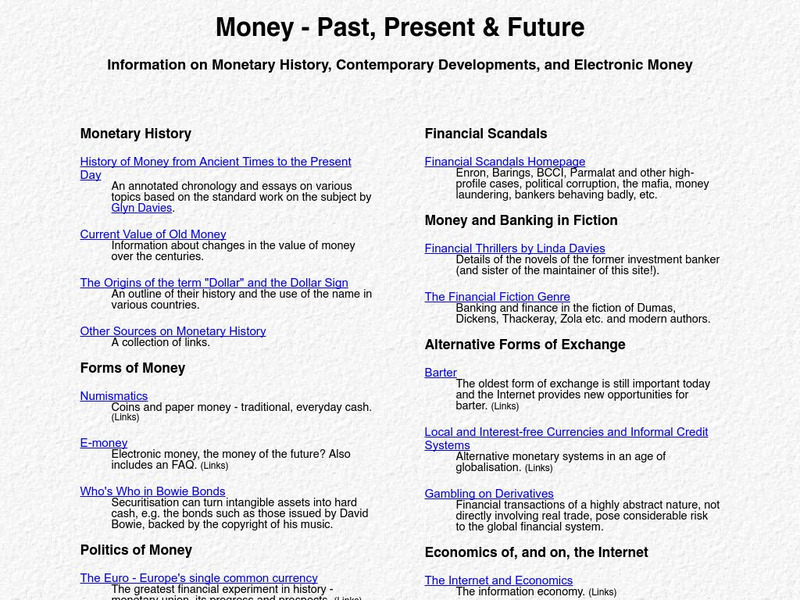
Roy Davies: Money
Explore the past, present, and future of money. Learn about exchange rates, money forms, banking, and more.
PBS
Pbs: Count on It!: Episode 206 Blossom and Snappy Go to the Bank, Part Ii
Blossom and Snappy continue to try to earn money for a present for Robbie's birthday by having a bake sale. They go back to the bank and learn about checking accounts and loans.
Council for Economic Education
Econ Ed Link: The Story of Jack and the Bank Stalk
Fairy tales have always been used to give lessons about life. The story of Jack and the Bean Stalk is a good lesson plan about the importance of knowing about money and banks. The story of Jack asks the question, "What is money?"
Crayola
Crayola: Money in the Bank
Young bankers and storekeepers practice counting money and making change. They keep their money in this recycled-box bank.
Council for Economic Education
Econ Ed Link: You Can Bank on This! (Part 1)
This is the first of four lessons on banking for elementary young scholars. This lesson provides the students with information on banking; it also allows them to try out some procedures for thinking about money and banking. There is a...
PBS
Pbs: Your Life, Your Money: Educators & Families: Picking a Bank
Learn how to select a bank through comparing and contrasting bank options.