Hi, what do you want to do?





Smithsonian Institution
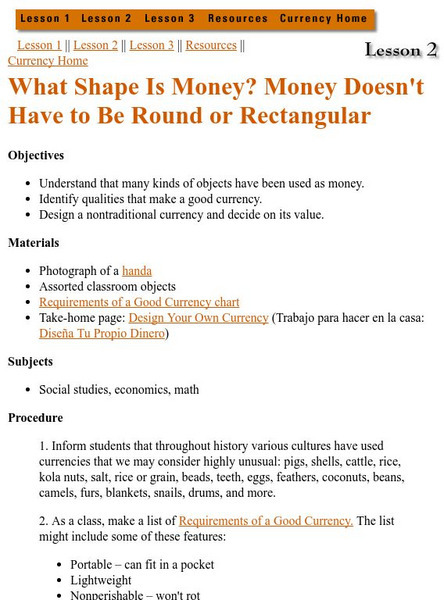
Smithsonian Learning Lab: What Shape Is Money? Money Doesn't Have to Be Round or Rectangular
Pigs, rice, nuts, teeth, eggs, feathers - these are all types of currency! This lesson discusses different types of objects that can be used as currency and students will decide what qualities make an effective currency. Included are...

Khan Academy
Khan Academy: Lesson Summary: Definition, Measurement, and Functions of Money
This information is intended for AP Macroeconomics students or for those taking college macroeconomics. This lesson reviews key terms and calculations related to the definition, measurement, and functions of money. Topics include the...
Council for Economic Education
Econ Ed Link: Do I Look Like I'm Made of Money?
One of the most common replies given by parents when their children ask for money is "Do I look like I'm made of Money?" This lesson is designed to educate students about the need for money as a generally accepted medium of exchange. The...

Better Lesson
Better Lesson: Time and Money
As the result of a Unit assessment, it was found that students showed some confusion with writing time and with adding sets of coins. These skills need to be reviewed to aid in mastery of the Common Core standards for time and money.

Scholastic
Scholastic: Adventures in Math: Lesson 3: Money in Our Community
Lesson focuses on how and why money circulated within our community. Being able to discern the difference between things we need and things we want is one of the foundational concepts for using money wisely. Goods and services are things...
Consumer Financial Protection Bureau
Consumer Financial Protection Bureau: Bouncing Ball Money Choices
Young scholars play a game to share how they think and feel about money.
Council for Economic Education
Econ Ed Link: Money Comes and Goes
Students read two online stories that introduce them to the elements of a budget and show that a successful budget balances money coming in (income) with money going out (expenses and savings). Follow-up activities point out the value of...
Better Lesson
Better Lesson: Identifying Coins
Find a instructional activity here to help students learn more about money that is all around them! Give them the chance to review coin identification with the coin game and practice.
Better Lesson
Better Lesson: Hundreds, Tens, Ones Are Coins Too
Second graders will extend their understanding of hundreds, tens and ones using dollars, dimes and pennies as another way to express groups of 100, 10 and 1.
University of Missouri
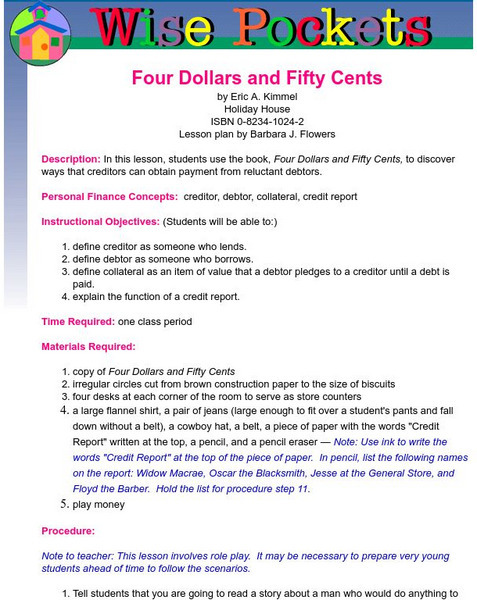
University of Missouri: Wise Pockets: Four Dollars and Fifty Cents
This is a lesson geared towards elementary level students. Using the book Four Dollars and Fifty Cents by Eric Kimmel, the teacher instructs students about the terms creditor, debtor, collateral, credit, and credit report. Lesson...
Illustrative Mathematics
Illustrative Mathematics: Saving Money 2
The purpose of this task is for students to relate addition and subtraction problems to money and to situations and goals related to saving money. A problem is given that will contain multiple solutions, this allows students to think...

University of Regina (Canada)
University of Regina: Math Central: Time, Money, and Temperature Lesson Plans
Money, time, and temperature are developed through several lessons. These topics of measurement are explained with suggested lessons, evaluations, instructional methods, and resources.
![Federal Reserve Bank of Philadelphia: Why Money? [Pdf] Lesson Plan](http://lessonplanet.com/content/resources/thumbnails/409976/large/bwluav9tywdpy2symdiwmduymc0xmdm5ny0xdnbua3j3lmpwzw.jpg?1589982798 "Federal Reserve Bank of Philadelphia: Why Money? [Pdf] Lesson Plan")
Federal Reserve Bank
Federal Reserve Bank of Philadelphia: Why Money? [Pdf]
Middle schoolers learn about barter, and the benefits of using money, as they participate in this trading simulation.
CPALMS
Cpalms: Dollars for Density
This is a guided inquiry activity in which students use simple lab procedures and discussions to develop and apply the concept of density. Students collect and graph data which they use to explore the relationship between mass and...
University of Texas
Inside Mathematics: Pocket Money [Pdf]
This task challenges a student to demonstrate fluency in adding and subtracting whole numbers.

Scholastic
Scholastic: Adventures in Math: Lesson 1: Money Matters
The process of earning money is the cornerstone of financial literacy. For this lesson, students will identify key terms associated with earning money, explore ideas for earning money now, and evaluate various career options as sources...

Writing Fix
Writing Fix: Smart Math and Writing
In this lesson, the poem "Smart" from Where the Sidewalk Ends, by Shel Silverstein, is used as the mentor text. Students will write a map of the poem and then analyze it to discover what happened when trades with money were made and...
Council for Economic Education
Econ Ed Link: Show Me the Money!
Students will investigate unforeseen costs of car loans and/or house loans. They will then evaluate the economics of decision making, the ramifications of their choices, and options available to them. Students will compute costs and...
Illustrative Mathematics
Illustrative Mathematics: 4.oa Comparing Money Raised
The purpose of this task is for students to solve three comparisons problems that are related by their context but are structurally different. Multiplicative comparison is purposefully excluded from third grade (see 3.OA.3 and 3.MD.2),...
Utah Education Network
Uen: Budgeting
It is very important that you know about budgeting and have discussed it before you get married. Learn why a budget must be flexible in order to work and is important for couples managing money.
Other
Money Management International: The Berenstain Bears' Trouble With Money
A lesson plan featuring the Berenstain Bears that introduces the concepts of spending, goods, services, income, saving, and interest.
Other
Finra Investor Education Foundation: Introduction to Earning Interest 11 & 12
Students will know and be able to use the formula for calculating compound interest and understand the effect of compounding on savings in this lesson plan.
Council for Economic Education
Econ Ed Link: The Credit Card Mystery
Credit Cards are a risky business these days, especially for students and those holding multiple cards. Interest rates on credit card balances have always been high relative to other rates, for several reasons. Despite this, there is...
Consumer Financial Protection Bureau
Consumer Financial Protection Bureau: Calculating the Numbers in Your Paycheck
Students review a pay stub from a sample paycheck to understand the real-world effect of taxes and deductions on the amount of money they take home.
Other popular searches
- Money Lessons
- Counting Money
- Adding and Subtracting Money
- Adding Money
- Money Math
- Money and Currency
- Money Games
- Australian Money
- Money Lesson Plans
- Money Place Values
- Saving Money
- Counting Money Worksheets