Hi, what do you want to do?






Curated OER
The Path of the Sun: The Ecliptic
Students investigate the celestial sphere and the paths it takes in the solar system.

Curated OER
Comparing the Satellite and Broadcast Radio Landscapes
Young scholars research the development of satellite technology over the last 50 years students explain how the enactment of the Telecommunications Act of 1996 changed the rules for corporate ownership of multiple media outlets.

Curated OER
Our Solar System
Students explore the solar system on the internet and video programs. They investigate the names of each planet and their places in the solar system. They chose their favorite planet and design an advertisement to sell a vacation to...

Curated OER
Eclipse: An Introduction
Learners write journal entries about eclipses with a focus on solar eclipses.

Curated OER
Motion Through the Ages
Eighth graders conduct internet research to produce a timeline of man's growth in understanding of concepts of motion and planetary motion through history.
Sophia Learning
Sophia: The Sun and Moon: Lesson 3
This lesson will analyze the role of the sun and moon relative to the earth's orbit. It is 3 of 4 in the series titled "The Sun and Moon."
Sophia Learning
Sophia: The Sun and Moon: Lesson 4
This lesson will analyze the role of the sun and moon relative to the earth's orbit. It is 4 of 4 in the series titled "The Sun and Moon."

University of Colorado
University of Colorado: Ph Et Interactive Simulations: Gravity and Orbits
An interactive simulation that teaches about gravitational force, circular motion, and astronomy by manipulating the sun, earth, moon, and a space station to observe the effects of gravity and orbital paths. This simulation can either be...
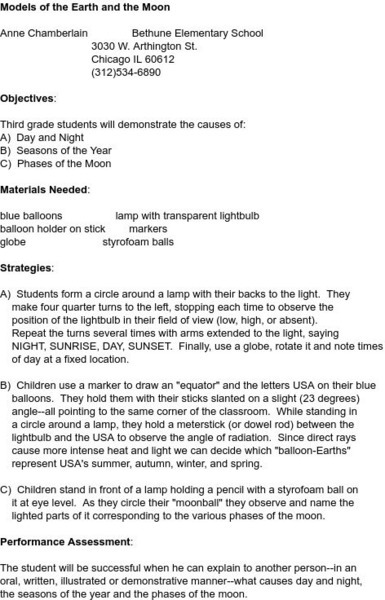
Science and Mathematics Initiative for Learning Enhancement (SMILE)
Smile: Models of the Earth and Moon
This lesson plan from the Illinois Institute of Technology demonstrates the causes of; day and night, seasons, and phases of the moon.With a few items, you help the elementary student discover why these phenomena occur.
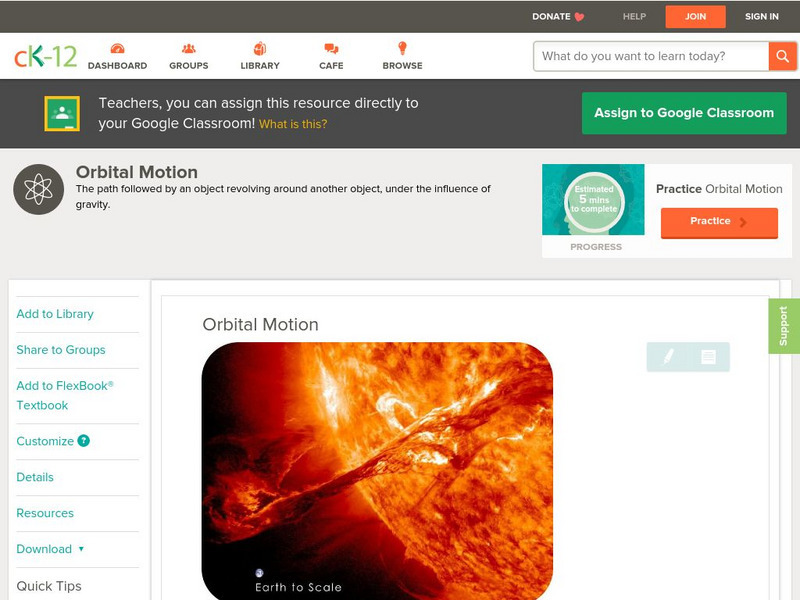
CK-12 Foundation
Ck 12: Physical Science: Orbital Motion
[Free Registration/Login may be required to access all resource tools.] Orbital motion and why it occurs, and the orbits of the Earth around the sun and the moon around the Earth.
American Geosciences Institute
American Geosciences Institute: Astronomy
Eight hands-on lessons module in which students explore the characteristics of planet Earth, its moons, the sun, the solar system, planets, and the difference between science fact and science fiction.
Utah Education Network
Uen: Trb 3:1: Investigation 4: Day and Night
A lesson for third graders in which they learn about the rotation of the Earth on its axis and how this movement creates day and night. They also examine the orbit of the moon about the Earth and the Earth's orbit around the sun.
NASA
Nasa: From Stargazers to Starships: The Calendar
A lesson plan that gives an overview of solar and lunar calendars, their history and lore. Also, of the day and the month, and their relations to the rotational period of the Earth and the orbital period of the Moon.For versions in...

Physics Classroom
The Physics Classroom: Circular and Satellite Motion: The Inverse Square Law
Through illustrated examples and interactive practice, students explore Newton's ability to relate the cause for heavenly motion (the orbit of the moon about the earth) to the cause for Earthly motion (the falling of an apple to the...