Hi, what do you want to do?






Curated OER
Machines Use Energy
Third graders observe and discuss examples of friction. They discuss what experimentally increases and decreases friction. They then predict which surface will produce the most friction and verify the prediction.

Curated OER
Momentum of Line in Art
In this momentum worksheet, students read about how artists use the term momentum to describe how a viewer's eyes move a long a line. Then students complete 4 short answer questions.

Curated OER
The Nature of Mathematics
Learners work in groups to describe plants using numbers. In this number instructional activity, students use numbers to define plants and then use numbers to write descriptions of themselves.

Curated OER
Simple Machine Test
Pupils complete several worksheets about machines. In this machine lesson students complete several handouts that describe the different machines and how pulleys work.

Curated OER
Let Your Ears Do the Walking
Students examine the effects of bycatching on water environments. They discover how echolocation works. They participate in a simulation of the process to use it while walking blindfolded.

Curated OER
Harnessing Solar Energy
Students identify the properties of light from the sun. In groups, they participate in experiments with solar collectors, cookers and calculators to determine which one harnesses the most energy. They record their observations and...

Curated OER
Preposition Combinations
In this prepositions combinations worksheet, students discover the rules governing noun, verb, and adjective plus preposition combinations. Students are also given three common types of sentence errors which involve prepositions.

Curated OER
Religious Symbols
Students research an overview of several world religions. They include explanations of common generalities, misunderstandings, and prejudices attached to those religions. Students gain knowledge of world religions through multiple...

Curated OER
Diving Raisins
Learners participate in a mini lab to explore density. In this density lesson students view a demonstration and answer questions.

ABCya
Ab Cya: Molly's More or Less Quest
Molly is back in a More or Less Quest! This educational activity provides word problems with manipulatives for kids to practice comparing more or less. The word problems are read aloud and have objects that can be used for counting and...
Shodor Education Foundation
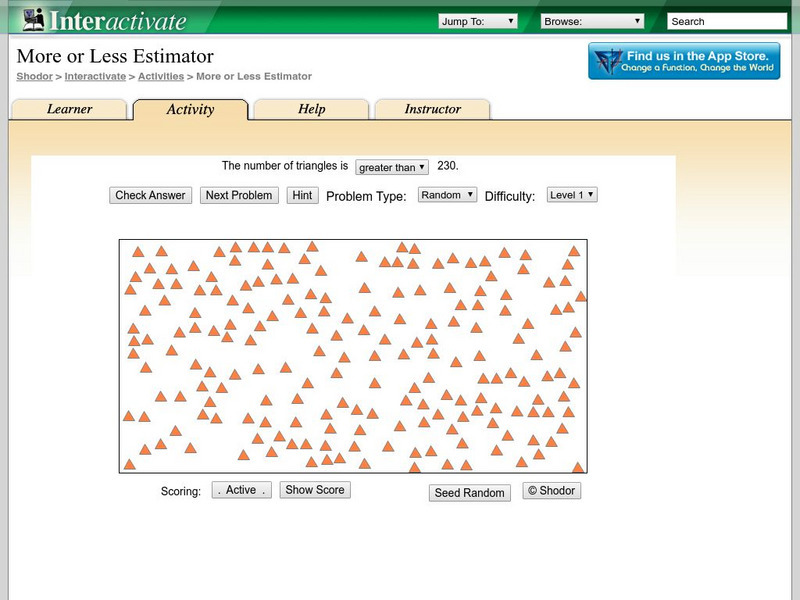
Shodor Interactivate: More or Less Estimator
Practice your estimation skills by comparing the number of objects shown, the length of a curve or the area of a shape to a given number. Your choices are "greater than" or "less than".
Shodor Education Foundation
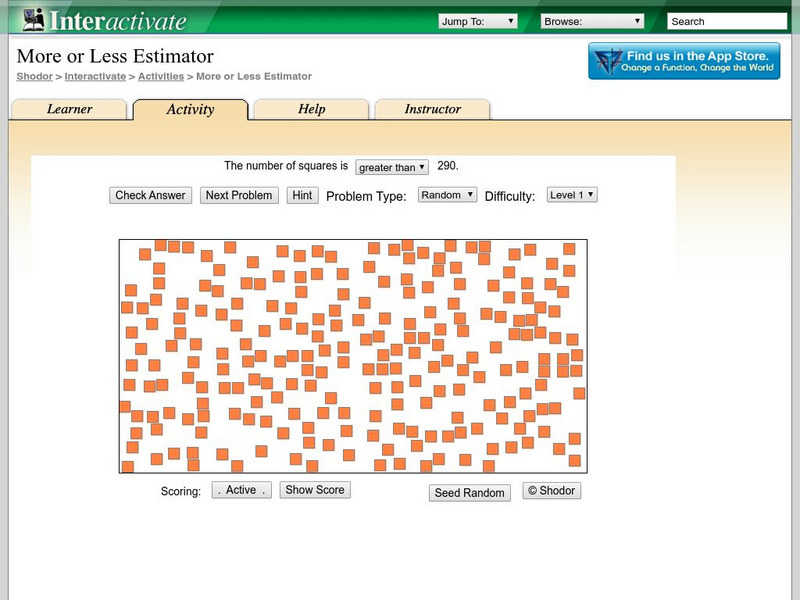
Shodor Interactivate: More or Less Estimator
This activity allows the user to practice estimation skills by determining if a given amount is more or less than the number of objects shown, the length of a curve, or the area of a shape. An interactive activity and teacher resources...
Khan Academy
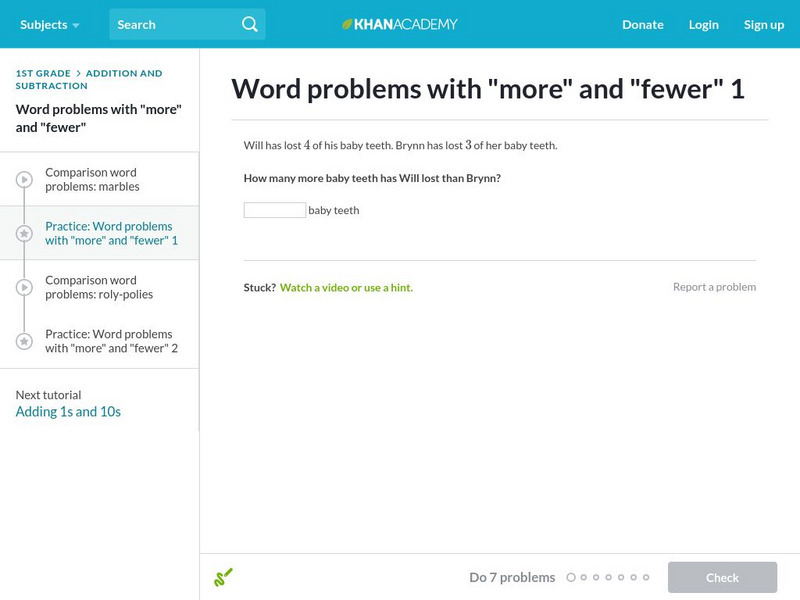
Khan Academy: Word Problems With "More" and "Fewer" 1
Practice solving word problems by finding how many more (or fewer) objects there are. Numbers used are 20 or less. Students receive immediate feedback and have the opportunity to try questions repeatedly, watch a video or receive hints.
Khan Academy
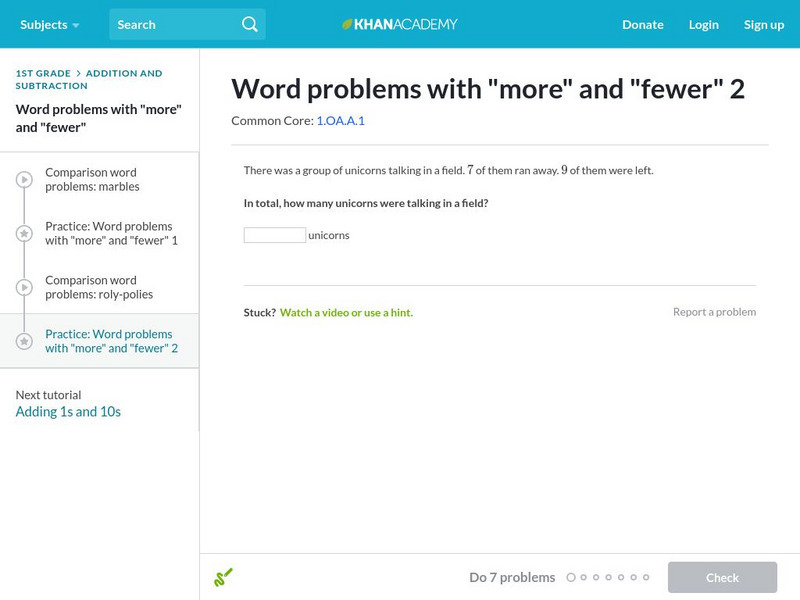
Khan Academy: Word Problems With "More" and "Fewer" 2
Practice solving more word problems by finding how many more (or fewer) objects there are. Numbers used are 20 or less. Students receive immediate feedback and have the opportunity to try questions repeatedly, watch a video or receive...
TeachEngineering
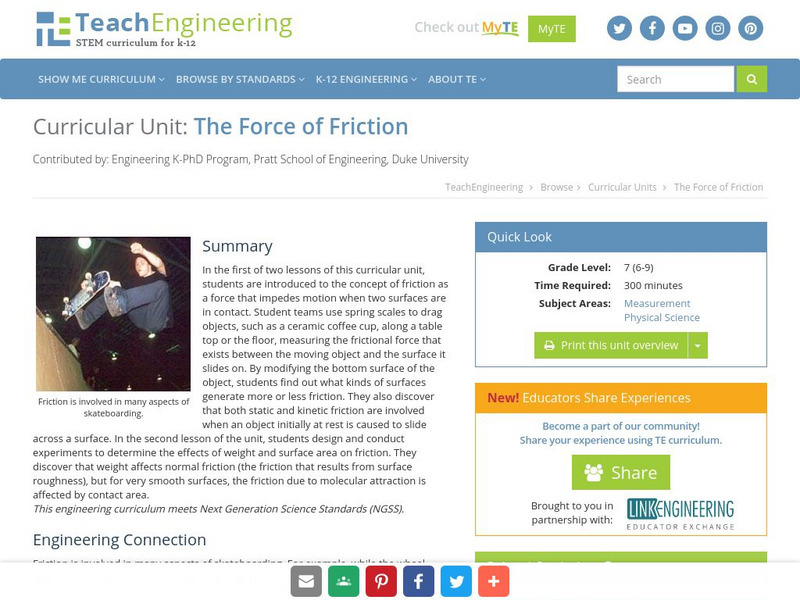
Teach Engineering: The Force of Friction
In the first of two lessons of this curricular unit, students are introduced to the concept of friction as a force that impedes motion when two surfaces are in contact. Student teams use spring scales to drag objects, such as a ceramic...
TeachEngineering
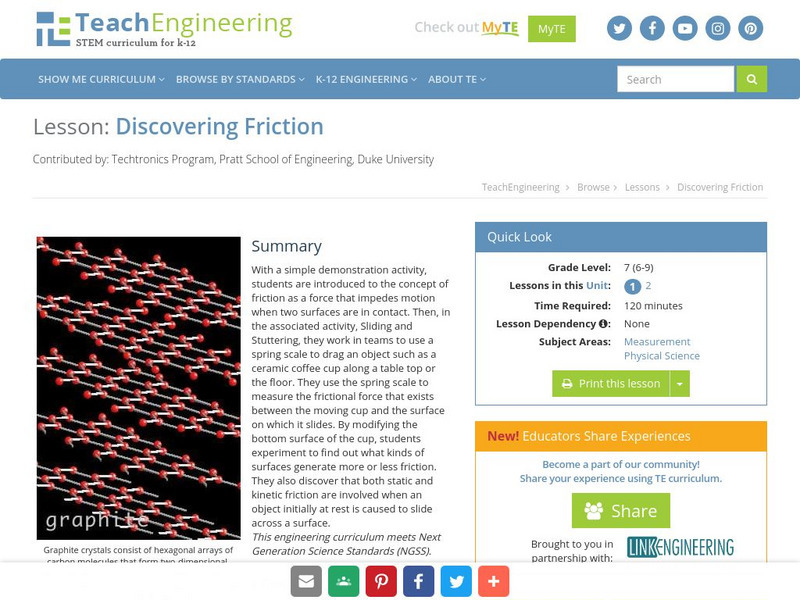
Teach Engineering: Discovering Friction
With a simple demonstration activity, young scholars are introduced to the concept of friction as a force that impedes motion when two surfaces are in contact. Then, in the Associated Activity (Sliding and Stuttering), they work in teams...
TeachEngineering
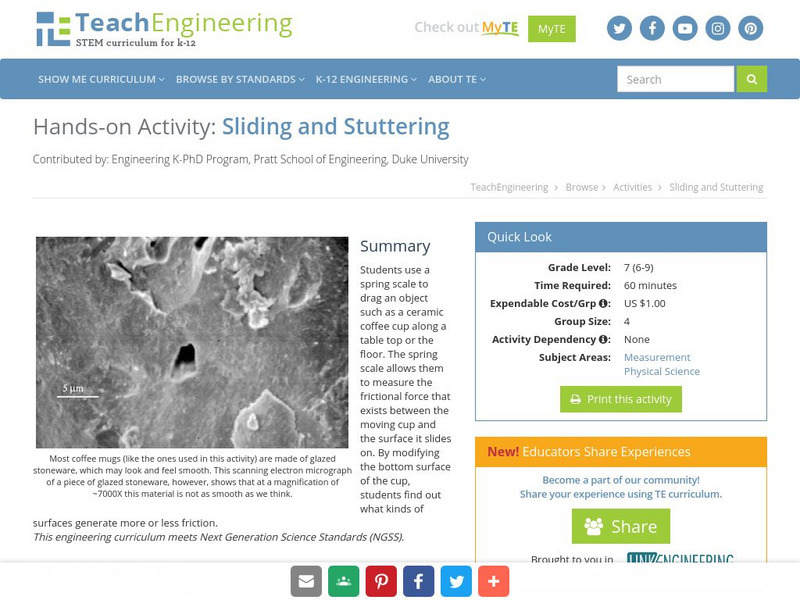
Teach Engineering: Sliding and Stuttering
Students use a spring scale to drag an object such as a ceramic coffee cup along a table top or the floor. The spring scale allows them to measure the frictional force that exists between the moving cup and the surface it slides on. By...
Illustrative Mathematics
Illustrative Mathematics: Which Weighs More? Which Weighs Less?
Learners will use a block to compare with other objects to decide which is heavier/lighter. They will fill in a chart by drawing a picture of it under "Heavier" or "Lighter" depending which applies.
Utah Education Network
Uen: Candy Bar Density
Activity allows students to think about what makes one object more or less dense than another.
AAA Math
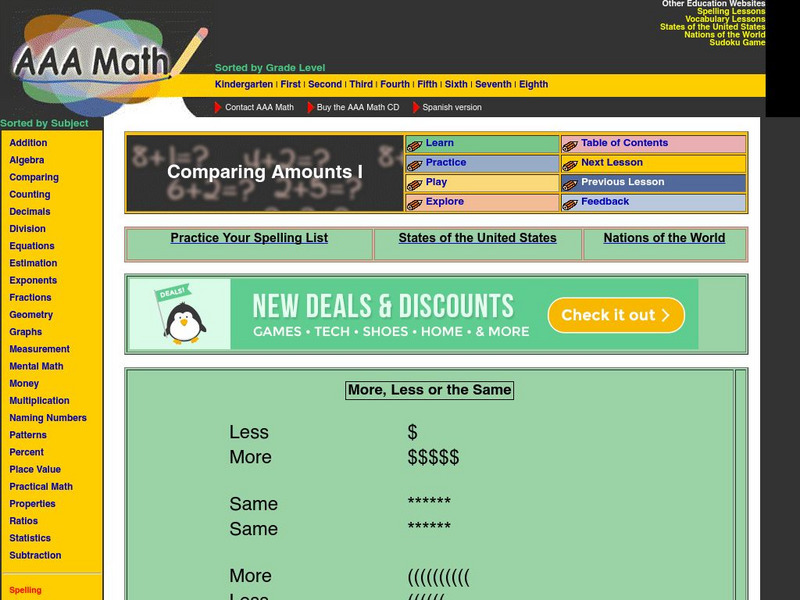
Aaa Math: More, Less or the Same: Comparing Quantities
This site provides examples of comparing quantities, as well as exercises and simple games to practice the skill.
Other
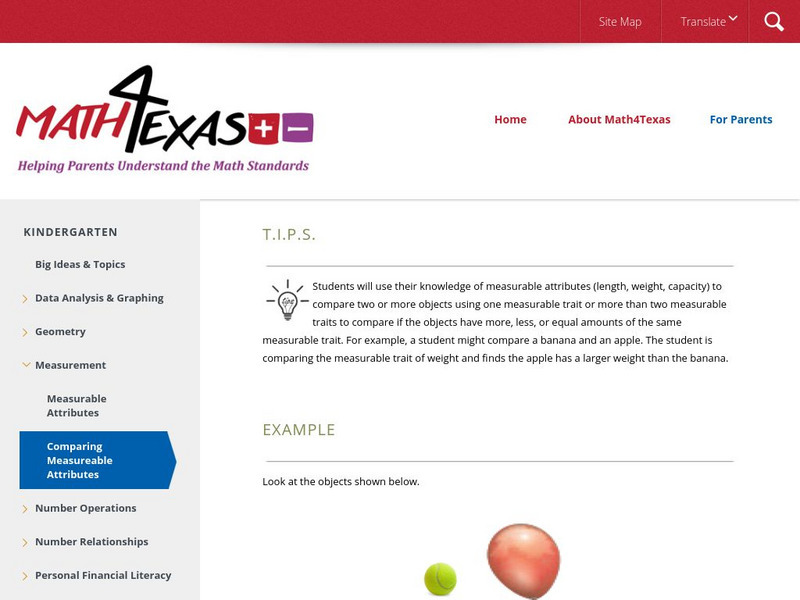
Math4 Texas: Comparing Measurable Attributes
Students will use their knowledge of measurable attributes (length, weight, capacity) to compare two or more objects using one measurable trait or more than two measurable traits to compare if the objects have more, less, or equal...