Hi, what do you want to do?





Texas Instruments
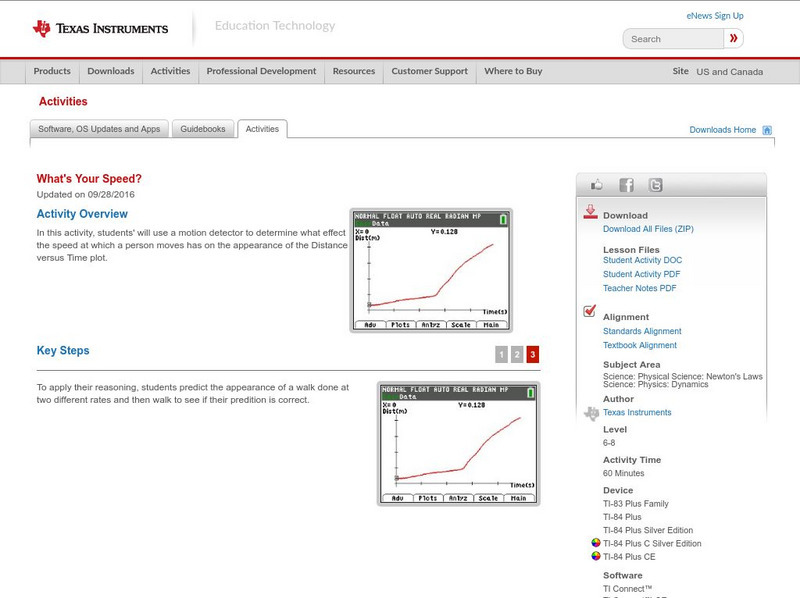
Texas Instruments: What's Your Speed?
In this activity, students' will use a motion detector to determine what effect the speed at which a person moves has on the appearance of the distance versus time plot.
Texas Instruments
Texas Instruments: What Goes Up: Position and Time for a Cart on a Ramp
In this activity, students' will use a motion detector to measure how the position of a cart on a ramp changes with time. They will then determine a parabolic model for the position data using the intercepts.
Texas Instruments
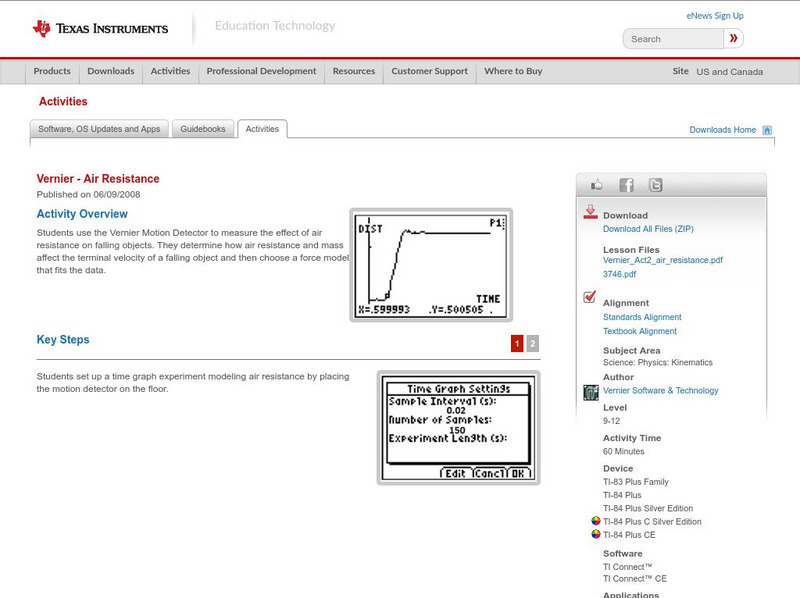
Texas Instruments: Air Resistance
Students use the Motion Detector to measure the effect of air resistance on falling objects. They determine how air resistance and mass affect the terminal velocity of a falling object and then choose a force model that fits the data.
Texas Instruments
Texas Instruments: Swinging Ellipses: Plotting an Ellipse
In this activity, Students can use a motion detector to record the position and velocity of a swinging pendulum. They will plot the data as a velocity versus position phase plot and determine an ellipse that fits it.
Texas Instruments
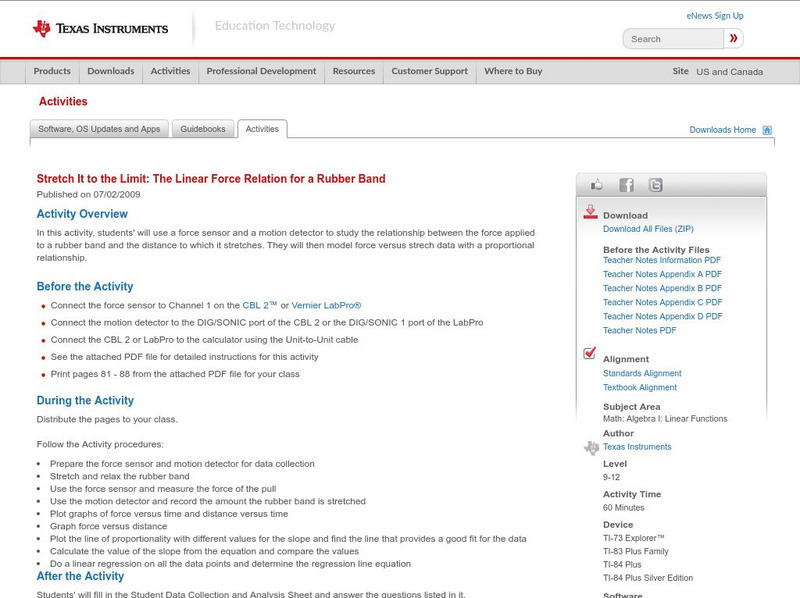
Texas Instruments: The Linear Force Relation for a Rubber Band
In this activity, students' will use a force sensor and a motion detector to study the relationship between the force applied to a rubber band and the distance to which it stretches. They will then model force versus strech data with a...
Texas Instruments
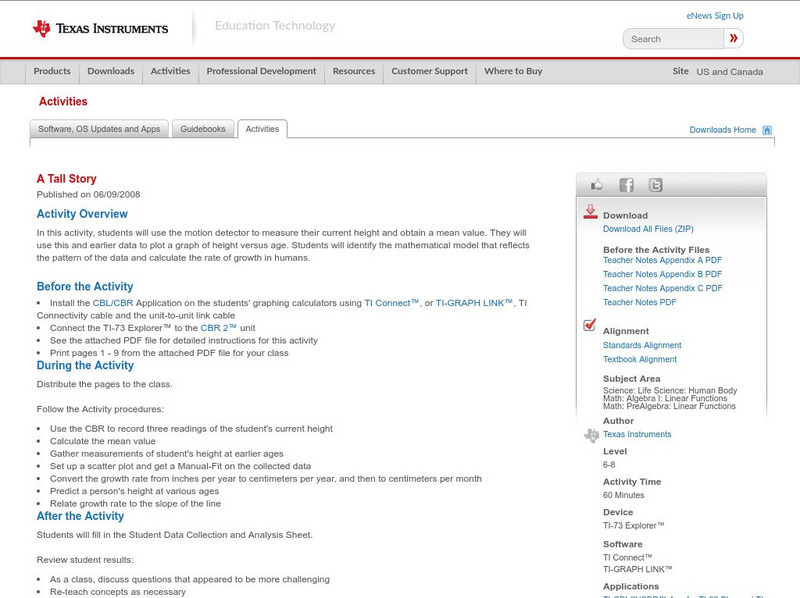
Texas Instruments: A Tall Story
In this activity, students can use the motion detector to measure their current height and obtain a mean value. They will use this and earlier data to plot a graph of height versus age. Students will identify the mathematical model that...

Texas Instruments
Texas Instruments: Stepping to the Greatest Integer: Greatest Integer Function
In this activity, students' will use a motion detector to collect position data showing evenly-spaced jumps in value. They will then model this data using the greatest integer function.
Texas Instruments
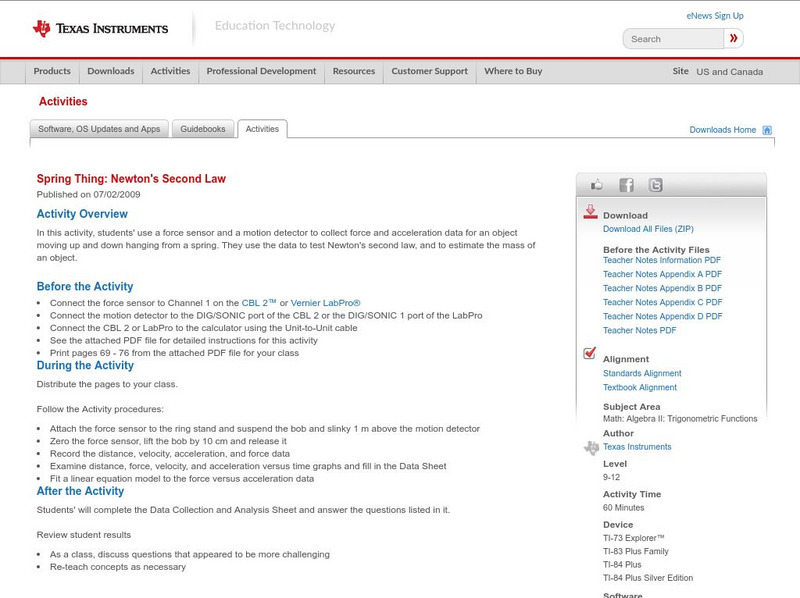
Texas Instruments: Spring Thing
This activity uses the CBL, TI-83 Plus/TI-84 Plus, force probe, and motion detector to investigate the acceleration of a mass on a spring. It also investigates Hooke's Law.
Texas Instruments
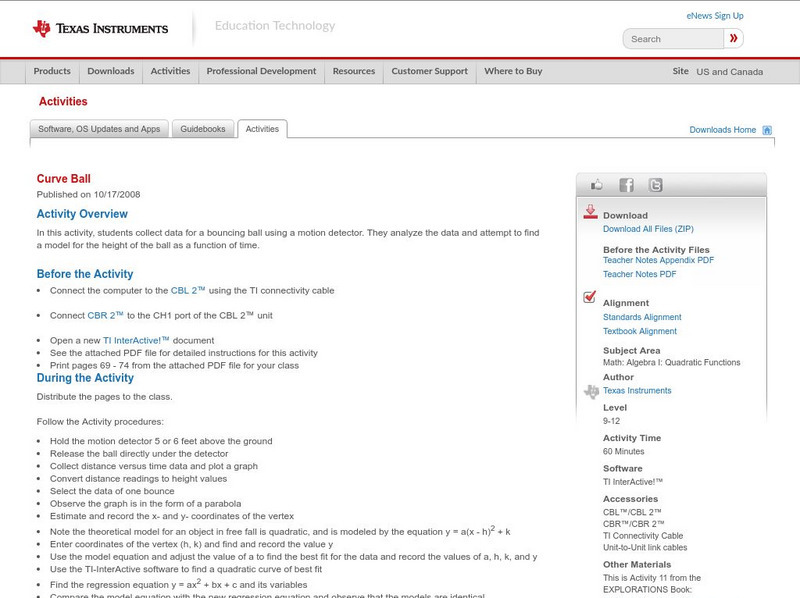
Texas Instruments: Curve Ball
In this activity, students collect data for a bouncing ball using a motion detector. They analyze the data and attempt to find a model for the height of the ball as a function of time.
Texas Instruments
Texas Instruments: Ball Bounce
This activity allows students to use real data obtained by them to model quadratic equations. students can use the TI-83 and/or TI-84 and a motion detector to collect their data. The students will then manually fit both quadratic and...
Texas Instruments
Texas Instruments: From Here to There Applications of the Distance Formula
In this activity, students' will use a pair of motion detectors to record the cartesian coordinates of a rod moving in a star-shaped pattern and calculate the distances moved between the vertices of the star. They also compare these...
Texas Instruments
Texas Instruments: How Tall? Describing Data With Statistical Plots
In this activity, students' will measure their heights using a motion detector and describe the data using the statistical concept called box plot.
Texas Instruments
Texas Instruments: Walk the Line: Straight Line Distance Graphs
In this activity, students' use a motion detector to create straight-line, or constant-speed, distance versus time plots, and analyze the linear equation that describes the plots.
Science Education Resource Center at Carleton College
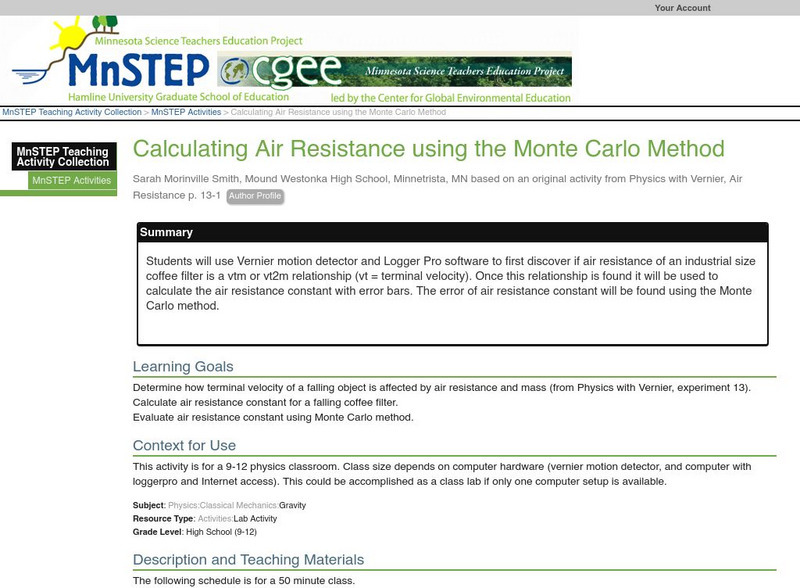
Serc: Calculating Air Resistance Using the Monte Carlo Method
Students will use Vernier motion detector and Logger Pro software to first discover if air resistance of an industrial size coffee filter is a vtm or vt2m relationship (vt = terminal velocity). Once this relationship is found it will be...
Texas Instruments
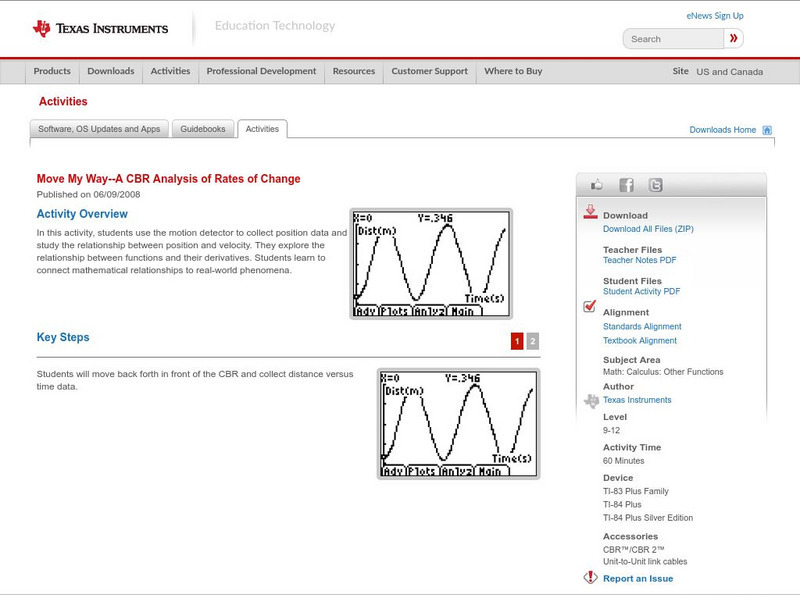
Texas Instruments: Move My Way a Cbr Analysis of Rates of Change
In this activity, students use the motion detector to collect position data and study the relationship between position and velocity. They explore the relationship between functions and their derivatives. Students learn to connect...
Exploratorium
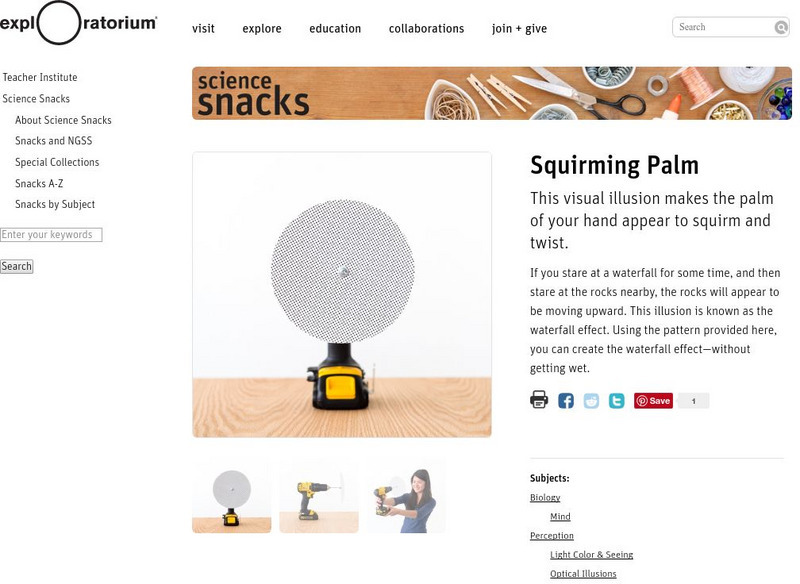
Exploratorium: Science Snacks: Squirming Palm
Create this optical illusion that incorporates what is known as the waterfall effect.