Hi, what do you want to do?





Texas Instruments
Texas Instruments: Graphing Your Motion With Easy Data App and Cbr 2
Students can use a CBR 2 motion detector to measure distance and velocity. Students prepare graphs of motion and analyze them. They compare and match graphs of distance versus time and velocity versus time.
Texas Instruments
Texas Instruments: Exploring Motion Graphs
Students will create distance-time and velocity-time graphs with CBL2 and motion detectors.
Alabama Learning Exchange
Alex: Newton's Laws of Motion
Students use toy cars, a CBR sonic motion detector, and pennies to investigate Newton's Laws of Motion.
Texas Instruments
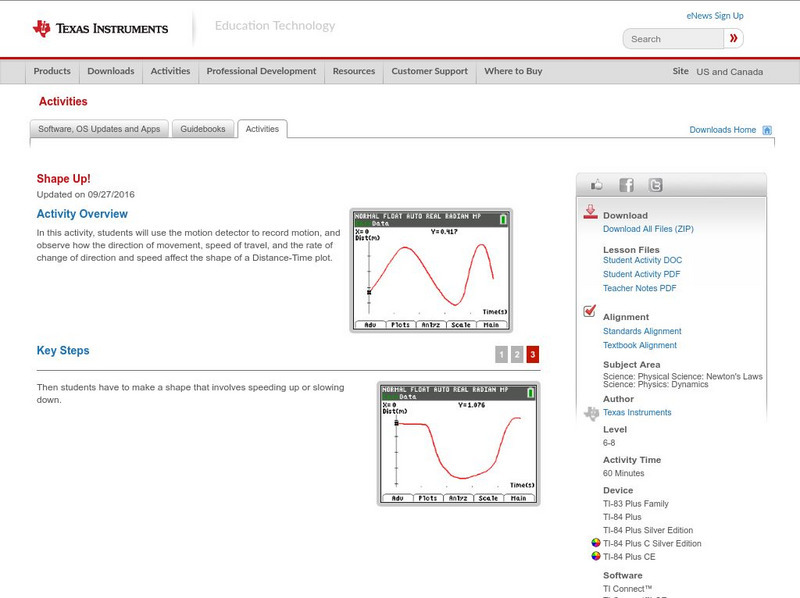
Texas Instruments: Shape Up!
In this activity, students can use the motion detector to record motion, and observe how the direction of movement, speed of travel, and the rate of change of direction and speed affect the shape of a distance-time plot.
Texas Instruments
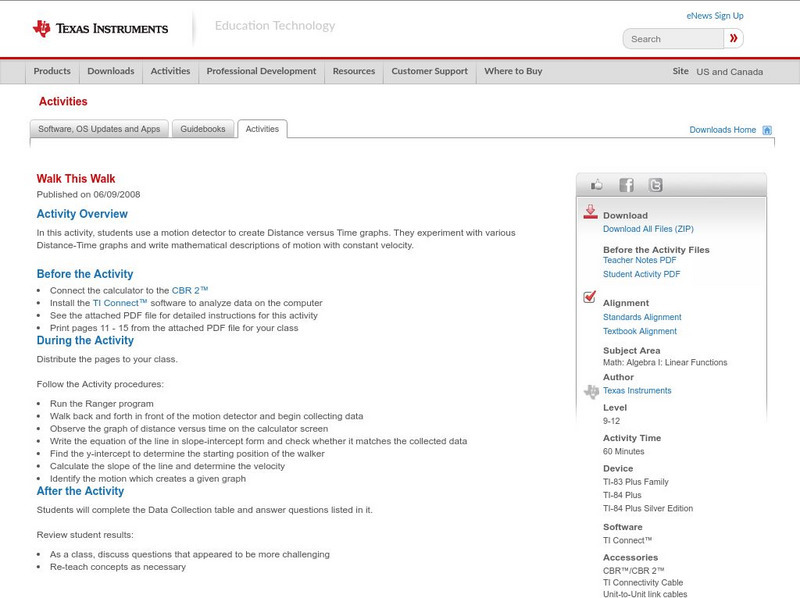
Texas Instruments: Walk This Walk
In this activity, students use a motion detector to create Distance versus Time graphs. They experiment with various Distance-Time graphs and write mathematical descriptions of motion with constant velocity.
Texas Instruments
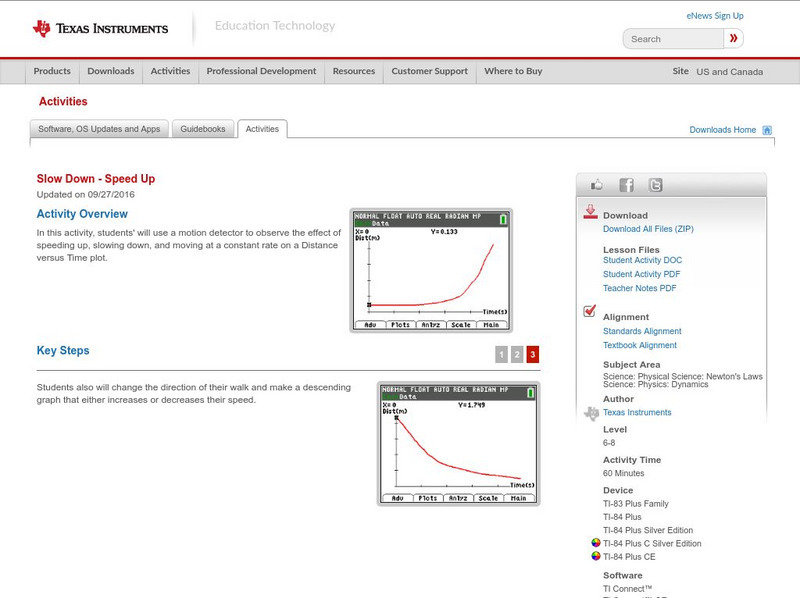
Texas Instruments: Slow Down: Speed Up
In this activity, students' will use a motion detector to observe the effect of speeding up, slowing down, and moving at a constant rate on a Distance versus Time plot.
Texas Instruments
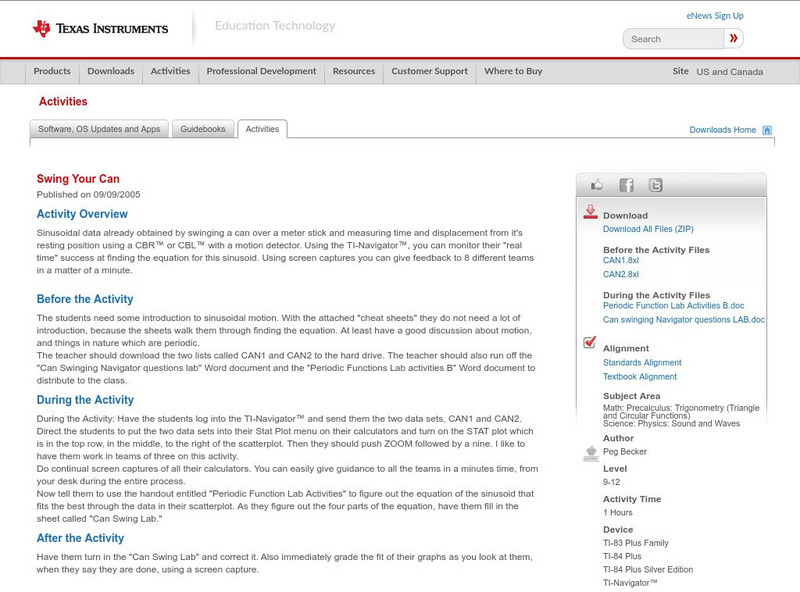
Texas Instruments: Swing Your Can
Sinusoidal data already obtained by swinging a can over a meter stick and measuring time and displacement from its resting position using a CBR or CBL with a motion detector. Using the TI-Navigator, you can monitor their "real time"...
Texas Instruments
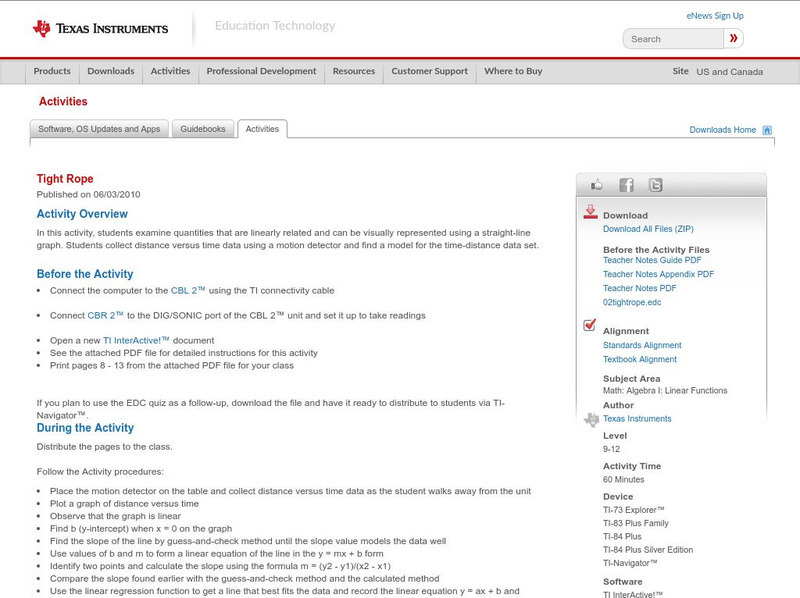
Texas Instruments: Tight Rope
In this activity, students examine quantities that are linearly related and can be visually represented using a straight-line graph. Students collect distance versus time data using a motion detector and find a model for the...

Texas Instruments
Texas Instruments: Walk This Way: Definition of Rate
In this activity, students' will use a motion detector to record distance and velocity versus time information for a walker. They find the area under the velocity versus time graph and compare it to the actual distance traveled by the...
Texas Instruments
Texas Instruments: Vernier a Speedy Slide With Easy Data App and Cbr 2
Students can use a CBR 2 motion detector to determine their speed or velocity going down a playground slide. They will also experiment with different ways to increase their speed going down the slide.
Texas Instruments
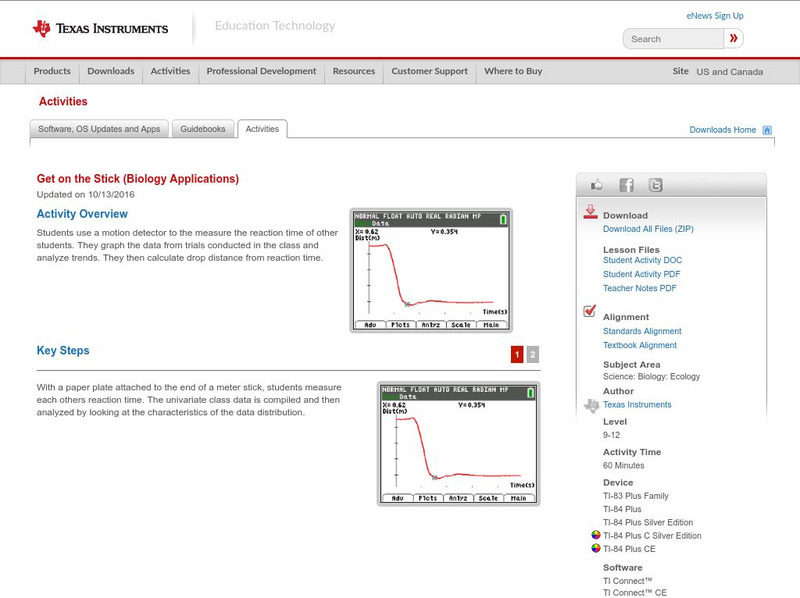
Texas Instruments: Get on the Stick
In this activity, students' use a motion detector to the measure the reaction time of students. They graph the data from trials conducted in the class and analyze trends. They then calculate drop distance from reaction time.
Texas Instruments
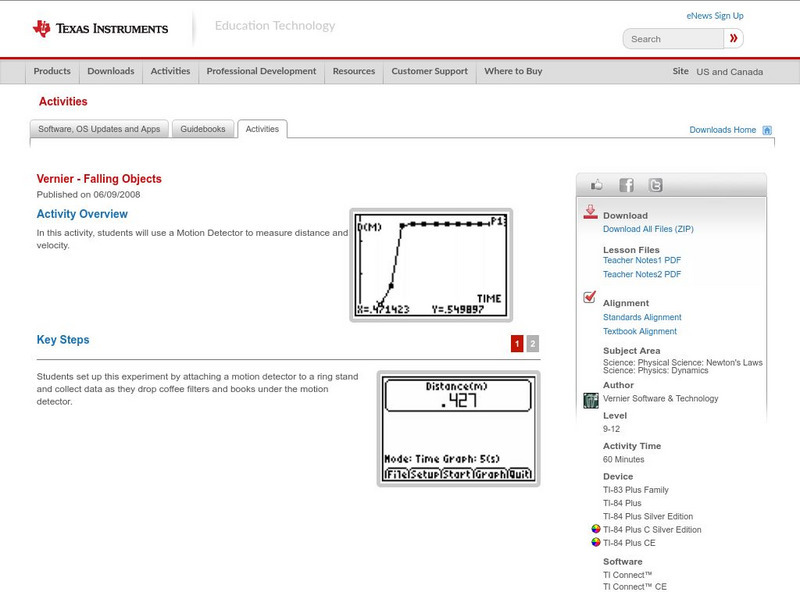
Texas Instruments: Falling Objects
In this activity, Students can use a Motion Detector to measure distance and velocity.
Concord Consortium
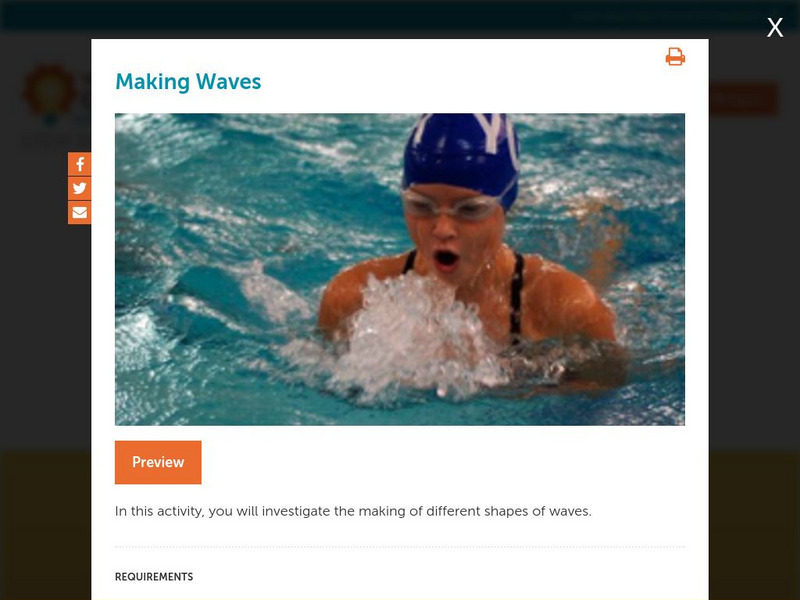
Concord Consortium: Stem Resources: Making Waves
Learn how to make waves! Using a motion sensor, students will recreate distance vs. time graphs given in the lab. Lab gives a detailed procedure as well as questions that can be saved online.
Science Education Resource Center at Carleton College
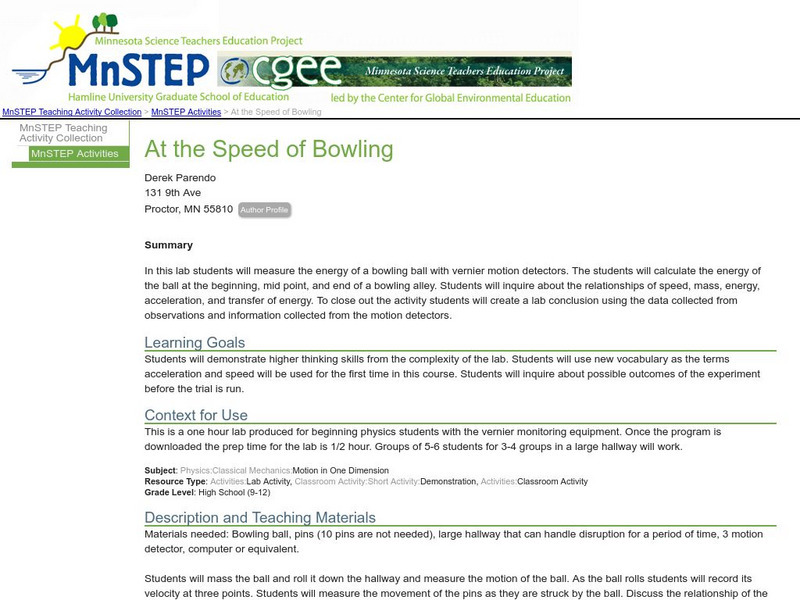
Serc: At the Speed of Bowling
In this lab students will measure the energy of a bowling ball with vernier motion detectors. The students will calculate the energy of the ball at the beginning, mid point, and end of a bowling alley. Students will inquire about the...
Texas Instruments
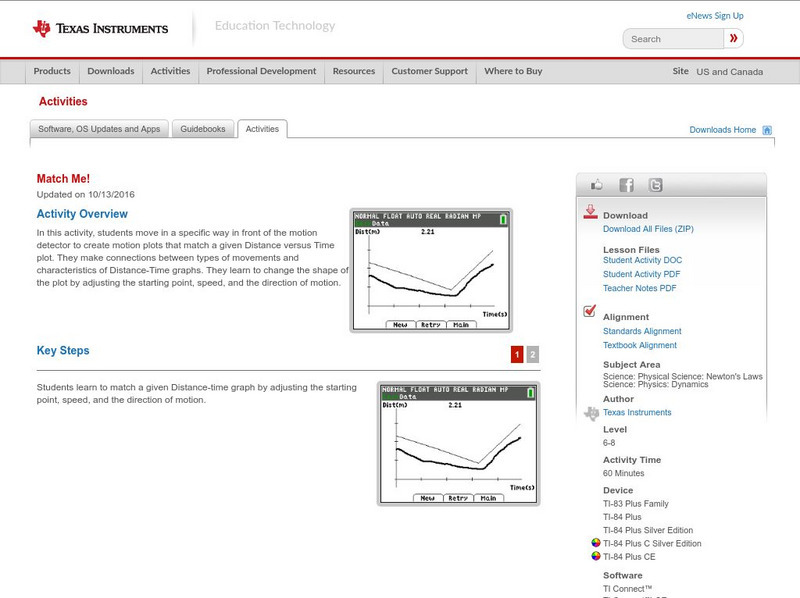
Texas Instruments: Match Me!
In this activity, students move in a specific way in front of the motion detector to create motion plots that match a given Distance versus Time plot. They make connections between types of movements and characteristics of Distance-Time...
Texas Instruments
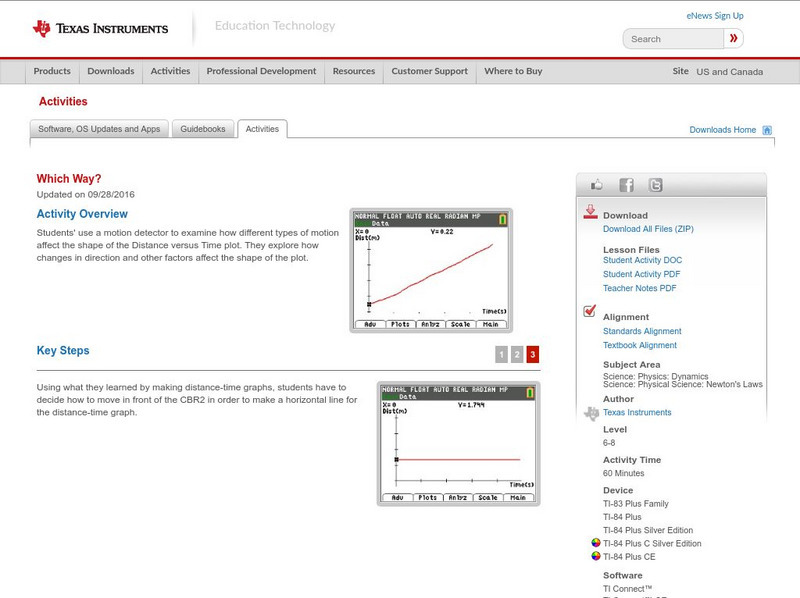
Texas Instruments: Which Way?
Students' use a motion detector to examine how different types of motion affect the shape of the distance versus time plot. They explore how changes in direction and other factors affect the shape of the plot.
Texas Instruments
Texas Instruments: Spring Thing: Newton's Second Law
In this activity, students' use a force sensor and a motion detector to collect force and acceleration data for an object moving up and down hanging from a spring. They use the data to test Newton's second law, and to estimate the mass...
Texas Instruments
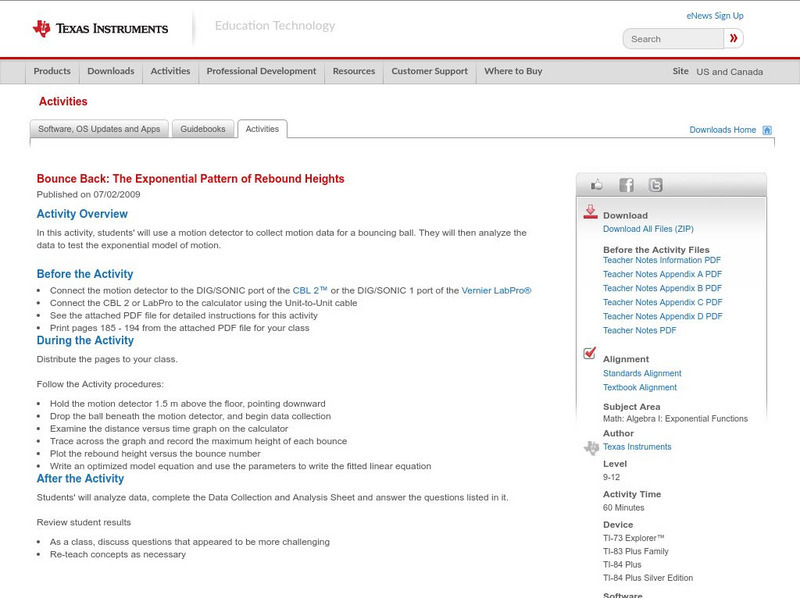
Texas Instruments: Bounce Back: The Exponential Pattern of Rebound Heights
In this activity, students' will use a motion detector to collect motion data for a bouncing ball. They will then analyze the data to test the exponential model of motion.
Texas Instruments
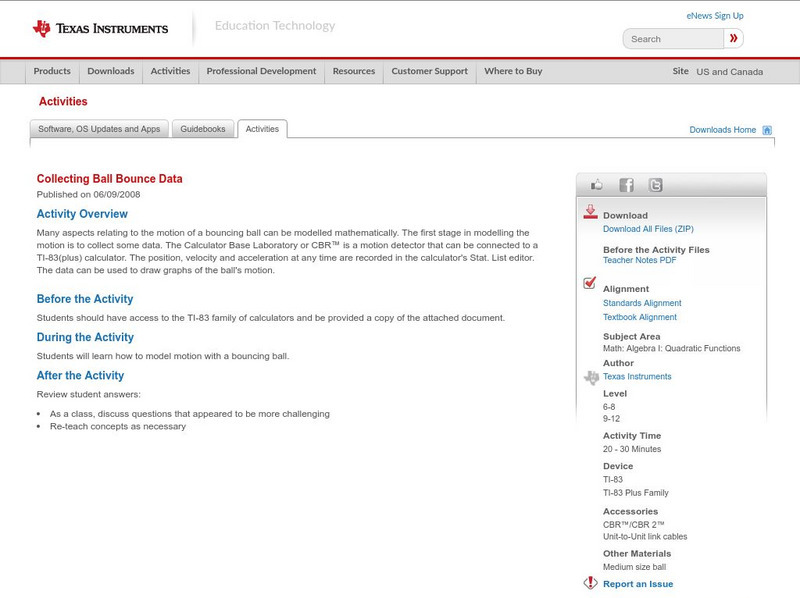
Texas Instruments: Collecting Ball Bounce Data
Many aspects relating to the motion of a bouncing ball can be modelled mathematically. The first stage in modelling the motion is to collect some data. The Calculator Base Laboratory or CBR is a motion detector that can be connected to a...
Texas Instruments
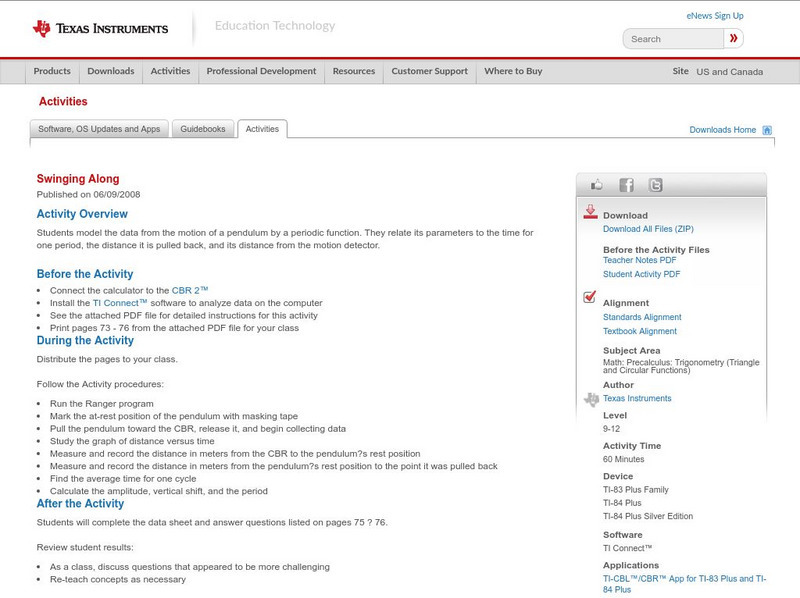
Texas Instruments: Swinging Along
Students model the data from the motion of a pendulum by a periodic function. They relate its parameters to the time for one period, the distance it is pulled back, and its distance from the motion detector.

Texas Instruments
Texas Instruments: Velocity Test: Interpreting Velocity Graphs
In this activity, students' will use a motion detector to record the distance versus time data for the simple motion of a walker. They will calculate velocity from this graph and compare it with the velocity graph generated by the...
Texas Instruments
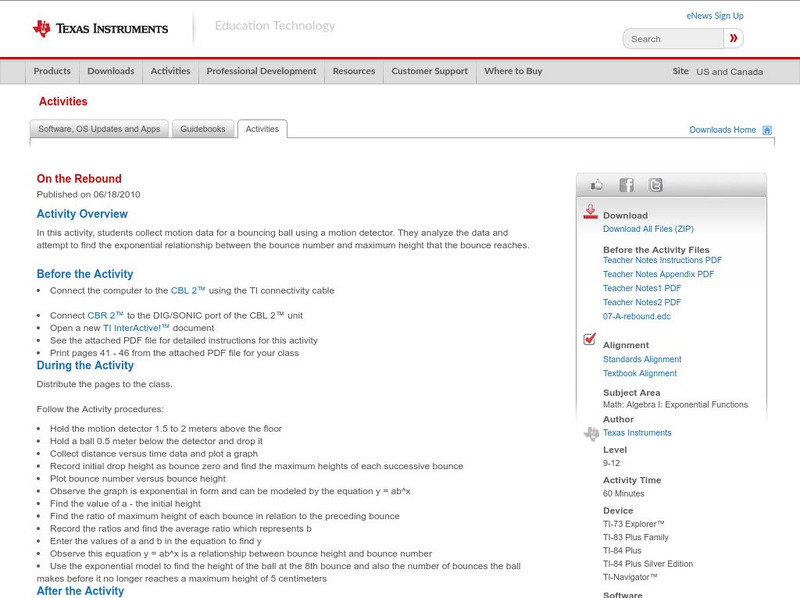
Texas Instruments: On the Rebound
In this activity, students collect motion data for a bouncing ball using a motion detector. They analyze the data and attempt to find the exponential relationship between the bounce number and maximum height that the bounce reaches.
Texas Instruments
Texas Instruments: How Can a Clock Part Measure Gravity?
In this activity students will learn how to make a simple pendulum. Students' will use a motion detector to measure the period of a pendulum and calculate its acceleration.They will also understand the effect that gravity has on the...
Texas Instruments
Texas Instruments: Height and Time for a Bouncing Ball
In this activity, students' will record the motion of a bouncing ball using a motion detector. They will then model a bounce using both the general and vertex forms of the parabola.