Hi, what do you want to do?






Curated OER
Momentum
Learners learn the concepts of momentum and its conservation, using the recoil of a cannon as an example. They examine how momentum is a vector, allowing its conservation to be applied to problems in 2 and 3 dimensions.

Curated OER
Perception And The Interpretation of Experiences
Students describe a problem and propose alternative strategies for the solution. They use a model or drawing to visualize the solution to a problem. Students identify alternative factors to be considered when examining possible...

Curated OER
Portrait and Figure Drawing
Students investigate the self-portraits and figure drawings of famous artists such as Käthe Kollowitz, Pablo Picasso, Rembrandt and others following their own attempts to create their expressive original drawings.

Teacher's Corner
The Magic School Bus: Plays Ball Video
Join the Magic School Bus crew as they take a field trip to the baseball field. Learners respond to questions as they watch the video.

Curated OER
Ptolemy, Copernicus, & the Church
Students determine the difference between a geocentric universe and a heliocentric universe.

Curated OER
Ptolemy, Copernicus, & the Church
Students explore the scientific revolution. In this scientific revolution instructional activity, students complete activities regarding Ptolemy, Copernicus, and the Church.

Curated OER
The Wheels on the Bot Go Round and Round, Part I
Young scholars determine how speed is measured. In this physics lesson, students design an experiment to find out if the robot's drive wheel size affects its speed. They collect data and discuss results.

Curated OER
Airplane flight
Students learn the basic concepts about airplane flight. They learn the reason jetliner wings are swept back and why jet engines have replaced propellers in high-speed flight.

PBS
Pbs Learning Media: Frames of Reference
Explore how different frames of reference affect your perception of motion in this interactive activity from the American Museum of Natural History.
Science Education Resource Center at Carleton College
Serc: Investigating Motion: Understanding Frame of Reference
In this lab activity, students investigate the concept of frame of reference by observing, describing and drawing the same walking motion from different positions. Additionally, they determine the effect of frame of reference on the...
American Museum of Natural History
American Museum of Natural History: Resources for Learning: Frames of Reference
Use this interactive physics simulation to determine how perception of motion changes with the frame of reference. The simulation introduces the principles of motion with respect to frame of reference.
CK-12 Foundation
Ck 12: Episd: Inertial Frames and Relative Motion
[Free Registration/Login may be required to access all resource tools.] Relative motion is always measured with a frame of reference. Evaluate a variety of frames of reference and inertial frames to understand relative motion.

CK-12 Foundation
Ck 12: Physical Science: Motion
[Free Registration/Login may be required to access all resource tools.] Definition of motion and how it is related to frame of reference.

Texas Education Agency
Texas Gateway: Fictitious Forces and Non Inertial Frames: The Coriolis Force
By the end of this section, you will be able to discuss the inertial frame of reference, discuss the non-inertial frame of reference, and describe the effects of the Coriolis force.
Texas Education Agency
Texas Gateway: 4.2 Newton's First Law of Motion: Inertia
By the end of this section, you will be able to define mass and inertia and to understand Newton's First Law of Motion: There exists an inertial frame of reference such that a body at rest remains at rest, or, if in motion, remains in...

OpenStax
Open Stax: Fictitious Forces and Non Inertial Frames: The Coriolis Force
In the following interactive students will begin to discuss the inertial frame of reference and the non-inertial frame of reference. They will also describe the effects of the Coriolis force.
Stanford University
Stanford University: Conventionality of Simultaneity
This site from Stanford University is on the topic of simultaneity in relativity.

Alabama Learning Exchange
Alex: Motion in One Dimension
This hands-on exercise allows students to view and calculate the various factors involved in one-dimensional motion. Students will use remote control vehicles to illustrate the linear motion. Students will use the information gathered...

Exploratorium
Exploratorium: Science Snacks: Spinning Blackboard
Explore the effects of drawing in a straight line within a rotating frame of reference. This activity requires a turntable. If this is unavailable, a cake turntable with a glued-on center post might work as well.
The Wonder of Science
The Wonder of Science: Ms Ps2 2: Forces, Mass and the Motion of an Object
Cover standards for middle school force, mass, and the motion of an object with this site. Find work samples, phenomena, assessment templates, and videos that directly address standard.
American Association of Physics Teachers
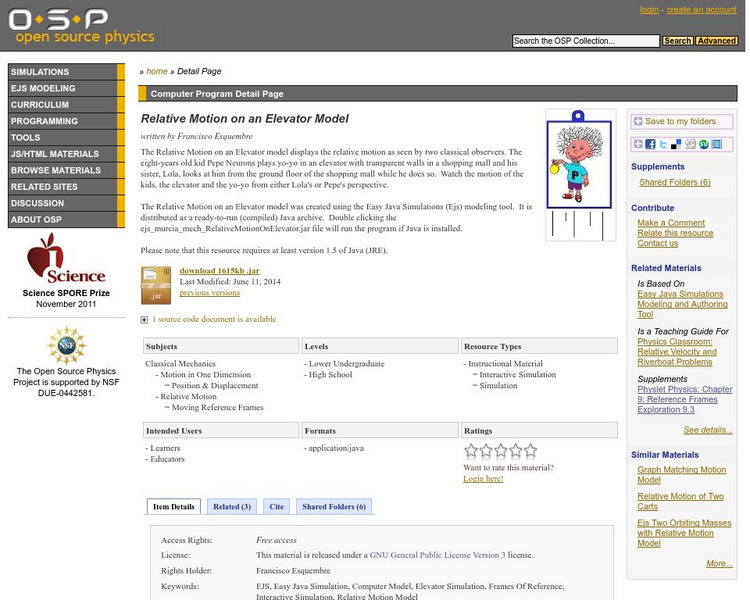
Com Padre Digital Library: Open Source Physics: Relative Motion on Elevator Model
What would happen if you played with a yo-yo in a moving elevator? This simulated exercise lets users observe what happens from two perspectives, one being the person playing with the toy and the other being on the outside of a glass...
Middle School Science
Middle School Science: Motion Notes
Personal site in which a teacher outlines a unit on motion. Probes through topics such as average speed, velocity, acceleration, speed, deceleration, force and more.

American Museum of Natural History
American Museum of Natural History: O Logy: Stuff to Do: Views From Windows
Instructions that take you through an Einstein-like thought experiment by having you imagine and record what you see when stationary and when moving at the speed of light.
CK-12 Foundation
Ck 12: Episd: Locating an Object: Distance and Displacement
[Free Registration/Login may be required to access all resource tools.] Understand how to analyze one dimensional motion by applying mathematic equations, distance, and displacement.