Hi, what do you want to do?





Texas Education Agency
Texas Gateway: 4.3 Newton's Second Law of Motion: Concept of a System
By the end of this section, you will be able to define net force, external force, and system; understand Newton's second law of motion; and apply Newton's second law to determine the weight of an object.
Texas Education Agency
Texas Gateway: Uniform Circular Motion and Gravitation: Centripetal Forces
By the end of this section, you will be able to calculate coefficient of friction on a car tire and to calculate ideal speed and angle of a car on a turn.

University of Colorado
University of Colorado: Ph Et Interactive Simulations: Forces and Motion: Basics
See how forces affect various items that are pushed or pulled.
University of Colorado
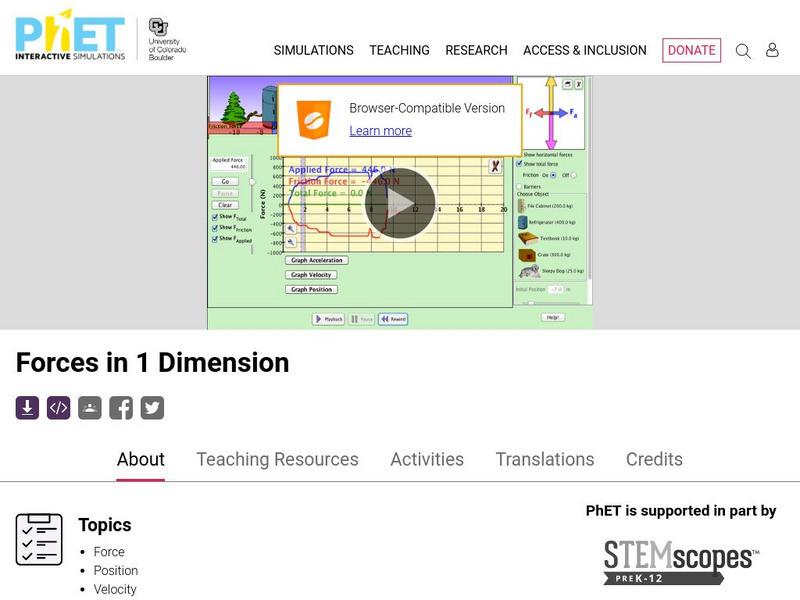
University of Colorado: Ph Et Interactive Simulations: Forces in One Dimension
Use this simulation to see the results of applying a force to move an object. Analyze forces and friction using graphs.
OpenStax
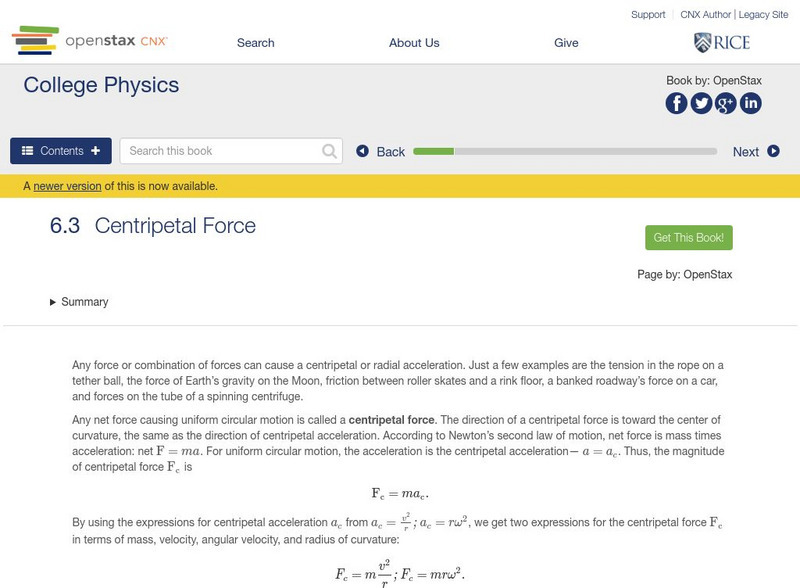
Open Stax: Physics: Centripetal Force
In the following interactive students will begin to calculate coefficient of friction on a car tire. They will also calculate ideal speed and angle of a car on a turn.
TeachEngineering
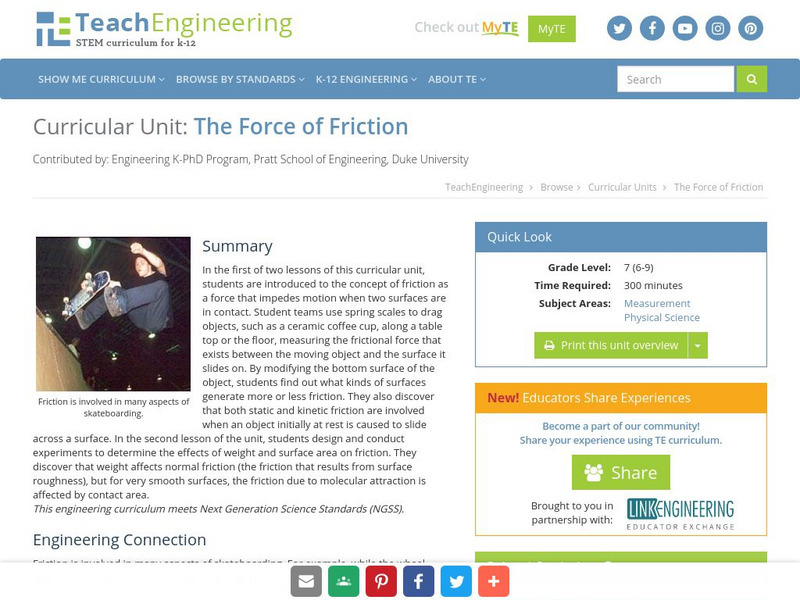
Teach Engineering: The Force of Friction
In the first of two lessons of this curricular unit, students are introduced to the concept of friction as a force that impedes motion when two surfaces are in contact. Student teams use spring scales to drag objects, such as a ceramic...

Discovery Education
Discovery Education: Friction in Our Lives
Young scholars observe objects in motion down a ramp to discover how the force of friction affects an object's motion. Includes the lesson plan, vocabulary list, and extensions for students.
University of Minnesota
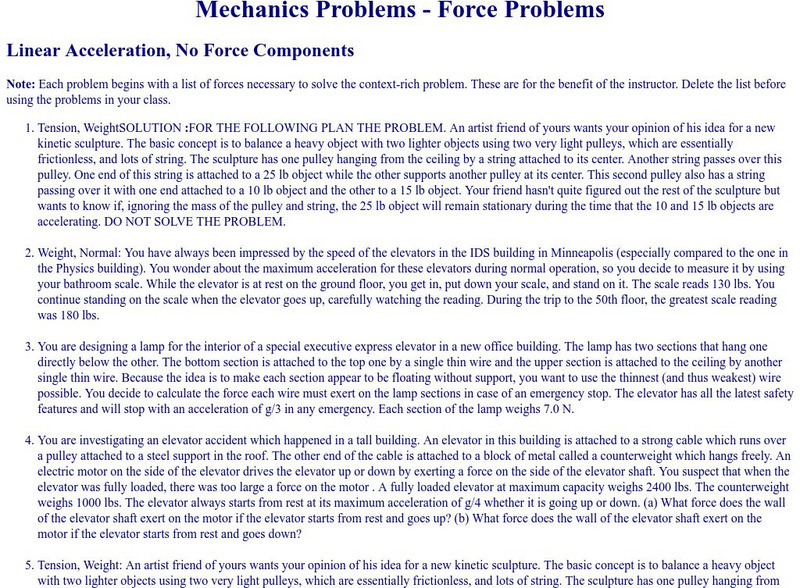
University of Minnesota: Mechanics Problems: Force Problems
This University of Minnesota site provides a series of contextually rich, real-world problems demonstrating force and Newton's second law of motion.

E-learning for Kids
E Learning for Kids: Science: Indian Ocean: What Kind of Natural Forces Do We Recognize?
Learn about forces (push or pull), gravity, and friction in this module by training dolphins.

BBC
Bbc Schools: Ks2 Bitesize: Science: Physical Processes: Friction
Use your knowledge about friction to help Carrie get to the Invigatron before someone steals it. Following the activity, read more about friction and resistance, and then take a quick quiz to check for understanding.

E-learning for Kids
E Learning for Kids: Science: Pirates: What Are Some Forces Around Us?
Covers the meanings of force, friction, and gravity, and the differences between magnetic and elastic spring force, and between weight and mass. The effect of air resistance on an object's motion is also touched upon.

Physics Classroom
The Physics Classroom: Finding Individual Forces
Explore the world of finding individual forces. "The process of determining the value of the individual forces acting upon an object involve [sic] an application of Newton's Second law and an application of the meaning of the net force."
Other
Bscs: Forces and Motion Content Background Document
In this document, we will try to answer a fundamental question of physical science, "Why do things start to move, slow down, speed up, stop moving or change direction?" In answering these core questions we can develop concepts that can...

CK-12 Foundation
Ck 12: Physical Science: Force
[Free Registration/Login may be required to access all resource tools.] Definition of force, how it relates to motion, and force as a vector.
Sophia Learning
Sophia: Friction: Lesson 4
This lesson will introduce the concept of friction and explain how it can affect forces. It is 4 of 5 in the series titled "Friction."
Physics Classroom
The Physics Classroom: Circular and Satellite Motion: Roller Coaster Model
An interactive playground for students to explore the physics of roller coasters. Learners investigate by changing the variables of force, velocity, friction, and vectors. Energy bar charts are displayed as the coaster car moves along...
Physics Classroom
The Physics Classroom: Newton's Laws: Finding Individual Forces
Through illustrated examples and interactive practice problems, students find the value of forces acting upon objects using force equations.
Project Britain
Primary Homework Help: Forces Quiz
First, read some fast facts about forces, then take a ten-question, multiple-choice quiz. Check to see if your answers are correct after each question.
Science Education Resource Center at Carleton College
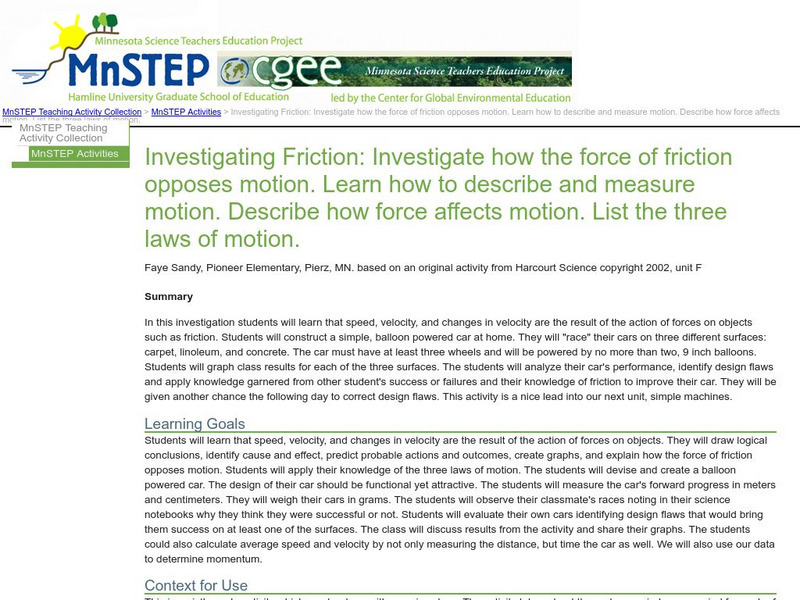
Serc:investigating Friction:investigate How the Force of Friction Opposes Motion
In this investigation, students will learn that speed, velocity, and changes in velocity are the result of the action of forces on objects such as friction. They will be able to explain how the force of friction opposes motion by...
Science Education Resource Center at Carleton College
Serc: Newton's Second Law: Constant Force Applied to a Skateboarder
In this lab activity, students will become familiar with Newton's 2nd Law of Motion. By investigating the motion of different skateboarders pulled with a variety of constant force values, they will discover that bodies acted on by a...
Other
Easyphysics: Chapter 4 Forces
Learners investigate forces and Newton's laws. Some topics examined are mass, friction, and Newton?s laws of motion. The resource includes example problems with solutions and a chapter quiz.

Science Education Resource Center at Carleton College
Serc: Inertia: An Object in Motion Will Tend to Stay in Motion
This activity is a take off of Galileo's experiment with the inclined planes to show that an object in motion would stay in a straight line motion if no outside forces acted were acting on it. In this version, students will roll a ball...
Physics Aviary
Physics Aviary: Practice Problems: Motion on Incline Level 2
Students must calculate the distance an object will move up an incline using Newton's Laws. Mass, angle, gravitational field, coefficient of friction and initial speed will be generated randomly.
Physics Aviary
Physics Aviary: Practice Problems: Motion on Incline Level 3
Students must calculate the speed of a block when it returns to its original location on an incline using Newton's Laws. Mass, angle, gravitational field, coefficient of friction and initial speed will be generated randomly.