Hi, what do you want to do?






PBS
A Science Odyssey: You Try It: Plate Tectonics
Using your computer mouse you can simulate transforming, collisional, divergent and convergent plate boundaries. Descriptions of each plate boundary are also available.

PBS
Pbs Learning Media: Tectonic Plate Movement in Alaska
In this video adapted from KUAC-TV and the Geophysical Institute at the University of Alaska, Fairbanks, learn how tectonic plate movement is responsible for building mountains, such as the Wrangell and St. Elias Mountains. 2m 16s
American Geosciences Institute
American Geosciences Institute: Earth Science Week: A Model of Three Faults
In this lesson, students learn about the different kinds of faults and plate boundaries and where they can be found. They research and report on the faults that are present in their state. They are also asked to develop models of three...
University of California
University of California: Understanding Earthquakes
This website is a resource for learning about earthquakes. Java animation at this site helps you visually understand the causes of earthquakes.
The History Cat
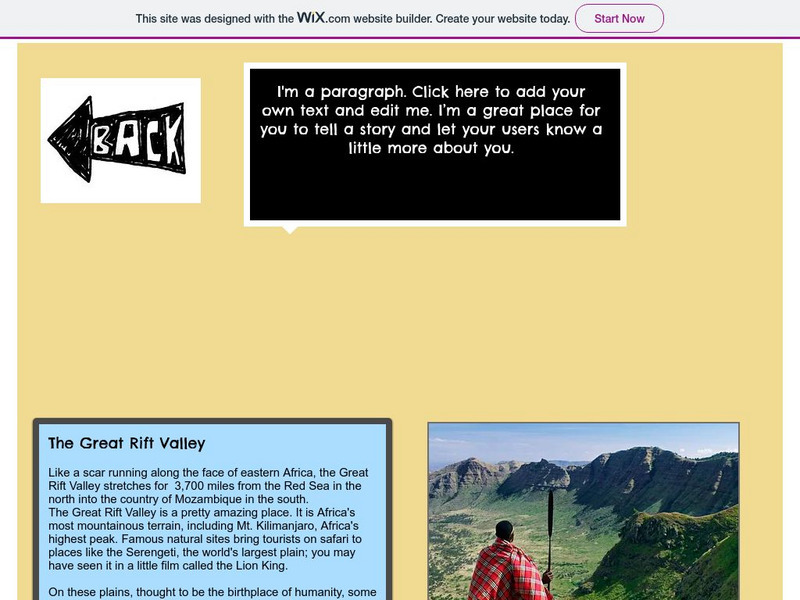
The History Cat: Geography: Places: Africa's Great Rift Valley
Describes the geography of the Great Rift Valley in Africa, how it was formed by tectonic plate separation, and the majestic lakes and falls that have been created by it.
Annenberg Foundation
Annenberg Learner: Essential Science for Teachers: Earth and Space 3
Visit an active volcano site to find out the connection between the movement of the Earth's plates and the processes deep within the Earth's interior. [58:23]
Other
University of Wisconsin Green Bay: Faults and Earthquakes
This site is primarily set up as an outline and is loaded with graphs, maps, and images. It covers a variety of earthquake-related topics, such as what causes earthquakes, fault lines and structures, seismology, a historical look at...
Science Struck
Science Struck: Examples of Destructive Forces of Nature
Discusses the destructive forces unleashed by volcanic eruptions, and the movement of water, wind, ice, and tectonic plates.
Science Struck
Science Struck: Examples of Constructive Forces of Nature
Discusses the constructive forces resulting from volcanic eruptions and the movement of water, wind, ice, and tectonic plates.
TeachEngineering
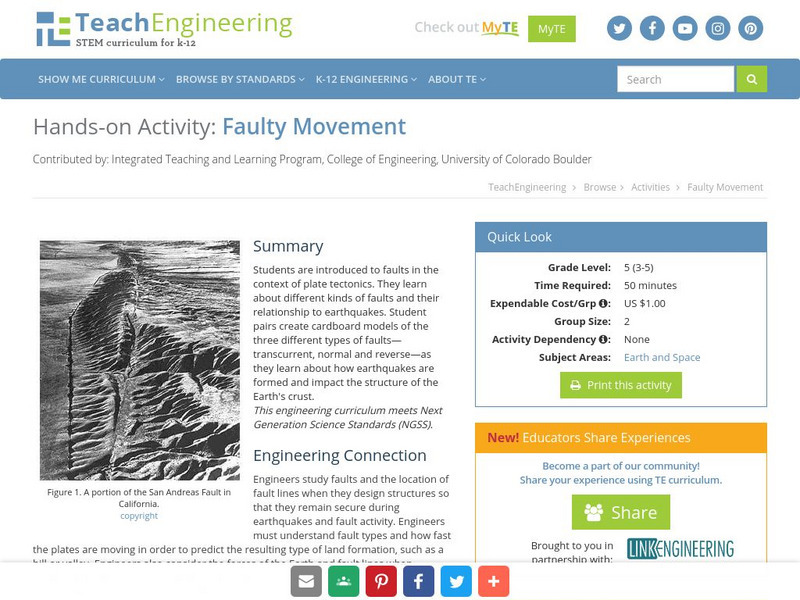
Teach Engineering: Faulty Movement
In this activity, students are introduced to faults. They will learn about different kinds of faults and understand their relationship to earthquakes. The students will build cardboard models of the three different types of faults as...

CK-12 Foundation
Ck 12: Earth Science: Long Term Climate Change
[Free Registration/Login may be required to access all resource tools.] Describes some factors that lead to long-term climate changes.
Science Struck
Science Struck: Facts About the Cenozoic Era and Its Life Forms
Describes the different periods, epochs, and stages of the Cenozoic Era and the events that took place in them. Looks at geology and tectonic plate movements, climate, flora and fauna, and the emergence of mammals as the dominant life...
Science Struck
Science Struck: Earthquakes and Volcanic Eruptions
Explains what earthquakes and volcanic eruptions are and how they are related.