Hi, what do you want to do?






Curated OER
Worksheet for Analysis of a Map
In this primary source analysis learning exercise, students respond to 6 short answer questions that require them to analyze the maps of their choice.

Curated OER
Valley of the Butterflies
First graders explore why butterfly populations in Idaho's Lapwai Valley have decreased.

Curated OER
Blast's Cosmic Carnival
Learners, after analyzing the history of a concentrator, model how a Genesis spacecraft concentrator works by playing a game. In groups of three or four, after being given materials to work with, are challenged to roll the rubber balls...

Curated OER
Life on the Border
Students discuss different types of boundaries. They research the United States/Mexico border and answer questions about their findings. They create collages, posters, or multimedia presentations showcasing various areas of concern...

Curated OER
Circle the Earth - Explore Surface Types on a Journey around Earth
Learners use CERES percent coverage surface data with a world map in locating landmasses and bodies of water at Earth's Equator.

Curated OER
Falling
Students should describe the path that the motion would take as well as what might begin or stop the motion. The common characteristic of all the motions that students have experienced directly is that one or more forces are acting on...

Curated OER
Adapted to Fire
Fourth graders explore forest species' adaptations to fire by participating in a scavenger hunt and mapping a burned forest. Students create maps and explore how indigenous species adapted to living with fire.

Curated OER
Hickory Dickory Dock: The Biological Clock
Students investigate the effect of day length on animal migrations. They view a Powerpoint presentation, identify their own personal migrations and cues, answer discussion questions, and test a hypothesis about seasons.

Curated OER
Monitor Marine Migrants
Students, in groups, track the seasonal journey of a species, such as a shorebird, sea turtle, or marine mammal, using various sources of migration data

Curated OER
On the Road Again": Moving People, Products, and Ideas
For this lesson students learn how to identify modes of transportation and communication for moving people, products, and ideas from place to place. Students also study the advantages and disadvantages of different modes of...

Curated OER
Entertaining Vancouver's Youth During World War II.
Students investigate relevant period documents and artifacts and have the
opportunity to replicate a 1943-44 entertainment experience by viewing a program
of World War II era motion pictures on site at Vancouver's historic...

Curated OER
What is an Explorer
Students become explorers. They examine a picture of an explorer and create props to explore within the classroom. Students are studying the Louisiana Purchase of 1803. They explore how to read a map and create a map of the classroom...

NASA
Nasa: Earth's Moon: Overview: Our Natural Satellite
Prepared by NASA, this site provides a detailed look at the Earth's moon. The menu tabs are divided into overview, photo gallery, and facts and figures.
European Space Agency
European Space Agency: Esa Kids: Our Universe: Satellites
A basic introduction to artificial, or man-made, satellites. Links to information about the planets and other objects in our solar system are included.
NASA
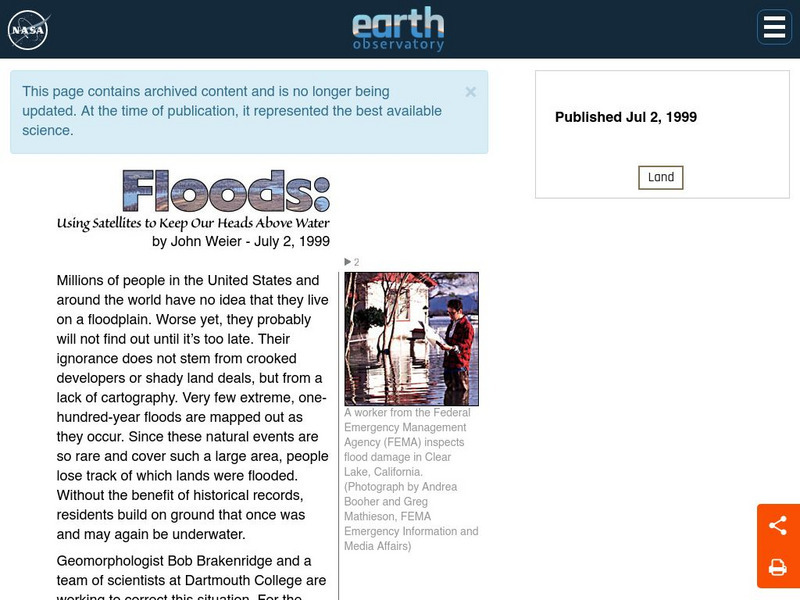
Floods: Using Satellites to Keep Our Heads Above Water
This article describes how scientists use satellite images to try and spot extreme floods. These satellites keep information stored, such as data on hundred-year floods, and try to identify likely flood plains based on that data.
TeachEngineering
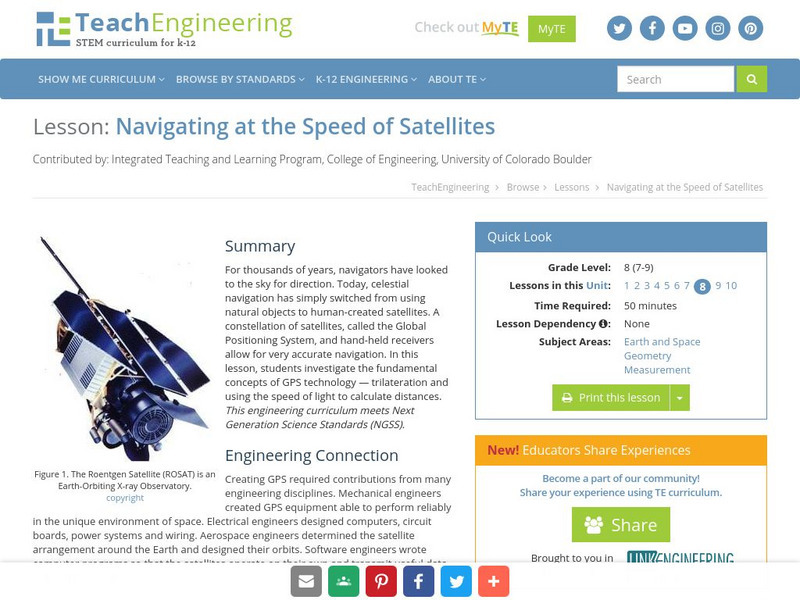
Teach Engineering: Navigating at the Speed of Satellites
For thousands of years, navigators have looked to the sky for direction. Today, celestial navigation has simply switched from using natural objects to human-created satellites. A constellation of satellites, called the Global Positioning...
Physics Classroom
The Physics Classroom: Circular and Satellite Motion: Gravity More Than a Name
This tutorial is intended for students to strengthen their understanding of gravitation and understand the nature of this force.
American Museum of Natural History
American Museum of Natural History: O Logy: Train of Thought
Try out your ability to think like Einstein by working through two thought experiments that help explain how satellites stay in orbit and how the speed of light affects the universe.
NASA
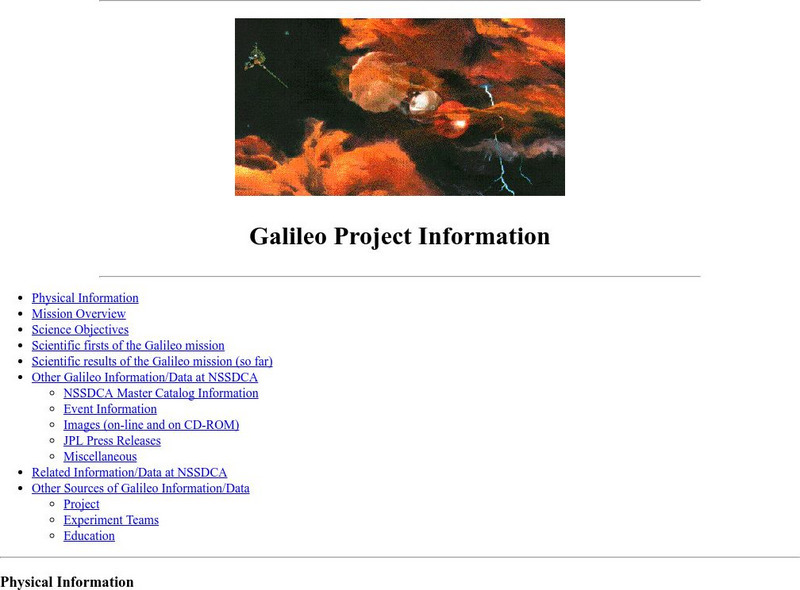
Nasa Space Science Data Archive: Galileo Project Information
This is the homepage of all of the archived information about and from the Galileo Mission. Included is data from the flybys of Venus, Earth, Moon, and Asteroids Gaspra and Ida, as well as the current data from Jupiter and its moons. See...
European Space Agency
European Space Agency: Esa Kids: Earth: Natural Disasters: Satellites Help Japan
A brief explanation of how satellite images are used to record and monitor the damage caused by a natural disaster, in this case the Japanese earthquake and tsunami of March 24, 2011.
US Geological Survey
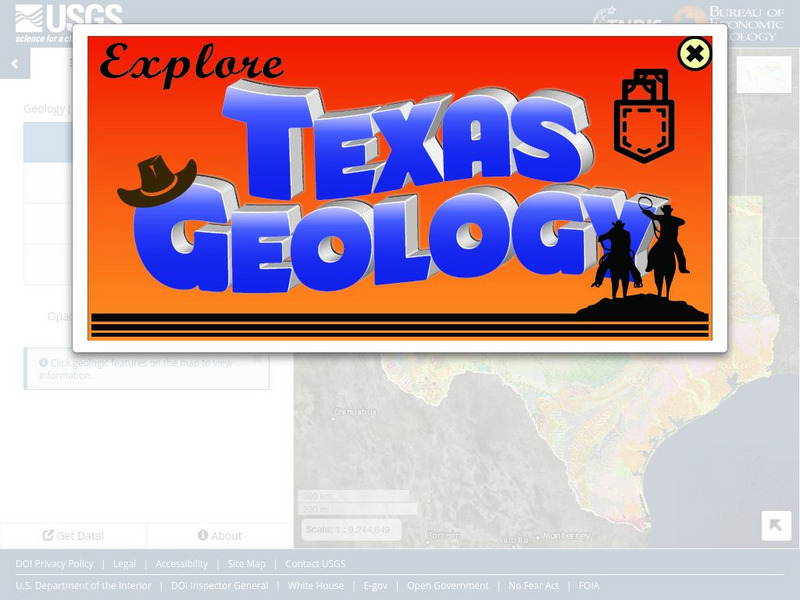
Usgs: Pocket Texas Geology
The interactive map from the USGS, along with the Texas Natural Resources Information System (TNRIS) and the Texas Bureau of Economic Geology, provides satellite images of Texas' rock units, members, faults, and map sheets. Explore Texas...
Nature Conservancy
The Nature Conservancy: Introduction to Sustainable Forestry
In this lesson, students interact with Google Earth to identify forests that have been logged selectively versus those that have not. They also learn how to distinguish the appearance of forestry methods in satellite images.
European Space Agency
European Space Agency: Protecting Nature: Fighting Pollution by Tracking Trucks
Article explains how satellite technologies are used to track and combat pollucton.

NASA
Nasa: Kepler and His Laws
This site from NASA provides biographical details about the lives of Tycho Brahe and Johannes Kepler. Discusses Kepler's successes at developing laws of planeatry motion. States the three laws and discusses each one individually....