Hi, what do you want to do?






Curated OER
Mustn't or Don't Have To
In this mustn't or don't have to worksheet, students fill in the blanks with the words mustn't or don't have to. Students complete 10 sentences total.

Curated OER
Must, Have got to, Have to
In this must, have got to, and have to worksheet, students read examples of when to use each in a sentence. Students also read the examples for the past and present.

Curated OER
Conversation Exercises: "So Do I" or "Neither Do I"
In this online conversation exercise worksheet, students read how to use "So do I!" and "Neither do I!" They complete complete 8 sentences by listening to the sentences and responding. They choose the correct response in each of 12...

Curated OER
Imperatives
In this imperatives worksheet, students read 7 reasons and examples of imperatives. Students then click on "continue with the exercises at the bottom" to choose the best imperative for 8 sentences.

Curated OER
Martha, My Dear: A Lesson About Imperatives
In this song lesson worksheet, students learn about the song Martha, My Dear by The Beatles. Teachers explain the song background and the grammar in the song. The class answers 6 questions while listening to the song and after listening...

Other
Esl Verbs: Present Simple Negative
Examples of some troublesome verb forms using the present simple negative.
University of Texas at Austin
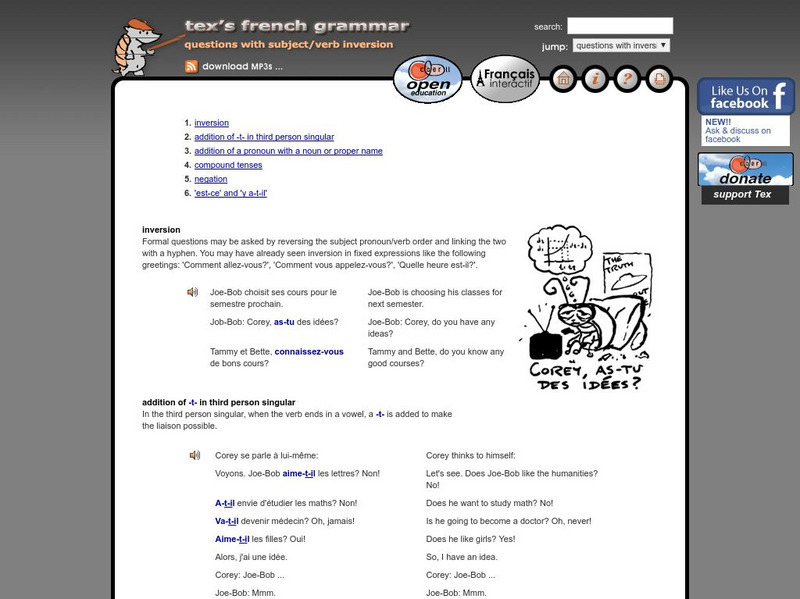
Tex's French Grammar: Subject Verb Inversion
This site from Tex's French Grammar provides a clear and concise description of forming a question through subject/verb inversion. Includes negation,, using 'est-ce' and 'y a-t-il', compound tenses etc. Provides both audio and written...
Language Guide
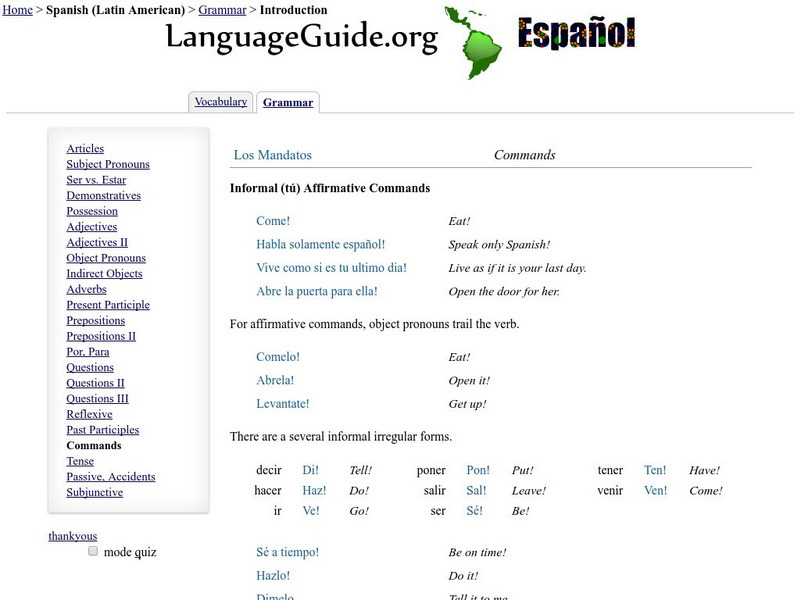
Language Guide: Los Mandatos
Formation of informal commands, regular and irregular forms are addressed with links to interactive practice activities. In addition, the formation of formal commands are explained with a link to interactive practice activities. A couple...

English Zone
English zone.com: Contractions Practice #2
Students type eight contractions that are formed by combining a helping verb with the adverb "not." When finished, students can check their work to see how many answers are correct.