Hi, what do you want to do?





Georgia State University
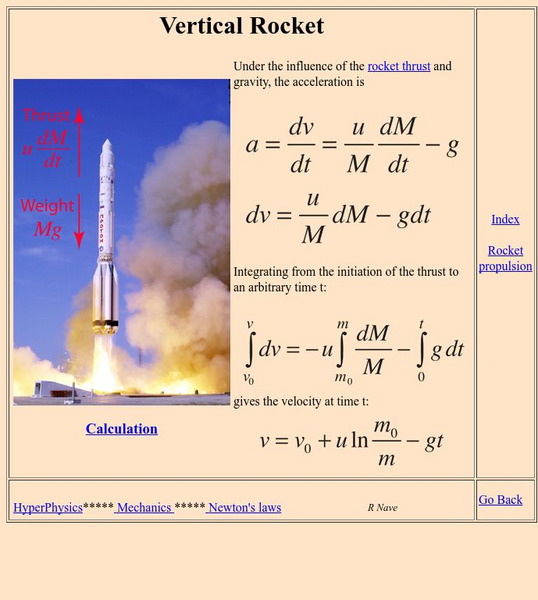
Georgia State University: Hyper Physics: Rockets
HyperPhysics site with dealing with the mathematics of rocket flight. The site is interactive and allows the user to input data. This is a rather high level site and, while any student could use it to get answers, to understand some of...
Curated OER
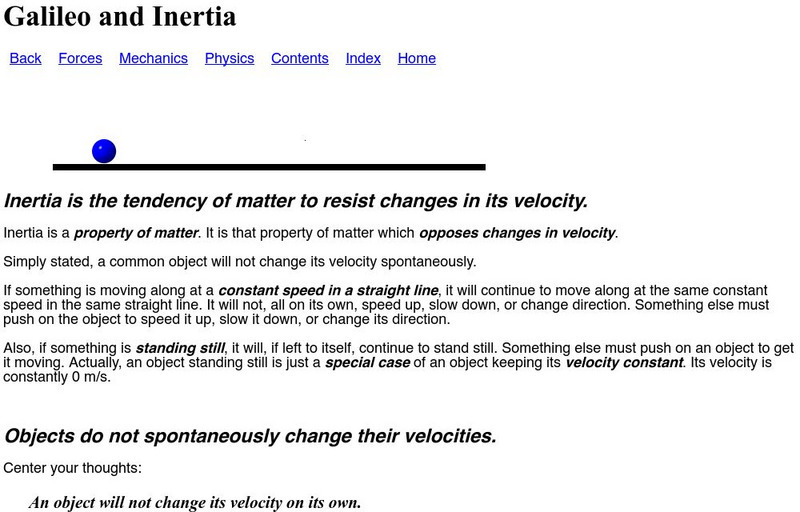
Zona Land: Galileo and Inertia
A tutorial with accompanying animations on classical mechanics. Well-illustrated. Good navigation.

University of Guelph
University of Guelph: Physics Tutorials: Torque and Angular Acceleration
Words and equations are used to explain the relationship between angular acceleration and the torque exerted upon an object. Well-written; great graphics.
CK-12 Foundation
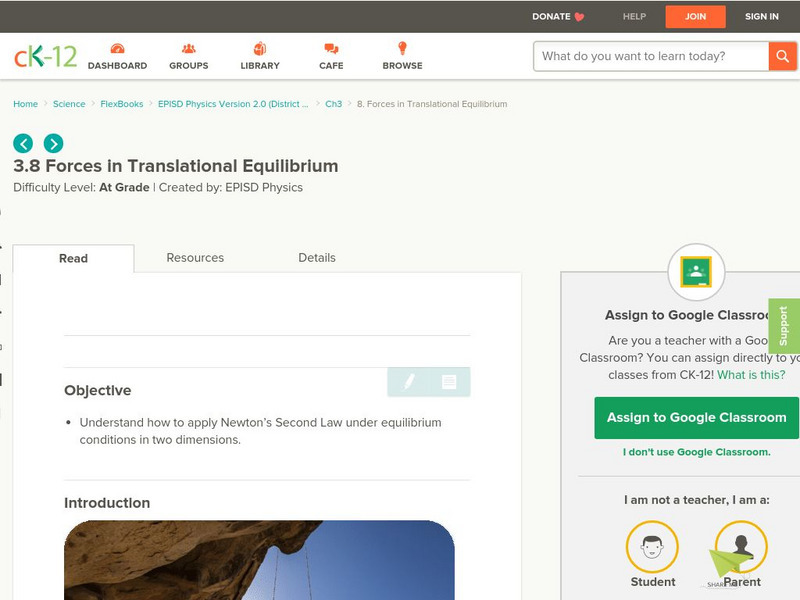
Ck 12: Forces in Translational Equilibrium
[Free Registration/Login may be required to access all resource tools.] The following tutorial helps students to understand how to apply Newton's Second Law under equilibrium conditions in two dimensions.

Physics Classroom
The Physics Classroom: Free Fall and Air Resistance
This lesson in high school physics on Newton's Second Law of Motion provides a discussion of free fall and air resistance, and answers, "Why do objects which encounter air resistance ultimately reach a terminal velocity?" and "In...
Science Bob Pflugfelder
Science Bob: The Lincoln High Dive
Instructions for a science demonstration of Newton's first law of motion using common supplies. Learn how to turn the demonstration into an experiment.

Exploratorium
Exploratorium: Science Snacks: Whack a Stack
Investigate Newton's first law of motion using just a set of wood blocks.
Sophia Learning
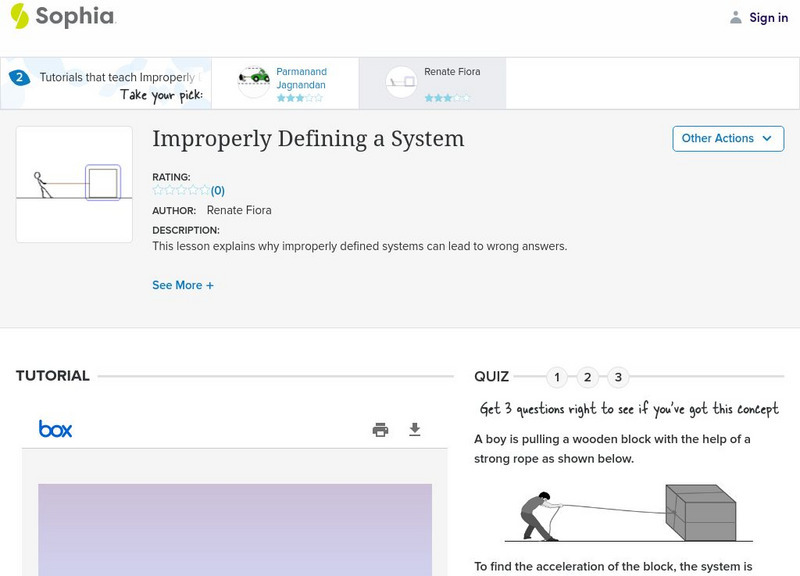
Sophia: Improperly Defining a System
This presentation explains why a poorly defined system can lead to incorrect answers in physics problems.
Sophia Learning
Sophia: System of Particles in an Object
This presentation explains why an object remains at rest, despite the fact that the particles within the object are in motion.
Science Struck
Science Struck: Conduction, Convection, and Radiation
Explains the concept of heat transfer and describes conduction, convection, and radiation which are the three modes of heat transfer. Includes formulas, examples, and applications.
Science Education Resource Center at Carleton College
Serc: Circular Motion Lab
In this activity students use a homemade circular motion machine to investigate the variables that affect circular motion. The students then graph their data in order to find mathematical relationships between the variables they have...
Physics Classroom
The Physics Classroom: Momentum and Its Conservation: Algebraic Problem Solving
In this physics tutorial, the law of momentum conservation will be combined with the use of a momentum table and some algebra skills to solve problems involving collisions occurring in isolated systems.
CK-12 Foundation
Ck 12: Fifth Grade Science: Earth Science: Gravity
Do you know how gravity affects you? This module defines gravity and explains how gravity affects the motion of objects.
CK-12 Foundation
Ck 12: Interactive Physics for High School
This digital textbook covers core physics concepts and includes interactive features, real world examples, videos, and study guides.
Curated OER
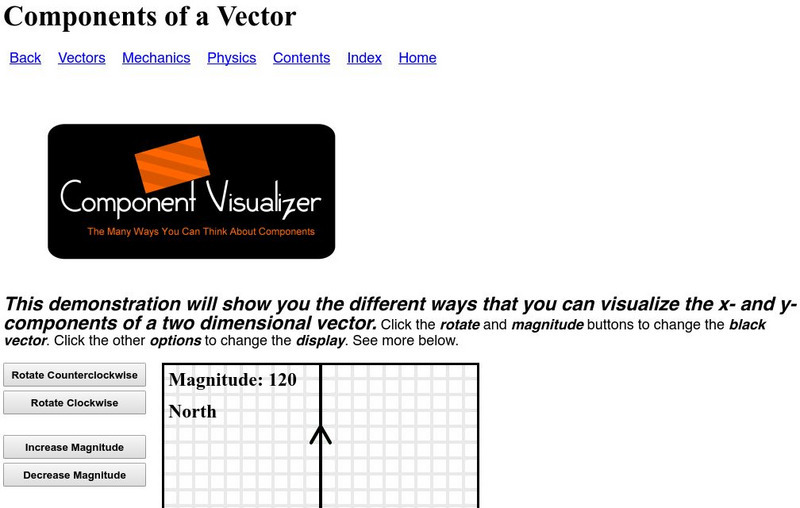
Zona Land: Components of a Vector
An interactive Java applet where users can rotate a vector about its tail and view the components of that vector. Magnitude of the components is updated on screen as the vector is dragged.
Massachusetts Institute of Technology
Mit: Open Course Ware: Angular Momentum and Conservation
Students explore angular momentum and conservation. Some topics examined in the activities are angular momentum, torque, and conservation. The resource consists of video clips, lecture notes, practice problems, and exam questions....
Pennsylvania State University
Acoustics and Vibration Animations: Demonstrations: The Simple Pendulum
A series of graphics, downloadable animations and text describe and explain the motion of a pendulum. Some sections require an understanding of calculus.
Texas Instruments
Texas Instruments: Velocity
This activity will test a student's understanding of the relationships between location and motion as pertaining to time.
Texas Instruments
Texas Instruments: Bouncing Ball
In this activity, students' will create a Height-Time plot for a bouncing ball. They will examine how the ball's height changes mathematically from one bounce to the next.
Texas Instruments
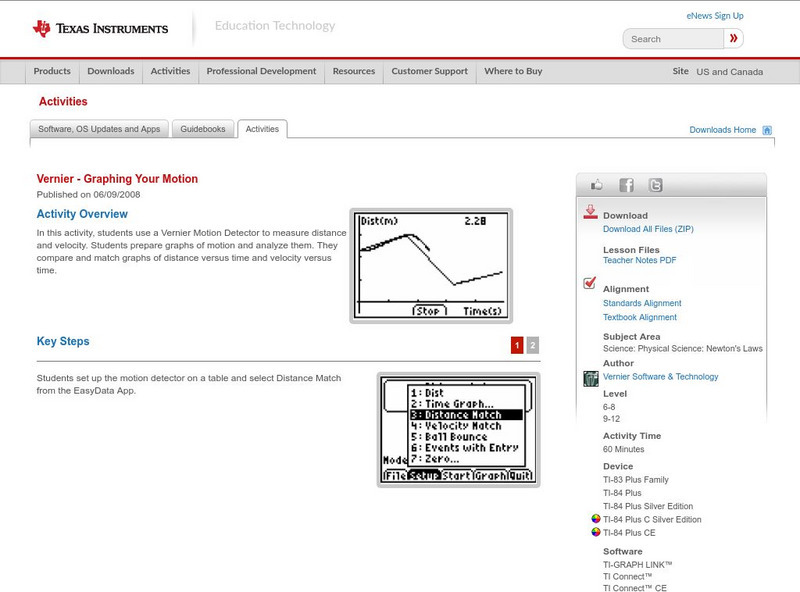
Texas Instruments: Graphing Your Motion
In this activity, students use a Motion Detector to measure distance and velocity. Students prepare graphs of motion and analyze them. They compare and match graphs of distance versus time and velocity versus time.
Texas Instruments
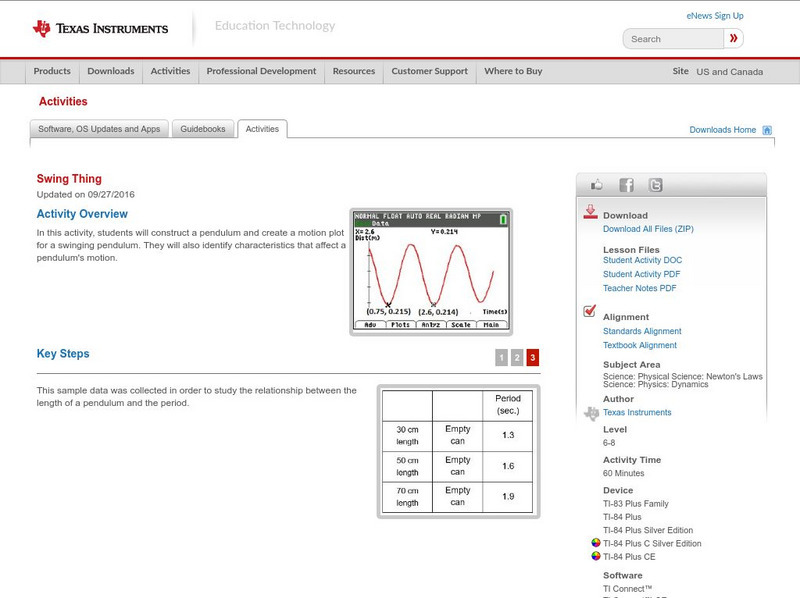
Texas Instruments: Swing Thing
In this activity, students will construct a pendulum and create a motion plot for a swinging pendulum. They will also identify characteristics that affect a pendulum's motion.
Texas Instruments
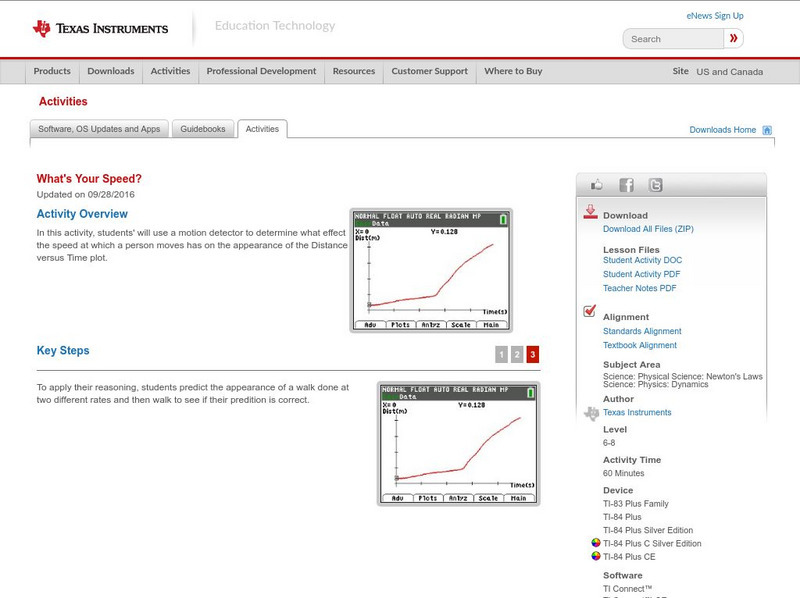
Texas Instruments: What's Your Speed?
In this activity, students' will use a motion detector to determine what effect the speed at which a person moves has on the appearance of the distance versus time plot.
Texas Instruments
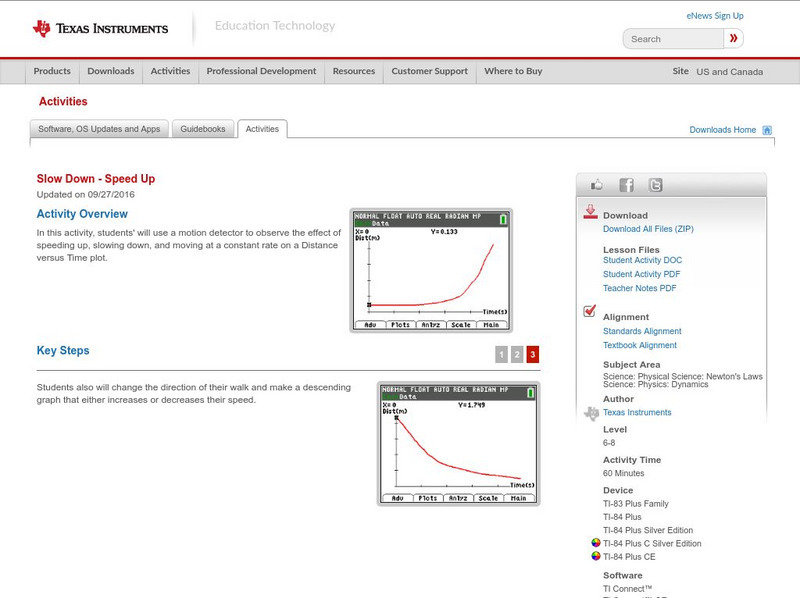
Texas Instruments: Slow Down: Speed Up
In this activity, students' will use a motion detector to observe the effect of speeding up, slowing down, and moving at a constant rate on a Distance versus Time plot.
Texas Instruments
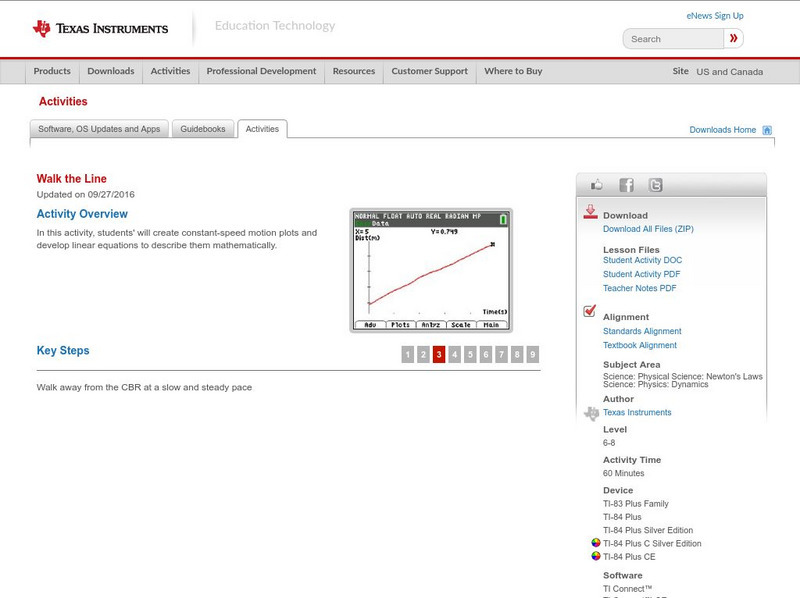
Texas Instruments: Walk the Line
In this activity, students will create constant-speed motion plots and develop linear equations to describe them mathematically.
Other popular searches
- Newtons Laws of Motion
- Newton's Laws Labs
- Newton's Three Laws of Motion
- Newton's Laws Webquest
- Newton's Laws Review Game
- Newtons Laws Lab
- Physics Newtons Laws
- Newtons Three Laws of Motion
- Newton's Laws Test
- Newton's Laws and Inertia
- Newton's Laws Websites
- Newton's Laws of Motions