Hi, what do you want to do?





BBC
Bbc: Gcse Bitesize: Forces, Acceleration and Newton's Laws Aqa
This lesson focuses on Newton's First Law: an object remains in the same state of motion unless a resultant force acts on it. If the resultant force on an object is zero, this means: a stationary object stays stationary; a moving object...

TED Talks
Ted: Ted Ed: Newton's 3 Laws, With a Bicycle
This video describes Newton's three laws of motion and how they relate to the everyday motion of a bicycle. [3:33] Followed by a short quiz and a list of additional resources to explore.
TeachEngineering
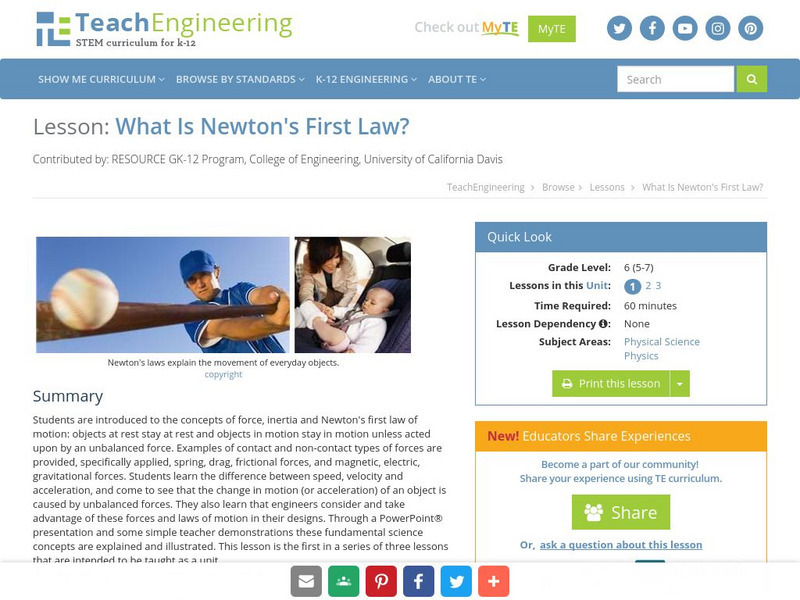
Teach Engineering: What Is Newton's First Law?
Students are introduced to the concepts of force, inertia, and Newton's first law of motion: objects at rest stay at rest and objects in motion stay in motion unless acted upon by an unbalanced force.This instructional activity is the...

Physics Classroom
The Physics Classroom: Newton's First Law of Motion
A clear explanation of Newton's First Law of Motion, the law of inertia, with diagrams and real-world examples. Useful for both students and teachers. Written by a high school physics teacher.

Khan Academy
Khan Academy: What Is Newton's First Law?
Newton's First Law also called the law of inertia is the most important thing to realize about motion. This article offers more information on motion and explains solved problems involving Newton's First Law. Also included is a video...
Soft Schools
Soft Schools: Physics Quizzes: Newton's Three Laws
Assess your understanding of Newton's three laws of motion and the ability to distinguish between the three with this interactive multiple choice quiz. Receive immediate feedback to your answers.
Sophia Learning
Sophia: Newton's First Law: Lesson 3
This lesson introduces Newton's First Law, that inertia causes objects at rest to remain at rest, and objects in motion to remain in motion. It is 3 of 3 in the series titled "Newton's First Law."
Curated OER
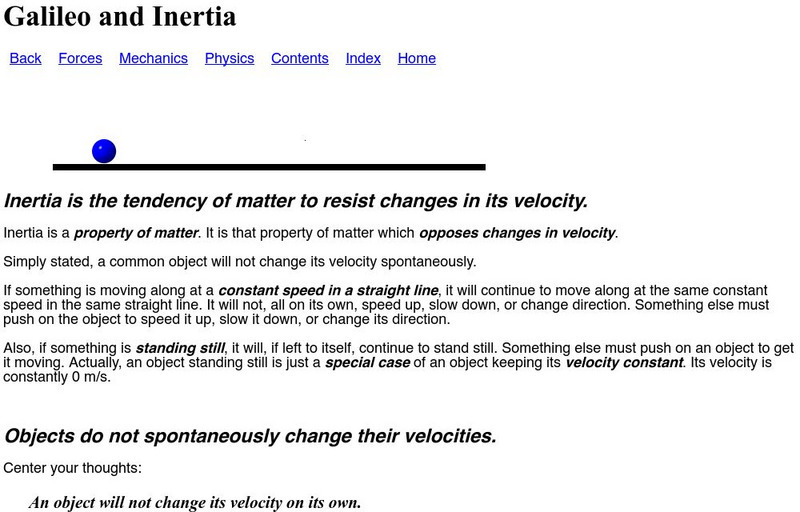
Zona Land: Galileo and Inertia
A tutorial with accompanying animations on classical mechanics. Well-illustrated. Good navigation.
PBS
Pbs Learning Media: Newton's Triple Play: Baseball Science
In this lesson, students watch a video and animations that relate Isaac Newton's three laws of motion to baseball and apply what they've learned about these laws to another sport or other real-life situation.
Other
Easy Science for Kids: All About Force: Pushing and Pulling
Students will understand that pushes and pulls can have different strengths and directions. Students investigate the effects of these different pushes and pulls.

University of Guelph
University of Guelph: Physics Tutorials: Torque and Angular Acceleration
Words and equations are used to explain the relationship between angular acceleration and the torque exerted upon an object. Well-written; great graphics.
Other
Bscs: Forces and Motion Content Background Document
In this document, we will try to answer a fundamental question of physical science, "Why do things start to move, slow down, speed up, stop moving or change direction?" In answering these core questions we can develop concepts that can...

Khan Academy
Khan Academy: Newton's First Law Review
Review the key concepts, equations, and skills for Newton's first law of motion, including the difference between mass and weight.

TeachEngineering
Teach Engineering: The Science of Swinging
Students learn what a pendulum is and how it works in the context of amusement park rides. While exploring the physics of pendulums, they are also introduced to Newton's first law of motion - about continuous motion and inertia.
Physics Central
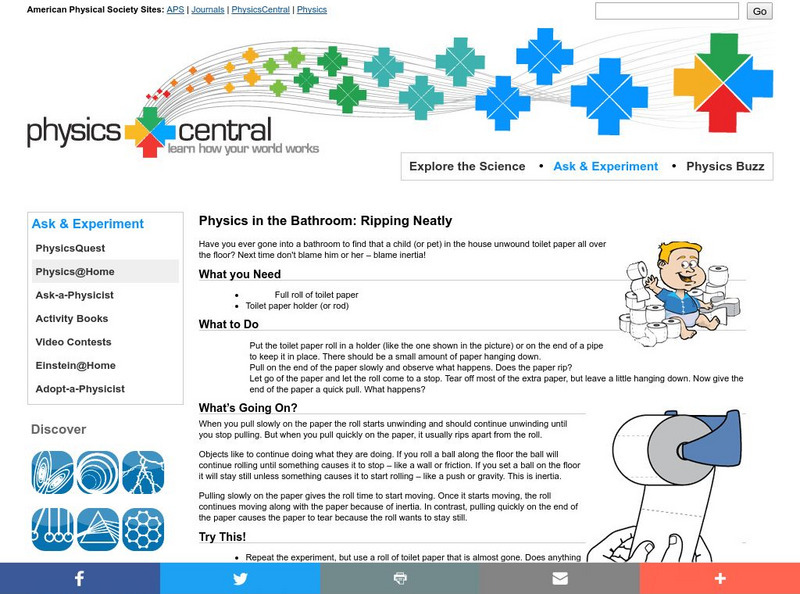
Physics Central: Physics in the Bathroom: Ripping Neatly
A great science experiment to demonstrate Newton's First Law of Motion, inertia. There is a step-by-step guide on how to conduct this experiment and links to other sites about inertia.

Scholastic
Scholastic: Study Jams! Science: Force and Motion: Newton's First Law: Inertia
A video and a short multiple-choice quiz on the meaning of inertia.
CK-12 Foundation
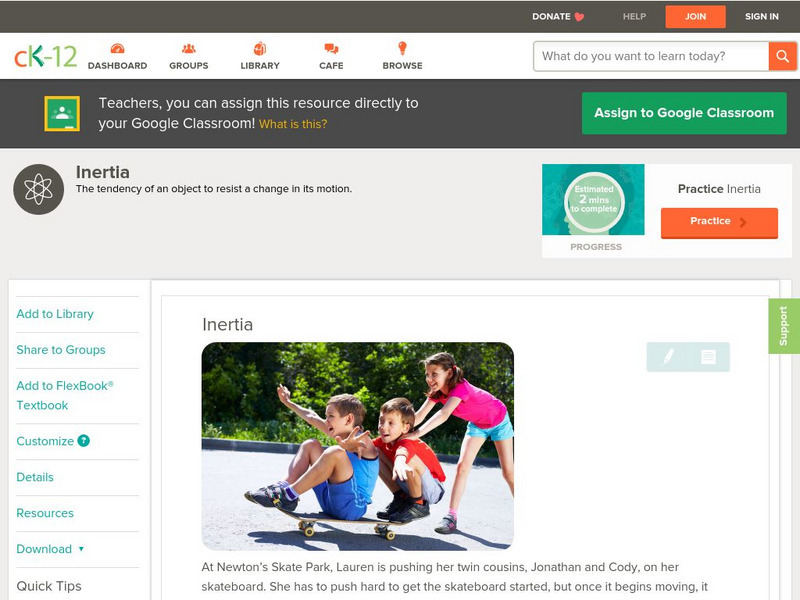
Ck 12: Physical Science: Inertia
[Free Registration/Login may be required to access all resource tools.] Explains inertia and how it affects motion, the relationship between inertia and mass, and how to overcome inertia.

Scholastic
Scholastic: Study Jams! Science: Forces and Motion: Acceleration
A video and a short quiz on acceleration.
TeachEngineering
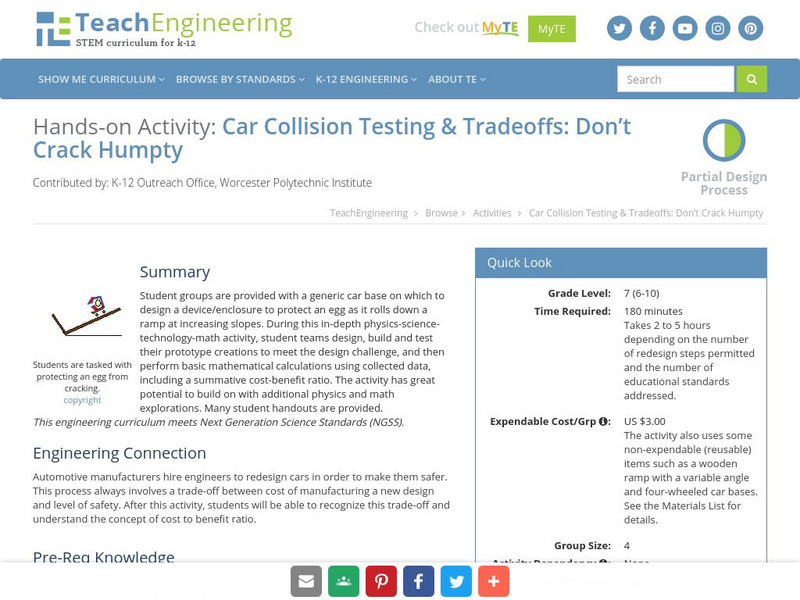
Teach Engineering: Car Collision Testing & Tradeoffs: Don't Crack Humpty
Student groups are provided with a generic car base on which to design a device/enclosure to protect an egg as it rolls down a ramp at increasing slopes. During this activity, student teams design, build and test their prototype...
Science Education Resource Center at Carleton College
Serc: Newton's First Law (Inertia)
This activity provides students an opportunity to investigate Newton's first law by observing inertia in a variety of experiments. Students will hypothesize on possible outcomes, write observations of what has happened, and apply...

Museum of Science
Museum of Science and Industry Chicago: Online Science: Drop Eggs Into Cups
Step-by-step illustrated instructions showing how to drop four eggs into four cups without touching them. Demonstrates the concept of inertia according to Newton's first law of motion.
Science Education Resource Center at Carleton College
Serc: Trucking and Thinking Newton's First Law of Motion
In this activity learners simulate the movement of cargo in the bed of a truck in order to experience Newton's first law of motion.
Physics Classroom
The Physics Classroom: Circular and Satellite Motion: Centripetal Force
Through illustrated examples and practice problems, students explore the centripetal force requirement. So for an object moving in a circle, there must be an inward force acting upon it in order to cause its inward acceleration.
Science Education Resource Center at Carleton College
Serc: Newton's Second: Having a Ball With Motion
Young scholars will create a gravity ball launcher to demonstrate their understanding of mass, force, momentum, and motion. The students will use critical thinking, measurement, and observation and analysis of data to make changes and...