Hi, what do you want to do?





Science and Mathematics Initiative for Learning Enhancement (SMILE)
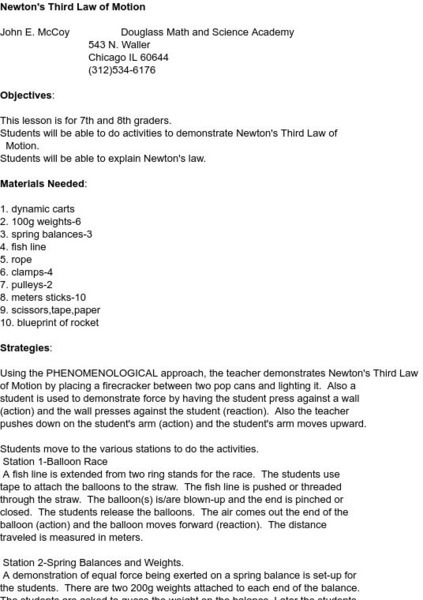
Smile: Third Law of Motion
This Illinois Institute of Technology site provides a teacher lesson plan for an activity in which students use spring balances and carts to investigate the action-reaction relationship for any given force. Includes directions, materials...
Discovery Education
Discovery Education: Introduction to Physical Science
Introduce students to the ideas of motion and force in this hands-on lesson plan.
Science Education Resource Center at Carleton College
Serc: Investigating Newton's Third Law Through Film Canister Cannons
In this physics lab (best done outside), students will explore Newton's Third Law - 'For every action there is an equal and opposite reaction'. Students will fill empty 35-mm film canisters with water and part of an Alka-Seltzer tablet,...
Science Education Resource Center at Carleton College
Serc: Newton's 2nd Law: Inquiry Approach
In this activity, students test Isaac Newton's ideas on the nature of motion, in particular his 2nd Law. The emphasis is on the process of science, investigation, and experimentation, not the results. Students must come up with their own...

Science Education Resource Center at Carleton College
Serc: Inertia: An Object in Motion Will Tend to Stay in Motion
This activity is a take off of Galileo's experiment with the inclined planes to show that an object in motion would stay in a straight line motion if no outside forces acted were acting on it. In this version, students will roll a ball...
Science Education Resource Center at Carleton College
Serc: Investigating Projectile Motion: Creating a Catapult
This lesson is for 9th grade physical science students. It begins with an inquiry-based lesson using a projectile motion computer simulation. It culminates with students building a catapult; applying and connecting science knowledge from...

Utah Education Network
Uen: Rock a Bye Pendulum
Activity uses scientific process to explore the effects of force on an object in motion.
Science Education Resource Center at Carleton College
Serc: Investigating Best Amount of Water to Fly a Bottle Rocket
In this rocket experiment, students will investigate the question, "Which amount of water will cause the rocket to stay in the air the longest?" Students will compare how long the rocket was in the air with how much water was in the...
TeachEngineering
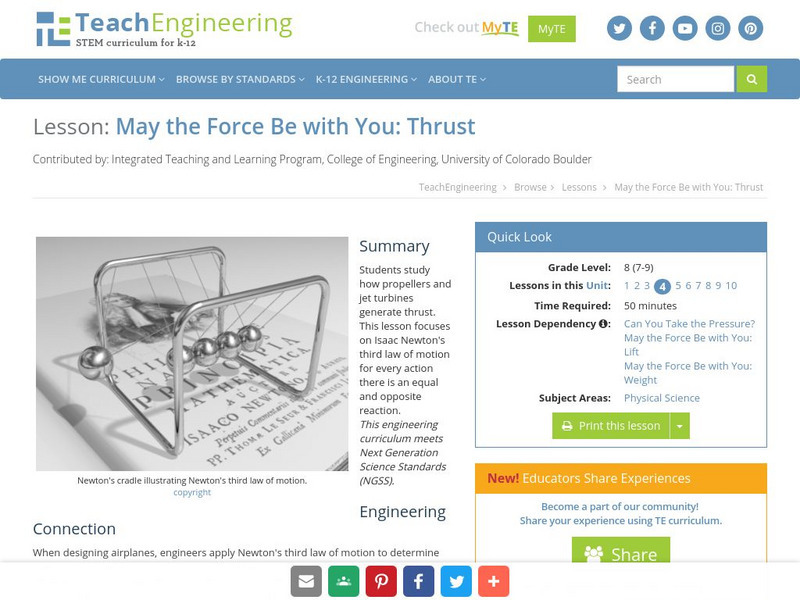
Teach Engineering: May the Force Be With You: Thrust
In this instructional activity, students will study how propellers and jet turbines generate thrust. This instructional activity focuses on Isaac Newton's 3rd Law of Motion, which states that for every action there is an equal and...

TeachEngineering
Teach Engineering: Destination Outer Space
Students acquire a basic understanding of the science and engineering of space travel as well as a brief history of space exploration. They learn about the scientists and engineers who made space travel possible and briefly examine some...
Science Education Resource Center at Carleton College
Serc: Newton's First Law (Inertia)
This activity provides learners an opportunity to investigate Newton's first law by observing inertia in a variety of experiments. Students will hypothesize on possible outcomes, write observations of what has happened, and apply...
Science Education Resource Center at Carleton College
Serc: Exploring Newton's Second Law
Students conduct an experiment that will reinforce their understanding of Newton's Second Law. Using simple objects, students control force, mass, and acceleration, and how each is related to each other.
Science Education Resource Center at Carleton College
Serc: Newton's Second: Having a Ball With Motion
Students will create a gravity ball launcher to demonstrate their understanding of mass, force, momentum, and motion. The students will use critical thinking, measurement, and observation and analysis of data to make changes and improve...
The Wonder of Science
The Wonder of Science: Ms Ps2 1: Collision Design Solution
Help your students explore how the motion of objects changes during a collision. This website includes work samples, phenomena, assessment templates, and videos that focus on collision design solution.
Science Education Resource Center at Carleton College
Serc: Investigating Projectile Motion: Predicting Point of Impact
Students discuss forces acting on objects in a trajectory motion. They review notes, study equations, solve projectile motion problems, and determine experimentally the impact point of a ball in projectile motion.
Science Education Resource Center at Carleton College
Serc: Conservation of Momentum Using Rollerblades and a Medicine Ball
In this guided inquiry demonstration, a person on rollerblades and a medicine ball are used to teach the concept of conservation of momentum. Various sorts of collisions are used to show how momentum is conserved within a system.
Science Education Resource Center at Carleton College
Serc: Elastic and Inelastic Collisions: The Case of the Happy and Sad Balls
Students improve their understanding of momentum conservation and learn that a recoiling object in an elastic collision will transfer more impulse than if it collided inelastically.

Khan Academy
Khan Academy: Start: How Do Computers Simulate the Motion of Virtual Particles?
In this instructional activity we'll explore how we use fairly simple physics to draw particles which move according to the forces we feel in the real world (such as wind & gravity).
TryEngineering
Try Engineering: Blast Off
Hands on activity where students focus on aerospace engineering to investigate space flight from the viewpoint of an engineer. They design, build, and launch their rocket, then share their experiences with the class.
Science and Mathematics Initiative for Learning Enhancement (SMILE)
Smile: Lab Activity: Tops
The Illinois Institute of Technology provides a lab activity on precession and spinning tops. Designed for primary grades, but easily adapted for any level. Includes directions and assessment ideas.
Science Education Resource Center at Carleton College
Serc: Water Bottle Rockets Understanding Energy
In this activity, students will design and construct a water bottle rocket. Students will demonstrate understanding of a good experimental design and analysis of results.
CK-12 Foundation
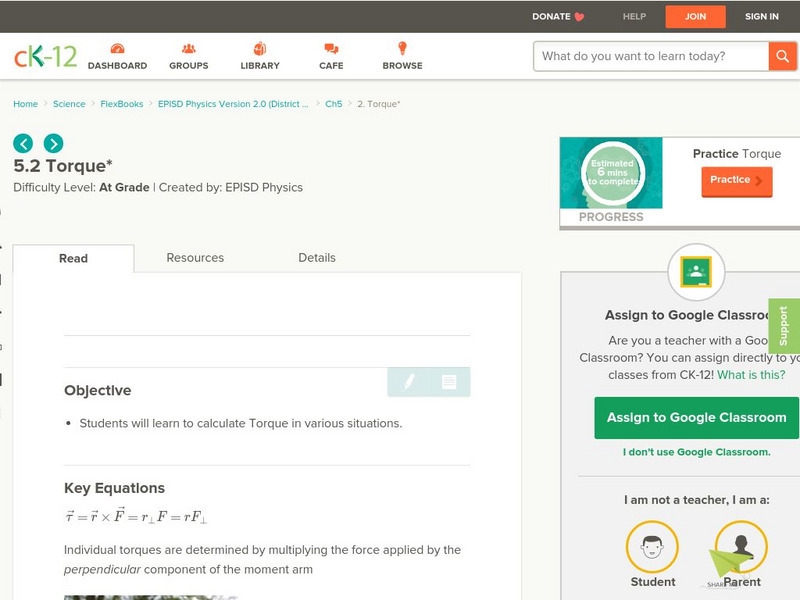
Ck 12: Torque
[Free Registration/Login may be required to access all resource tools.] In this online lesson young scholars will learn about Torque and how to calculate Torque in various situations.
Science Buddies
Science Buddies: Teaching Engineering Design With an Egg Drop
Students build a device to protect an egg and prevent it from breaking when dropped.
Science and Mathematics Initiative for Learning Enhancement (SMILE)
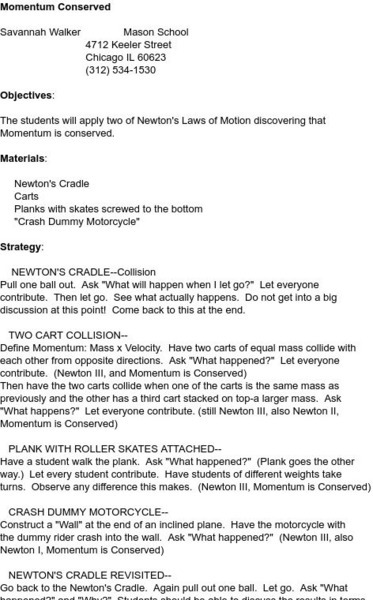
Smile: Momentum Conserved
This site by the Illinois Institute of Technology gives a Lab activity in which students use a variety of toys to discover Newton's second law and momentum conservation. Newton's cradle, skate boards, and a toy motorcycle are incoporated...