Hi, what do you want to do?






Khan Academy
Khan Academy: Isaac Newton
A biography of the scientist that developed the theory of gravity and founded the three basic laws of motion, Isaac Newton.
Soft Schools
Soft Schools: Physics Quizzes: Force, Mass Acceleration
Assess your understanding of force, mass and acceleration and the relationship amongst the three with this interactive multiple choice quiz. Immediate feedback is offered.
Columbia University
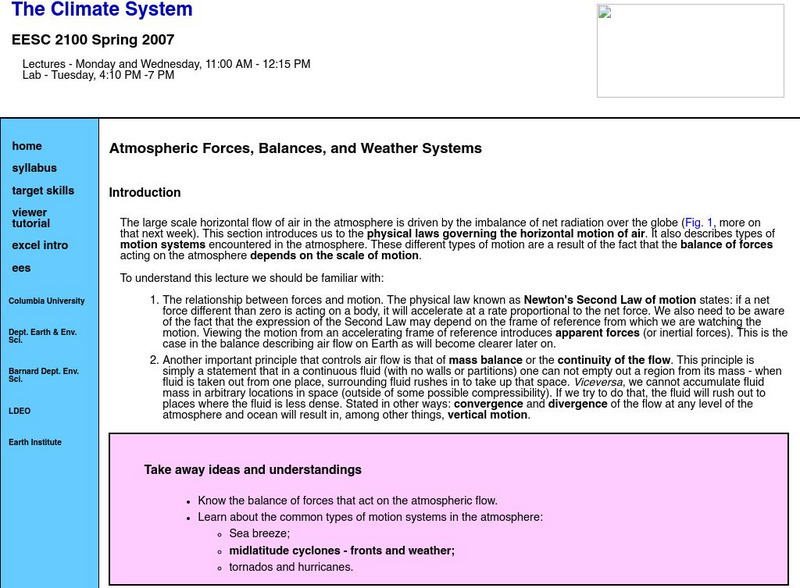
The Climate System: Atmospheric Forces, Balances, and Weather Systems
The large scale horizontal flow of air in the atmosphere is driven by the imbalance of net radiation over the globe. This resource introduces us to the physical laws governing the horizontal motion of air. It also describes types of...

TeachEngineering
Teach Engineering: Mechanics Mania
Through ten lessons and numerous activities, students explore the natural universal rules engineers and physicists use to understand how things move and stay still. Together, these rules are called "mechanics." The study of mechanics is...
University of Colorado
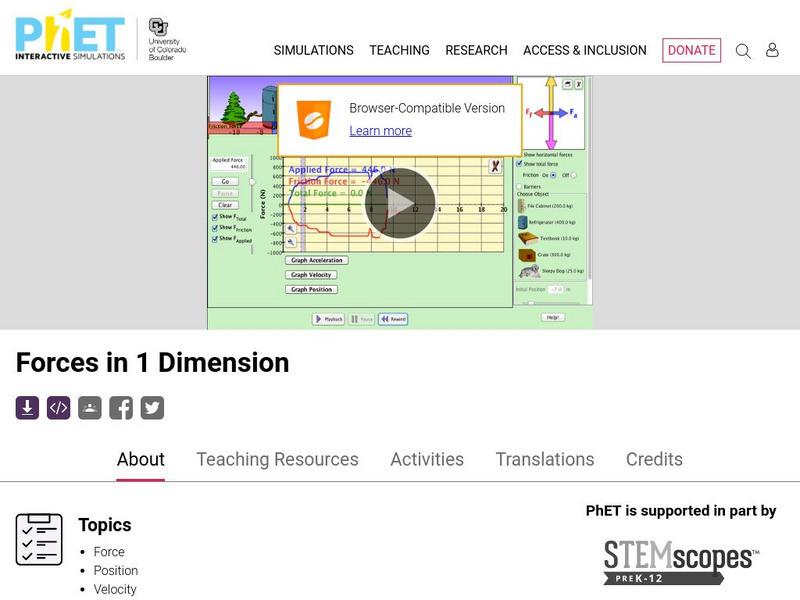
University of Colorado: Ph Et Interactive Simulations: Forces in One Dimension
Use this simulation to see the results of applying a force to move an object. Analyze forces and friction using graphs.
Texas Instruments
Texas Instruments: Spring Thing: Newton's Second Law
In this activity, students' use a force sensor and a motion detector to collect force and acceleration data for an object moving up and down hanging from a spring. They use the data to test Newton's second law, and to estimate the mass...
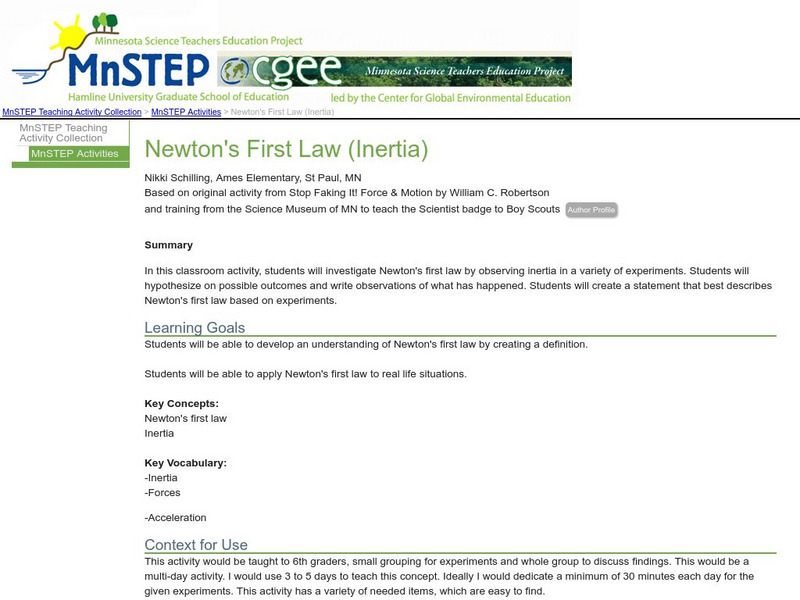
Science Education Resource Center at Carleton College
Serc: Newton's First Law (Inertia)
This activity provides students an opportunity to investigate Newton's first law by observing inertia in a variety of experiments. Students will hypothesize on possible outcomes, write observations of what has happened, and apply...
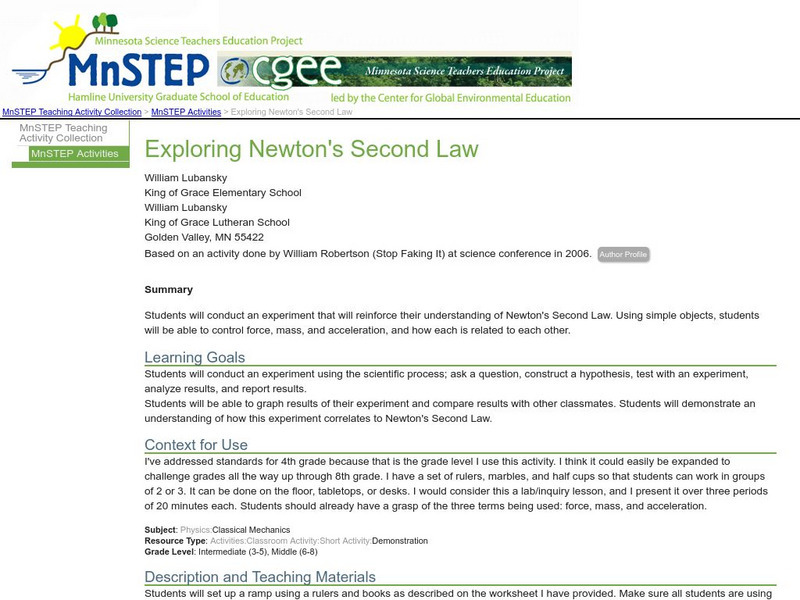
Science Education Resource Center at Carleton College
Serc: Exploring Newton's Second Law
Learners conduct an experiment that will reinforce their understanding of Newton's Second Law. Using simple objects, students control force, mass, and acceleration, and how each is related to each other.
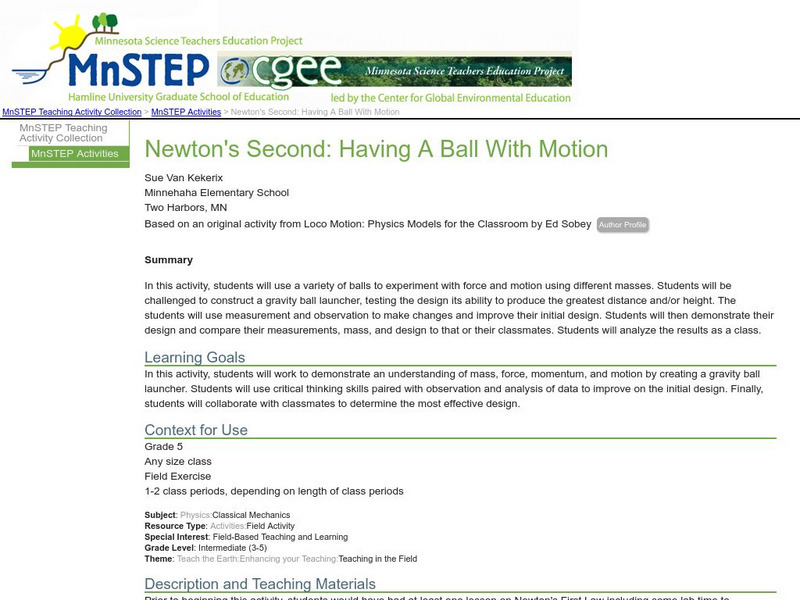
Science Education Resource Center at Carleton College
Serc: Newton's Second: Having a Ball With Motion
Learners will create a gravity ball launcher to demonstrate their understanding of mass, force, momentum, and motion. The students will use critical thinking, measurement, and observation and analysis of data to make changes and improve...
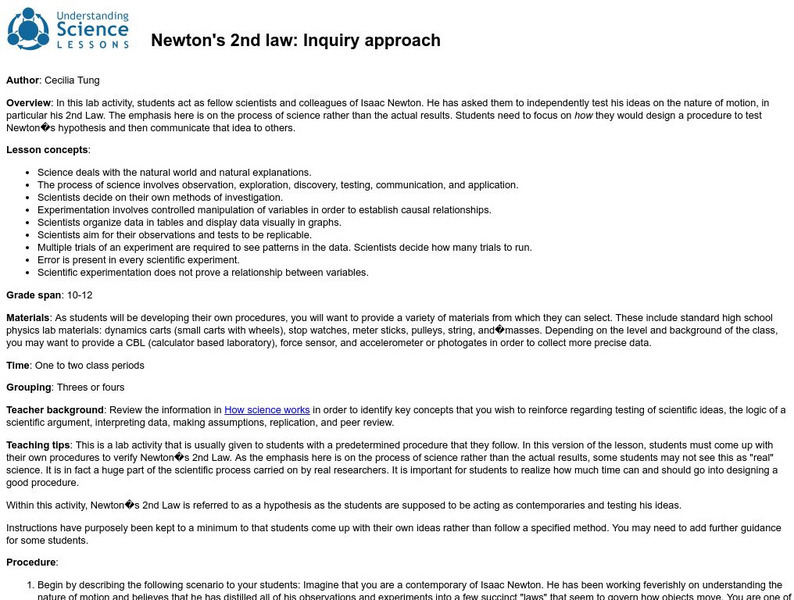
University of California
Understanding Science: Newton's 2nd Law: Inquiry Approach Lesson
For this lesson, students develop their own scientific experiment to test Newton's hypothesis that the acceleration of an object depends on the net force acting upon it and its mass. After completing their designed experiment, students...
BBC
Bbc: Gcse Bitesize: Newton's Second Law
This lesson focuses on Newton's Second Law including the formula Force = mass to the x power acceleration, an example of how to calculate the force needed to accelerate based on mass, and a link to a test.
The Wonder of Science
The Wonder of Science: Ms Ps2 1: Collision Design Solution
Help your students explore how the motion of objects changes during a collision. This website includes work samples, phenomena, assessment templates, and videos that focus on collision design solution.

CK-12 Foundation
Ck 12: Plix Series: Newton's First and Second Laws
[Free Registration/Login Required] Read a force scenario, and then analyze the graphs provided to gain an understanding of inertia and force. After the activity, answer three challenge questions to check for understanding.

CK-12 Foundation
Ck 12: Plix Series: Projectile Motion: Object Launched Horizontally
[Free Registration/Login Required] Use the interactive diagram to solve a projectile motion problem. After the activity, answer a challenge question to check for understanding.
Science Education Resource Center at Carleton College
Serc: Investigating Projectile Motion: Predicting Point of Impact
Students discuss forces acting on objects in a trajectory motion. They review notes, study equations, solve projectile motion problems, and determine experimentally the impact point of a ball in projectile motion.
Other
Institute of Physics: Newton's Cradle
The interactive simulation demonstrates the conservation of momentum through a Newton?s Cradle simulation.

CK-12 Foundation
Ck 12: Plix Series: Projectile Motion: Object Launched at an Angle
[Free Registration/Login Required] Explore how angles affect the projectile motion of a thrown object. After the activity, answer a challenge question to check for understanding.
Science Education Resource Center at Carleton College
Serc: Conservation of Momentum Using Rollerblades and a Medicine Ball
In this guided inquiry demonstration, a person on rollerblades and a medicine ball are used to teach the concept of conservation of momentum. Various sorts of collisions are used to show how momentum is conserved within a system.
Science Education Resource Center at Carleton College
Serc: Elastic and Inelastic Collisions: The Case of the Happy and Sad Balls
Students improve their understanding of momentum conservation and learn that a recoiling object in an elastic collision will transfer more impulse than if it collided inelastically.
Physics Classroom
The Physics Classroom: Circular and Satellite Motion: The Inverse Square Law
Through illustrated examples and interactive practice, students explore Newton's ability to relate the cause for heavenly motion (the orbit of the moon about the earth) to the cause for Earthly motion (the falling of an apple to the...
University of Colorado
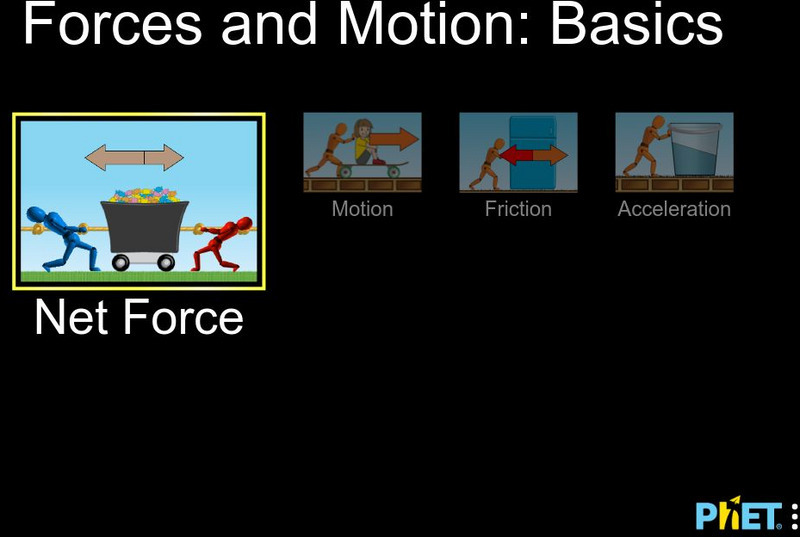
University of Colorado: Ph Et Interactive Simulations: Forces and Motion: Basics
Explore the forces at work when pulling against a cart, and pushing a refrigerator, crate, or person. Create an applied force and see how it makes objects move. Change friction and see how it affects the motion of objects.
Georgia Department of Education
Ga Virtual Learning: Ap Physics 1: Linear Momentum and Collisions
This physics tutorial aims to model and predict not the motion of just one object, but rather what happens when two or more objects collide. The concept of momentum will be the main focus of this module.
Science Bob Pflugfelder
Science Bob: The Lincoln High Dive
Instructions for a science demonstration of Newton's first law of motion using common supplies. Learn how to turn the demonstration into an experiment.

Exploratorium
Exploratorium: Science Snacks: Whack a Stack
Investigate Newton's first law of motion using just a set of wood blocks.