Hi, what do you want to do?






Science Buddies
Science Buddies: Distance and Constant Acceleration
This project is an experiment in classical physics. You'll be following in Galileo's footsteps, and investigating Newton's laws of motion, using a metronome as your timing device. This resource will help you get a firm understanding of...
Science Buddies
Science Buddies: Distance and Speed of Rolling Objects
This project is an experiment in classical physics. You'll be following in Galileo's footsteps, and investigating Newton's laws of motion, but you'll be taking advantage of modern video recording technology to make your measurements. The...
University of Virginia
Uva Physics: Using Vectors to Describe Motion
Background information on vectors and their use in describing motion in two dimensions. A comparison of Aristotle's and Galileo's perspectives on force and motion is given.

Vision Learning
Visionlearning: Mechanics: Gravity: Newtonian Relationships
Explanation of how astronomers and scientist developed the current theories of gravity.
NASA
Nasa Star Child: Who's Who in Space (Level 2)
This site provides a list of people who have given their lives to studying space science. Each person has a biography that you can read.
NASA
Nasa Star Child: Who's Who in Space (Level 1)
StarChild presents biographies of people who have contributed to space exploration from Tycho Brahe to Sally Ride.
University of Maryland
Optics Highlights: The Telescope
Part of an anecdotal history of optics and the study of light. Extremely thorough treatment of the invention of the telescope. Includes a short biographical sketch and discusses the work of Isaac Newton which focuses on his contribution...
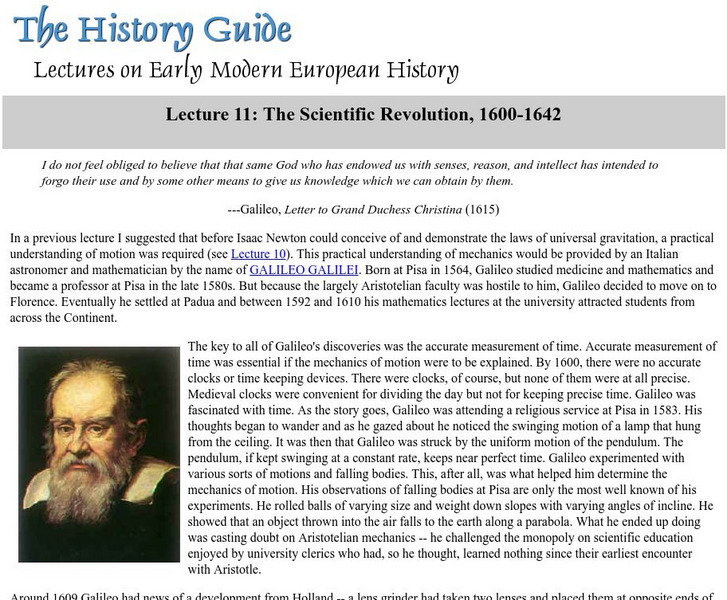
Steven Kreis, PhD
The History Guide: The Scientific Revolution, 1600 1642
A survey of Galileo's discoveries that not only helped other scientists like Newton develop their ideas but challenged the scientific thinking of the time. Also includes a look at how Galileo was not accepted by society because of his...

Ducksters
Ducksters: Biography for Kids: Scientists and Inventors
This site contains links to biographies of famous scientists and inventors such as Albert Einstein, Isaac Newton, Galileo, and Marie Curie. Learn how these men and women made discoveries that changed the world forever.
Discovery Education
Discovery Education: Physical Science: Gravity Gets You Down
In this instructional activity, young scholars make predictions about falling objects of different sizes and masses to learn about gravity and air resistance. Includes audio vocabulary list and extension activities.
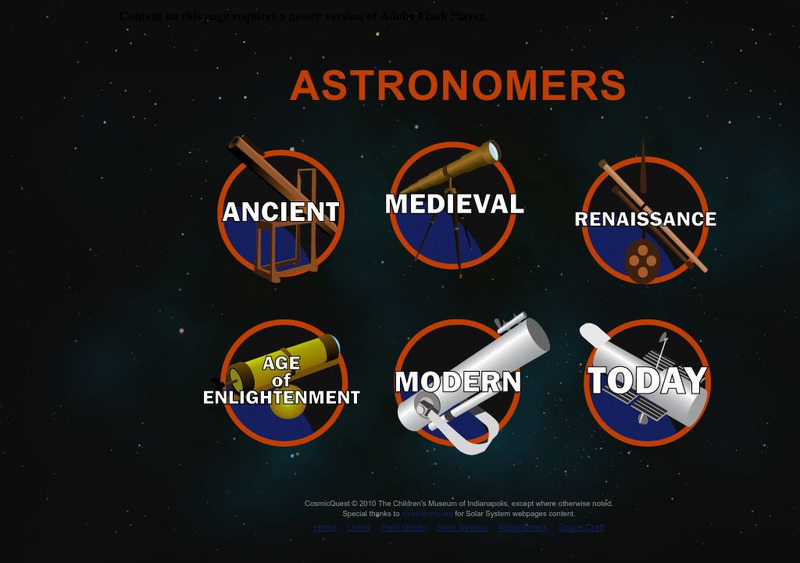
Children's Museum
Children's Museum: Field Guide to the Universe: Astronomers
Read brief biographies of astronomers who are grouped by time period.
Science Struck
Science Struck: Famous Scientists Who Believed in God
It is sometimes assumed that scientists do not believe in God but these famous scientists actually did. Read details about their lives and beliefs, and some quotes attributed to them.
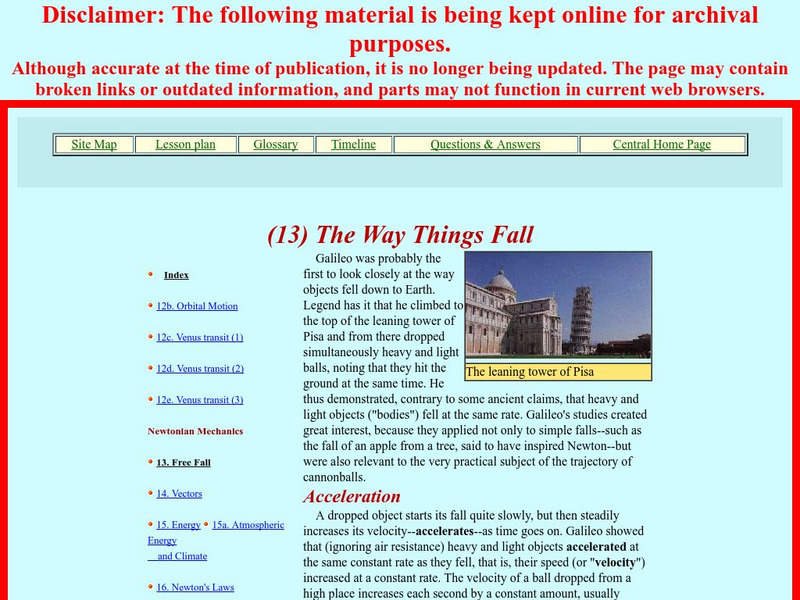
NASA
Nasa: The Way Things Fall
This site from NASA compares free falling motion to falling with air resistance. Discusses Galileo's experiment. Explains why we believe all objects free fall with the same acceleration.
Science4Fun
Science4 Fun: Telescope
Illustrated discussion of the invention of the telescope with details on Galileo's telescope, the reflecting telescope, and the space telescope.
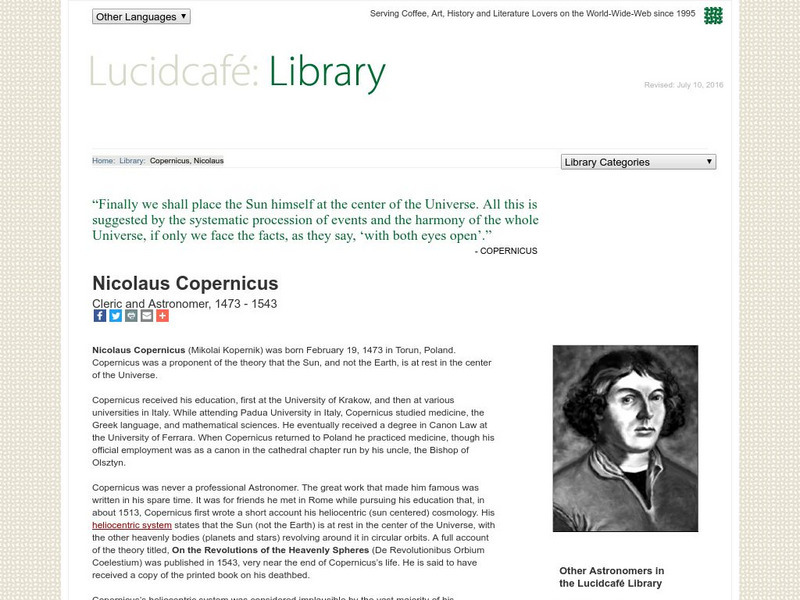
Robin Chew
Lucid Cafe: Polish Cleric and Astronomer
This site from the Lucid Cafe contains a short bibliography of Nicholas Copernicus. The information, though it is brief, is very factual and worth checking out with great links throughout for additional information on related subjects.
TED Talks
Ted: Ted Ed: The Story Behind Your Glasses
Video describes the developments and advancements in the history of the study of optics. [4:17] Includes a short quiz and a list of additional resources to explore.
Other
Bscs: Forces and Motion Content Background Document
In this document, we will try to answer a fundamental question of physical science, "Why do things start to move, slow down, speed up, stop moving or change direction?" In answering these core questions we can develop concepts that can...
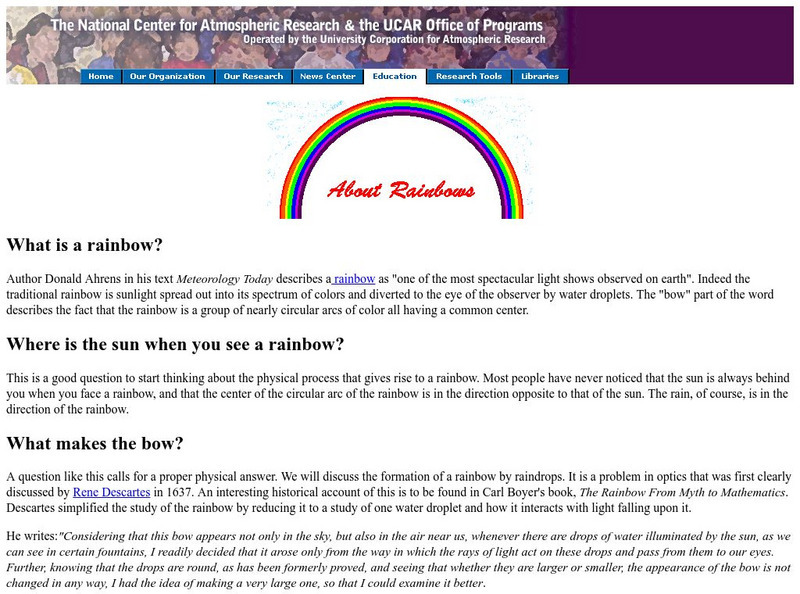
University Corporation for Atmospheric Research
Ucar: About Rainbows
This site from the University Corporation of Atmospheric Research provides an illustrated article about the phenomenon of rainbows.
University of Chicago
University of Chicago: Reflector and Refractor
From the Yerkes Observatory Virtual Tour web site. Compares and contrasts reflecting and refracting telescopes. A link from the page leads to a second page which explains why most modern research telescopes are reflecting telescopes.
University of Houston
University of Houston: Lesson Plan: Famous Mathematicians
This lesson plan is aimed at 7th and 8th grade students and involves researching famous mathematicians and the import of their contributions.

ClassFlow
Class Flow: Science Revolution
[Free Registration/Login Required] This flipchart discusses What occurred in the 1500's to change science? Changes in science beliefs began with the universe and continued to development of the scientific method.
Other popular searches
- Galileo and Newton
- Galileo Newton Einstein
- Sir Issac Newton, Galileo
- Interview Newton, Galileo
- Sir Issac Newton Galileo
- Galileo and Newton Plants
- Interview Newton Galileo