Hi, what do you want to do?





Discovery Education
Discovery Education: Introduction to Physical Science
Introduce young scholars to the ideas of motion and force in this hands-on lesson plan.
Science Education Resource Center at Carleton College
Serc: Investigating Newton's Third Law Through Film Canister Cannons
In this physics lab (best done outside), students will explore Newton's Third Law - 'For every action there is an equal and opposite reaction'. Students will fill empty 35-mm film canisters with water and part of an Alka-Seltzer tablet,...
TeachEngineering
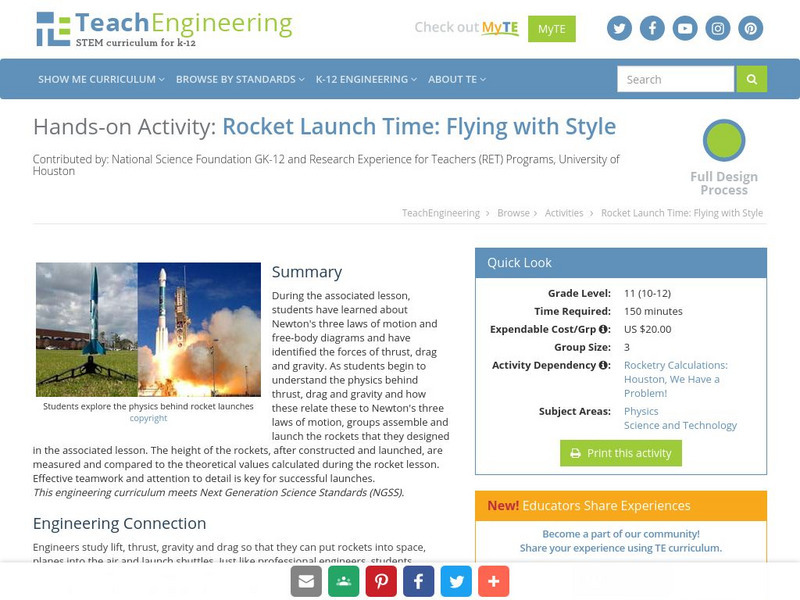
Teach Engineering: Flying With Style
As students begin to understand the physics behind thrust, drag, and gravity and how these relate these to Newton's three laws of motion, groups assemble and launch the rockets that they designed in the associated lesson.
University of Colorado
University of Colorado: Ph Et Interactive Simulations: Gravity Force Lab
An interactive simulation that teaches about gravitational force, Newton's Third Law, and force pairs by varying properties affect the gravitational force exerted between two objects. This simulation can either be downloaded or played...

Other
Bscs: Forces and Motion Content Background Document
In this document, we will try to answer a fundamental question of physical science, "Why do things start to move, slow down, speed up, stop moving or change direction?" In answering these core questions we can develop concepts that can...
Science Education Resource Center at Carleton College
Serc: Newton's 2nd Law: Inquiry Approach
In this activity, students test Isaac Newton's ideas on the nature of motion, in particular his 2nd Law. The emphasis is on the process of science, investigation, and experimentation, not the results. Students must come up with their own...
CK-12 Foundation
Ck 12: Physics Simulation: First Law Simulation
[Free Registration/Login Required] In this simulation, students investigate the question of whether force is required to keep a sled moving on ice.
The History Cat
The History Cat: Isaac Newton
Profile of Isaac Newton, with a description of his scientific theories, the impact he had on the world of science in his day, and the influence his ideas still have in the world today.
Georgia Department of Education
Ga Virtual Learning: A Brief History of Astronomy
In this interactive module students will explore what different ancient cultures believe was an explanation of the stars and planets. They will look at how the work of Nicolas Copernicus revolutionize the world of astronomy and learn how...

Science Education Resource Center at Carleton College
Serc: Inertia: An Object in Motion Will Tend to Stay in Motion
This activity is a take off of Galileo's experiment with the inclined planes to show that an object in motion would stay in a straight line motion if no outside forces acted were acting on it. In this version, students will roll a ball...
Science Education Resource Center at Carleton College
Serc: Investigating Projectile Motion: Creating a Catapult
This lesson is for 9th grade physical science students. It begins with an inquiry-based lesson using a projectile motion computer simulation. It culminates with students building a catapult; applying and connecting science knowledge from...
Read Works
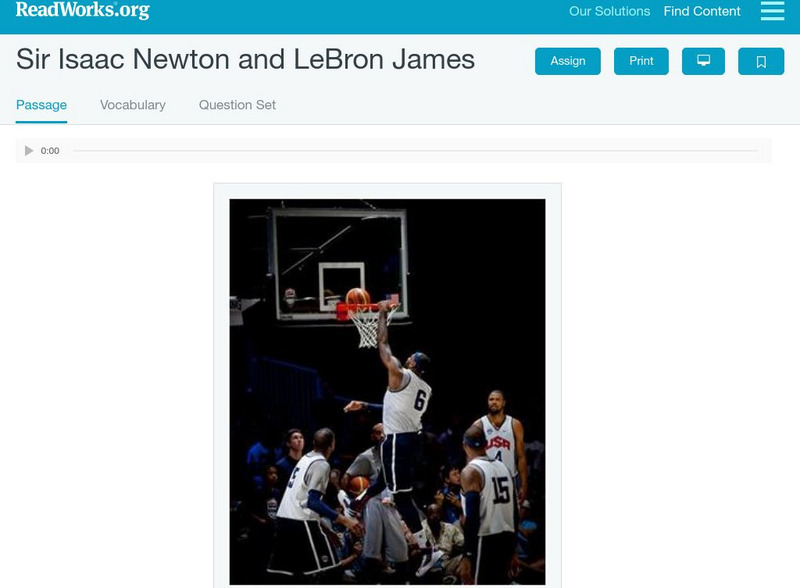
Read Works: Sir Isaac Newton and Le Bron James
[Free Registration/Login Required] An informational text explaining how the laws of motion apply to basketball. A question sheet is available to help students build skills in reading comprehension.
Physics Aviary
Physics Aviary: Practice Problems: Newton's Law System (No Friction)
Students must find out different things for a series of objects moving as a system.
PBS
Pbs Learning Media: Aerodynamics: What Causes Lift?
How does an airplane stay aloft when upside down? This media-rich essay from the NOVA Web site offers an explanation based on Newton's third law of motion.
Other
Federal Aviation Administration: Anti Gravity Marble [Pdf]
This experiment examines Newton's Second Law of Motion. Learn how centrifugal and centripetal force help to keep a marble in a can when turned upside down.
Utah Education Network
Uen: Rock a Bye Pendulum
Activity uses scientific process to explore the effects of force on an object in motion.
Libre Text
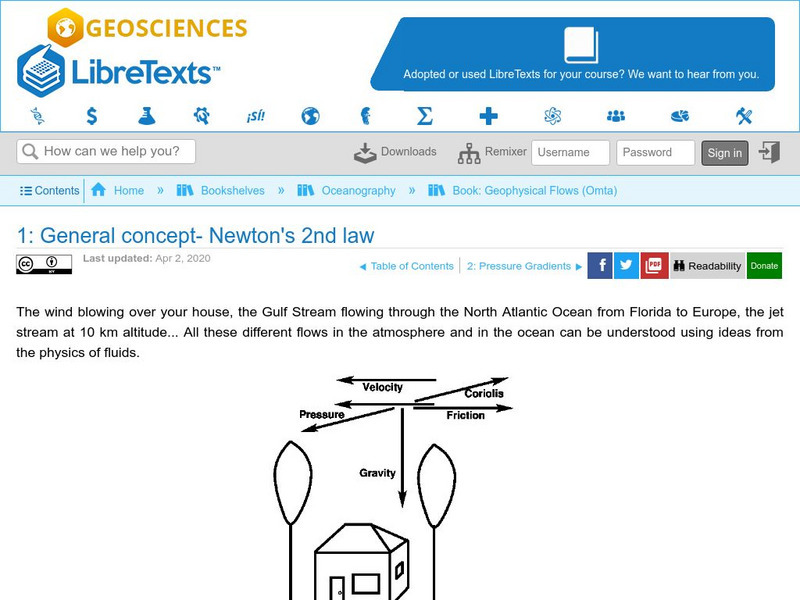
Uc Davis Geo Wiki: Newton's 2nd Law
The wind blowing over your house, the Gulf Stream flowing into the North Atlantic Ocean from Florida to Europe, the jet stream at 10 km altitude. All these different flows in the atmosphere and in the ocean can be understood using ideas...
Physics Classroom
The Physics Classroom: Newtons Laws: Rocket Sledder Interactive
Experience the effect of friction, air resistance, and applied force upon a sledder. The speed, acceleration, and force values are displayed as the sled moves. Learners can vary the mass of the sledder and the size of the parachute...
University of Minnesota
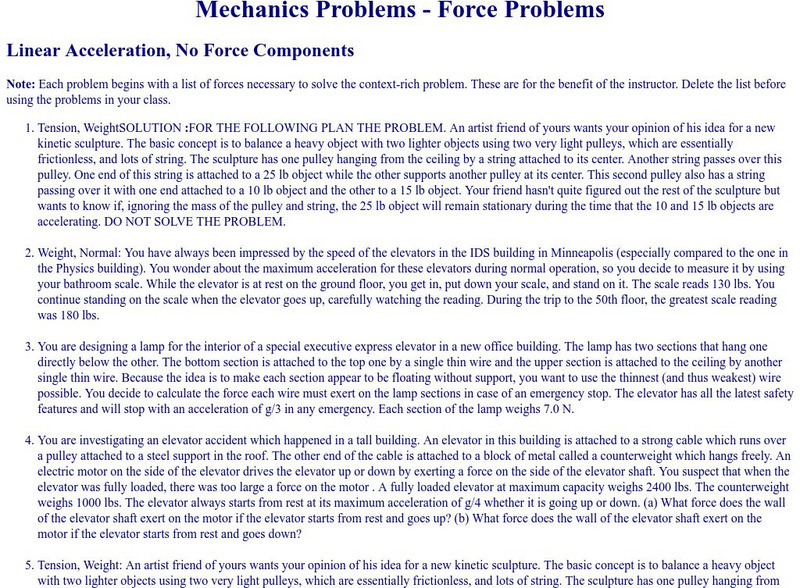
University of Minnesota: Mechanics Problems: Force Problems
This University of Minnesota site provides a series of contextually rich, real-world problems demonstrating force and Newton's second law of motion.
Sophia Learning
Sophia: System of Particles in an Object
This presentation explains why an object remains at rest, despite the fact that the particles within the object are in motion.
Science Education Resource Center at Carleton College
Serc: Investigating Best Amount of Water to Fly a Bottle Rocket
In this rocket experiment, middle schoolers will investigate the question, "Which amount of water will cause the rocket to stay in the air the longest?" Students will compare how long the rocket was in the air with how much water was in...
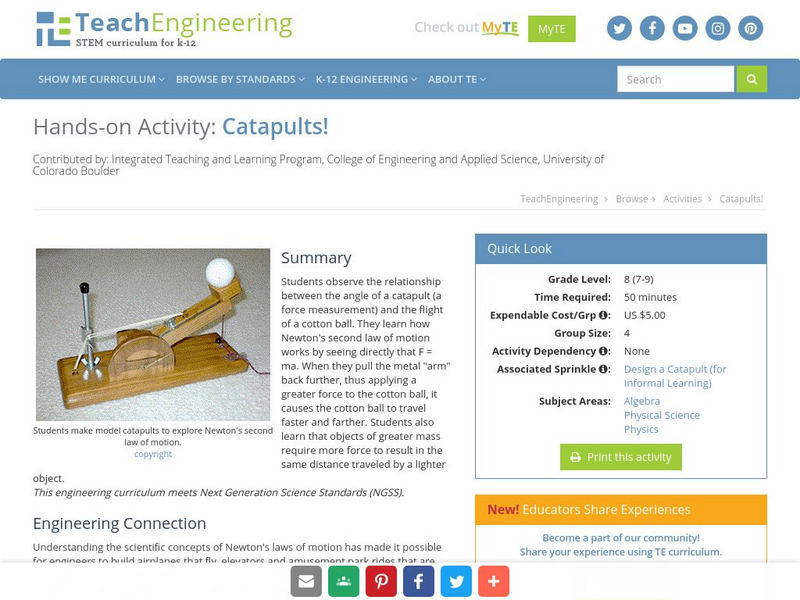
TeachEngineering
Teach Engineering: Catapults!
Students observe the relationship between the angle of a catapult (a force measurement) and the flight of a cotton ball. They learn how Newton's second law of motion works by seeing directly that F = ma. When they pull the metal "arm"...
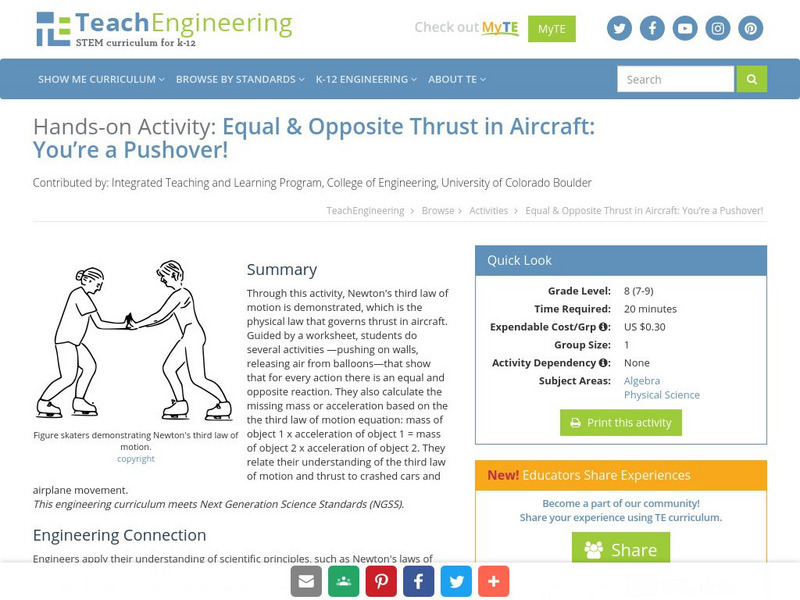
TeachEngineering
Teach Engineering: You're a Pushover!
The purpose of this activity is to demonstrate Newton's 3rd Law of Motion, which is the physical law that governs thrust in aircraft. The students will do several activities that show that for every action there is an equal and opposite...
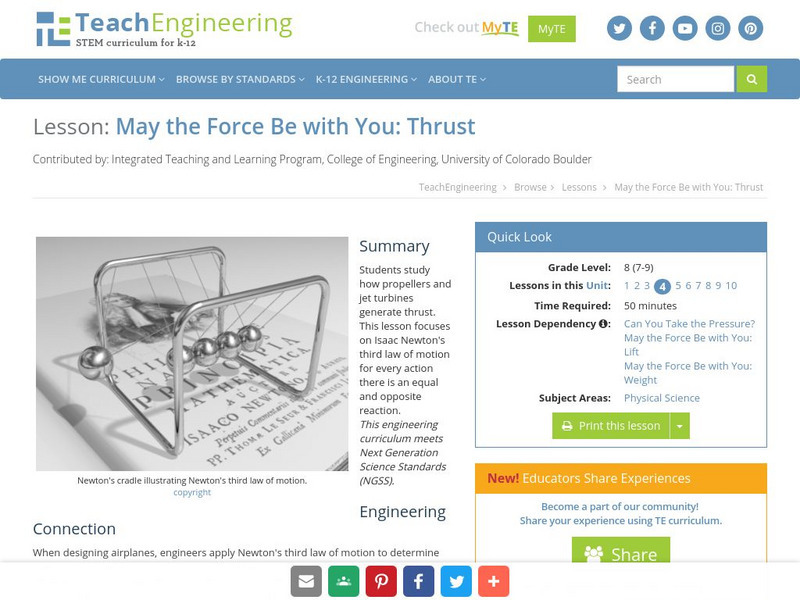
TeachEngineering
Teach Engineering: May the Force Be With You: Thrust
In this lesson, students will study how propellers and jet turbines generate thrust. This lesson focuses on Isaac Newton's 3rd Law of Motion, which states that for every action there is an equal and opposite reaction.