Hi, what do you want to do?





NASA
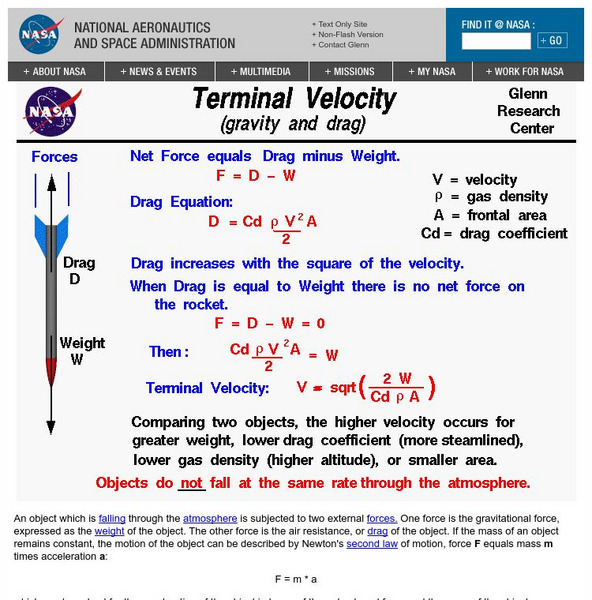
Nasa: Beginner's Guide to Aerodynamics
This site from NASA uses a colorful graphic to illustrate why objects reach terminal velocity. Provides equation for the terminal velocity of an object. Graphic is accompanied by a simple explanation.

Cosmo Learning
Cosmo Learning: Momentum & Collisions
Review momentum and collisions with this collection of video lectures from East Los Angeles College. Lectures vary in length and explain the concepts with examples.
Sophia Learning
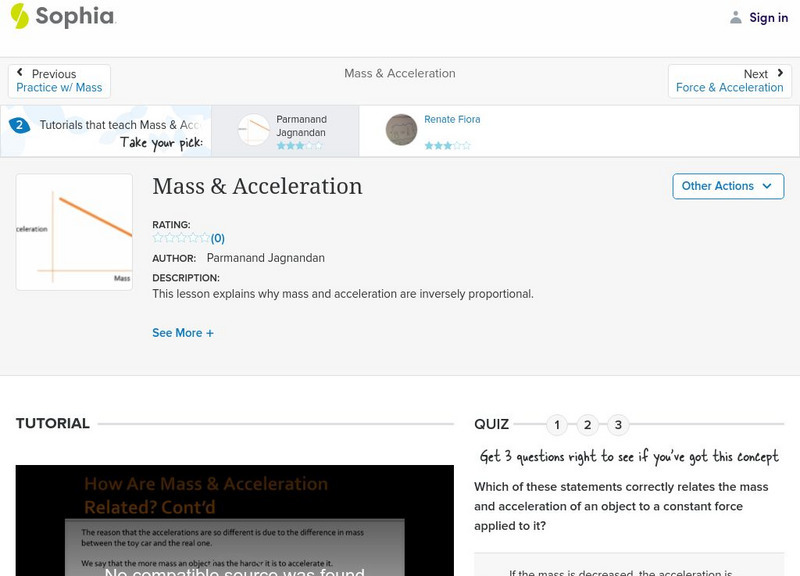
Sophia: Mass & Acceleration: Lesson 1
This lesson explains why mass and acceleration are inversely proportional. It is 1 of 2 in the series titled "Mass & Acceleration."
Sophia Learning
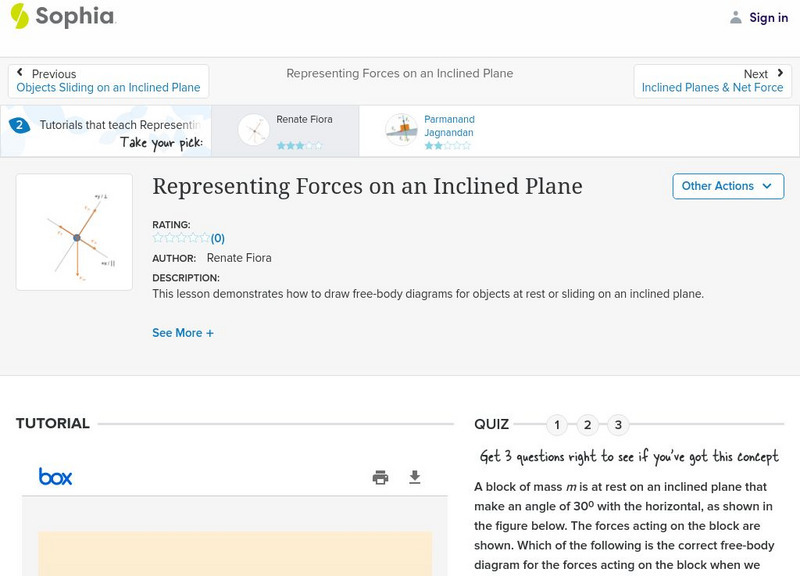
Sophia: Representing Forces on an Inclined Plane: Lesson 2
This lesson demonstrates how to draw free-body diagrams for objects at rest or sliding on an inclined plane. It is 2 of 2 in the series titled "Representing Forces on an Inclined Plane."
Physics4kids
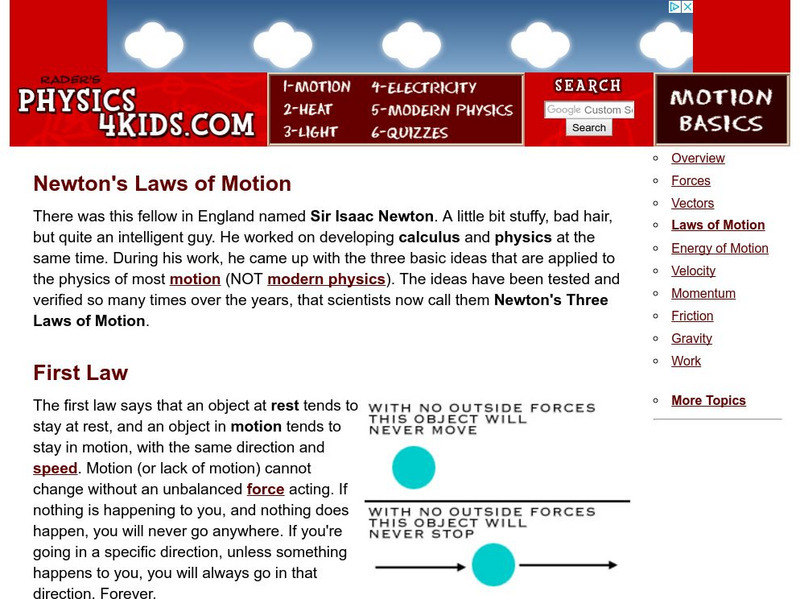
Physics4 kids.com: Newton's Laws of Motion
Get a brief overview of Newton's three laws of motion. Examples with diagrams are used to explain each law. An online quiz is available to test your understanding of these topics.
American Association of Physics Teachers
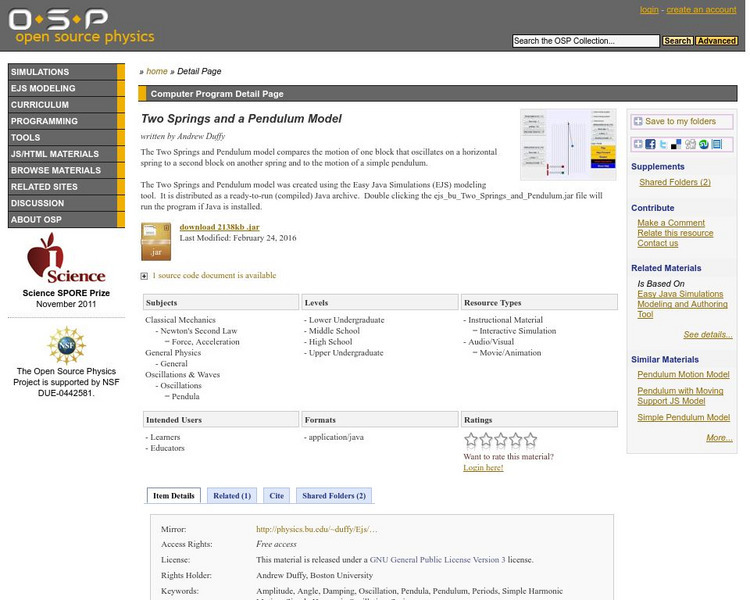
Com Padre Digital Library: Open Source Physics: Two Springs and a Pendulum Model
Swing virtual pendulums and compare the motion of one oscillating weight on a horizontal spring to a second weight on another spring. Then, compare how these motions differ from the motion of a simple pendulum.
Annenberg Foundation
Annenberg Learner: Amusement Park Physics: Roller Coaster
This interesting and interactive exhibit demonstrates how Newton's Laws of Motion impact the design and safety of roller coasters.
Physics Classroom
The Physics Classroom: Newtons Laws: Skydiving Interactive
Students explore the motion of an object falling under the influence of air resistance. Force arrows and values are shown as the object falls, and a speedometer displays the speed of the object. The mass of the falling object and the...

NASA
Nasa: Beginner's Guide to Aerodynamics
Includes exhaustive information and a wealth of activities pertaining to aerodynamics and the physics of flight.
Walter Fendt
Walter Fendt: Apps Zur Physik
This site, in German, offers numerous apps that illustrate common physics principles. Apps are organized into categories: mechanics, oscillations and waves, electrodynamics, optics, thermodynamics, the theory of relativity, physics of...
Curated OER
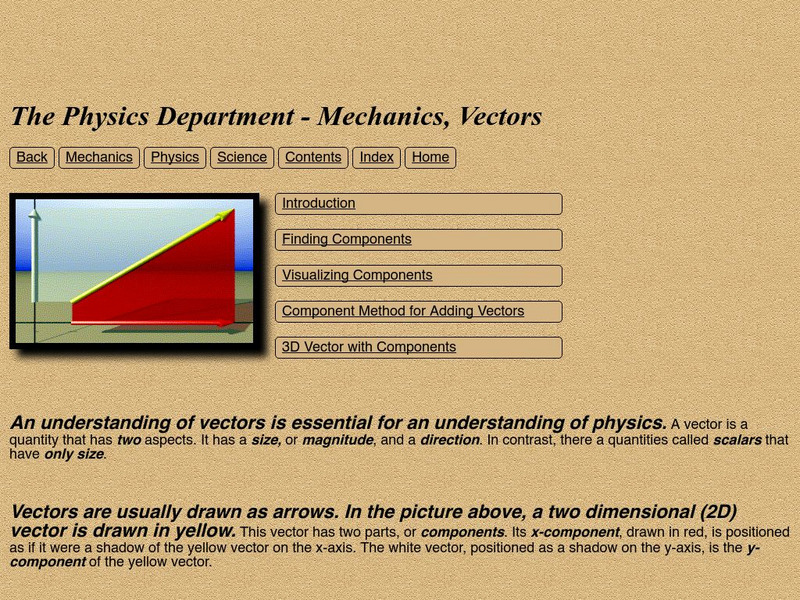
Zona Land: Mechanics and Vectors
An exceptional tutorial on the topic of vectors that offers many helpful graphics, some of which are interactive.

NASA
Nasa: Vectors
This site from NASA provides an excellent tutorial on vectors and their use in physics to describe the motion of objects. Vector addition and resolution are illustrated.
Michigan Reach Out
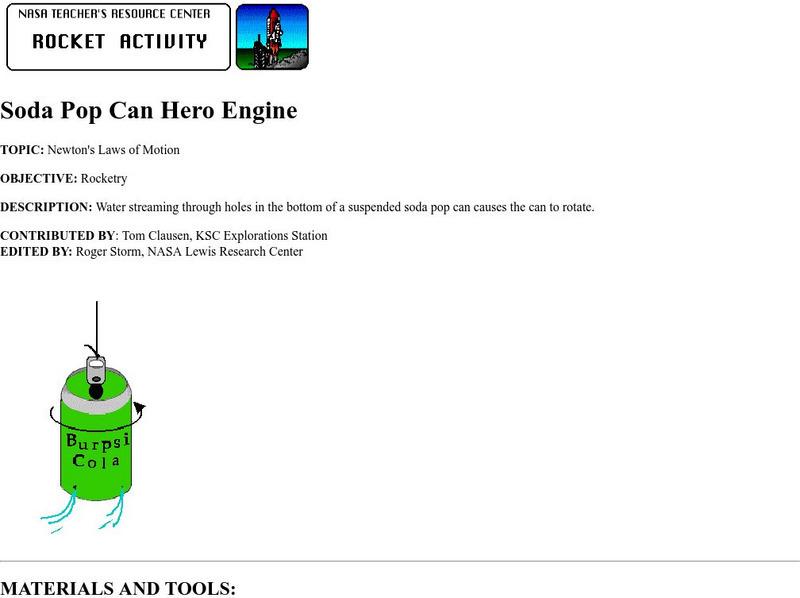
Nasa: Soda Pop Can Hero Engine
Students explore all three parts of Newton's Laws of Motion by observing a spinning pop can.
Science Education Resource Center at Carleton College
Serc: Balloon Racer Project
This project will motivate students to process and apply Newton's laws of motion to make their vehicle travel as far as possible
Physics Classroom
The Physics Classroom: Momentum and Its Conservation: Algebraic Problem Solving
In this physics tutorial, the law of momentum conservation will be combined with the use of a momentum table and some algebra skills to solve problems involving collisions occurring in isolated systems.

TED Talks
Ted: Ted Ed: Would You Weigh Less in an Elevator?
Video that uses an elevator in motion to describe the relationship among weight, gravity, and relative motion. [3:36] Includes a short quiz and a list of additional resources to explore.
San Jose State University
San Jose State University: Buildings in Earthquakes [Ppt]
Explains the physics of building movement during an earthquake through a discussion of force, mass, acceleration, frequency, and period. Then looks at the factors that affect a building's resilience versus the damage it could sustain.
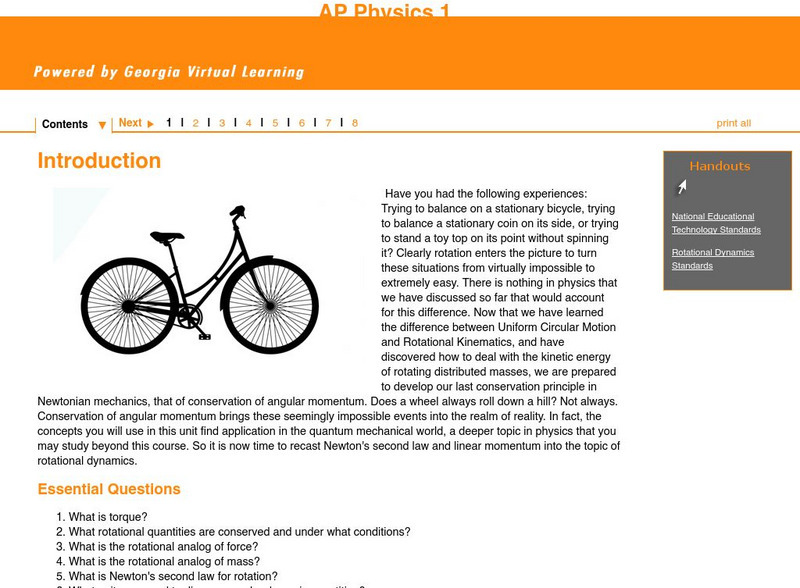
Georgia Department of Education
Ga Virtual Learning: Ap Physics 1: Rotational Dynamics
Students learn about the Newtonian mechanics principle of conservation of angular momentum and the application in the quantum mechanical world.
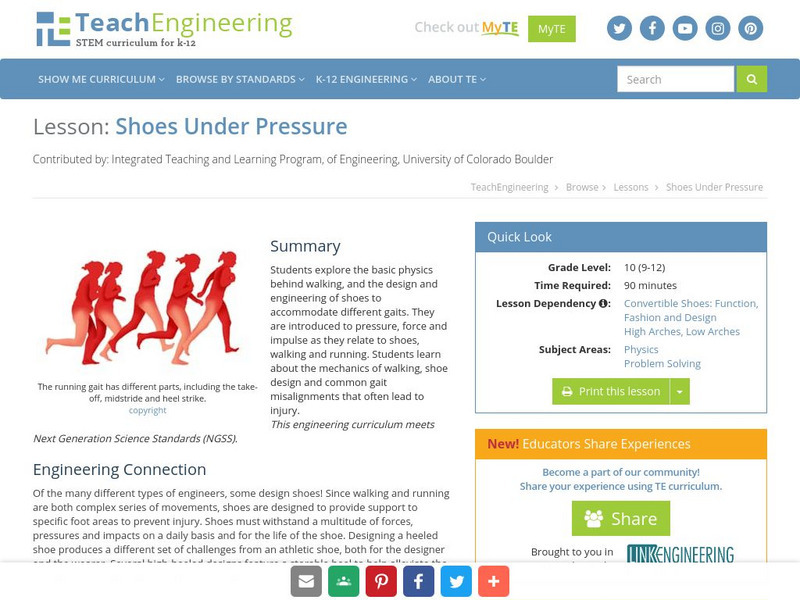
TeachEngineering
Teach Engineering: Shoes Under Pressure
Students explore the basic physics behind walking, and the design and engineering of shoes to accommodate different gaits. They are introduced to pressure, force and impulse as they relate to shoes, walking and running. Students learn...
CK-12 Foundation
Ck 12 Exploration Series: Simulations: Physics: Ballistics Tests
[Free Registration/Login Required] Practice with the concepts of conservation of momentum and energy by analyzing a special case of the ballistic pendulum.
CK-12 Foundation
Ck 12 Exploration Series: Simulations: Physics: Collisions
[Free Registration/Login Required] This sim explains the concept of elastic and inelastic collision using two bumper cars. A PDF worksheet and a video tutorial are also available. [3:40]
NASA
Nasa: Mass vs. Weight
Several learning modules that explain the difference between mass and weight. Each module includes a video introduction and detailed lesson plan.
Science Education Resource Center at Carleton College
Serc: Investigating Projectile Motion: Creating a Catapult
This lesson is for 9th grade physical science learners. It begins with an inquiry-based lesson using a projectile motion computer simulation. It culminates with students building a catapult; applying and connecting science knowledge from...
Physics Aviary
Physics Aviary: Practice Problems: Car on a Turn Problem
Students must determine the force of friction on a car on a turn and the maximum speed the car could navigate a turn.
Other popular searches
- Newton's Second Law of Motion
- Newtons Second Law of Motion
- Newtons Second Law Lab
- Newton's Second Law Problems
- Newton's Second Law Bricks
- Newtons Second Law Practice
- Webquest Newton's Second Law
- Newtons Second Law Activity
- Newtons Second Law Motion