Hi, what do you want to do?






Annenberg Foundation
Industrializing America
Imagine an eight year old spindle boy working barefoot in a factory in the late 1800s. Scholars research the industrial period in American history in the 14th lesson of a 22-part series that explores the country's background. Groups...

Annenberg Foundation
Social Realism
Many American writers in the late nineteenth century wanted their writing to reflect real life. Individuals watch and discuss a video, read and explore author biographies, write a journal entry and a poem, and complete a multimedia...

Annenberg Foundation
America's History in the Making: Classroom Applications Three
How can primary sources bring history to life? Scholars create detailed lesson plans on the late nineteenth and early twentieth centuries in American history. The 17th installment of a 22-part program exploring American history examines...

Annenberg Foundation
Gothic Undercurrents
Terror, mystery, excitement. American writers of the 19th century, including Nathaniel Hawthorne, Herman Melville, and Emily Dickinson, used these elements to create morally ambiguous tales that challenged the prevailing belief in...

Annenberg Foundation
A Growing Global Power
How does a nation turn into a global superpower? The 16th installment of the 22-part series on American history investigates the rise of the United States to global importance in the late nineteenth and early twentieth centuries. Groups...

Curated OER
Legends of the Fifth
Students explore the the legends and myths of the Orient, Africa, Europe, Asia, and the Americas in this six lessons unit. Different cultures and belief systems of the inhabitants of these areas are examined through storytelling techniques.
The Newberry Library
Newberry: Mark Twain, Huckleberry Finn, and Race in Postbellum America
Learning module in which students learn how Twain's Huckleberry Finn engaged and challenged popular ideas about slavery and race in nineteenth-century America and examine whether a text can be offensive yet worthwhile.
The Newberry Library
Newberry Library: Imagining the American West in the Late Nineteenth Century
Learning modules with primary resources explores how the West has been imagined as both America's manifest destiny and a wild frontier and examines the ways American Indian art and literature challenge these popular narratives.
Annenberg Foundation
Annenberg Learner: America's History in the Making: Antebellum Reform
Nineteenth century United States saw the creation of reform movements: temperance, abolition, school and prison reform, as well as others. This unit traces the emergence of reform movements instigated by the Second Great Awakening and...
Annenberg Foundation
Annenberg Learner: American Passages: Race and Identity in Antebellum America
This unit features authors of Antebellum America and how they portray the American identity through their literature. Click on the tabs to explore the various resources available to enhance this unit.
Annenberg Foundation
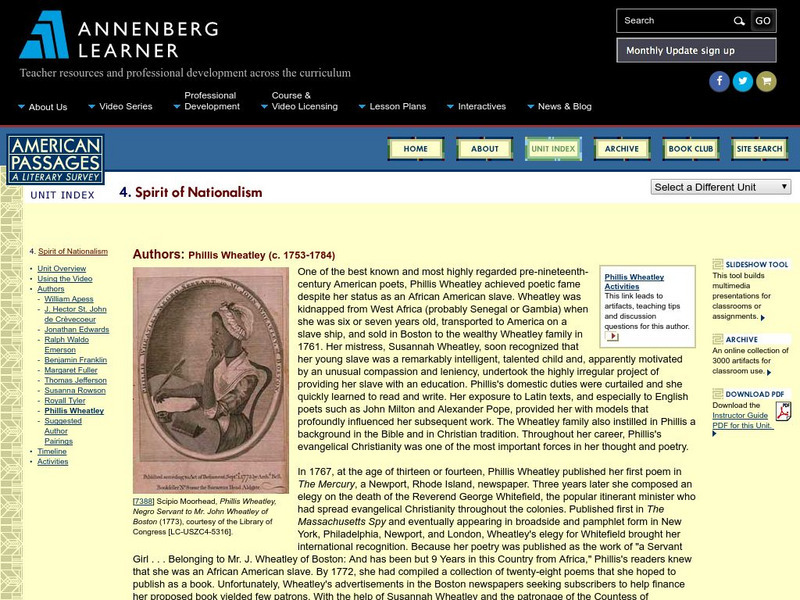
Annenberg Learner: American Passages: Spirit of Nationalism: Phillis Wheatley
Phillis Wheatley, an African-American slave, is featured for her neoclassical poetry of pre-nineteenth century America. Click on "Phillis Wheatley Activities" for more resources.
Annenberg Foundation
Annenberg Learner: American Passages: Slavery and Freedom: Frederick Douglass
This concise biography presents author/journalist Frederick Douglass, who was groundbreaking in his slave narratives and establishing "The North Star" abolitionist periodical in mid-nineteenth-century America. See "Frederick Douglass...
National Humanities Center
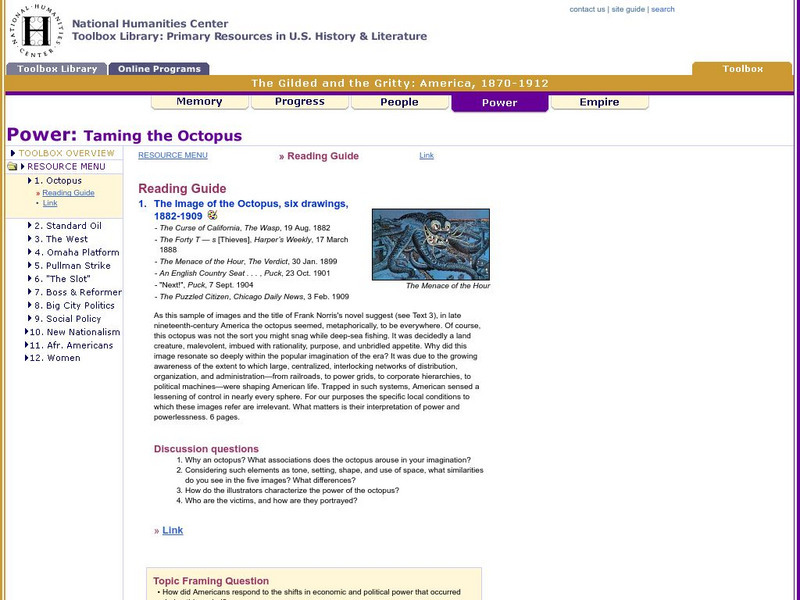
National Humanities Center: Toolbox Library: Power: Taming the Octopus: The Image of the Octopus
Six versions of the octopus, a pervasive image in late-nineteenth-century America, that illustrate the extensive and corrosive power held by corporations over American political and economic life. Reading guide with discussion questions.
National Humanities Center
National Humanities Center: Toolbox Library: People: Assimilation and the Crucible of the City: Street Life in New York
Excerpt from Horatio Alger's well-known novel, "Ragged Dick, Or, Street Life in New York," that describes the values and attitudes needed to make it in the capitalistic, urban America of the late-nineteenth century.
National Humanities Center
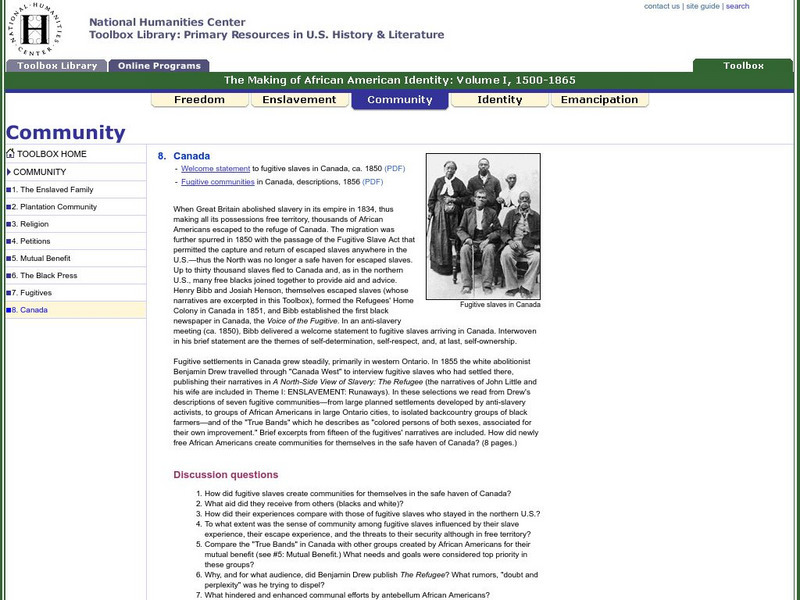
National Humanities Center: Toolbox Library: Making of African American Identity: Canada
Descriptions of fugitive slave communities in Canada and comments from those who escaped to these locations as well as welcoming statements to fugitive slaves in the mid-nineteenth century.
National Humanities Center
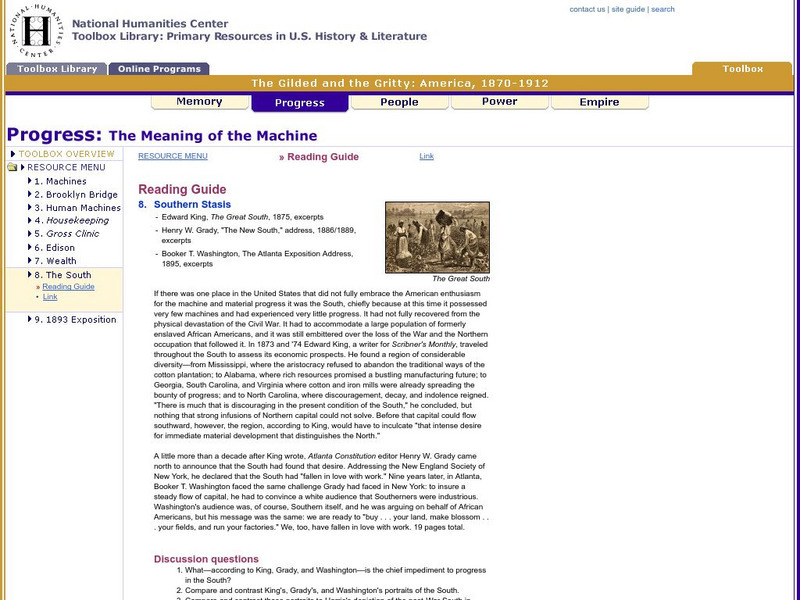
National Humanities Center: Toolbox Library: Progress: The Meaning of the Machine: Southern Stasis
A survey of the lagging Southern economy of the late-nineteenth century and two speeches, one by a black Southerner and one by a white Southerner, making the case for Northern investment in the region.
University of Chicago
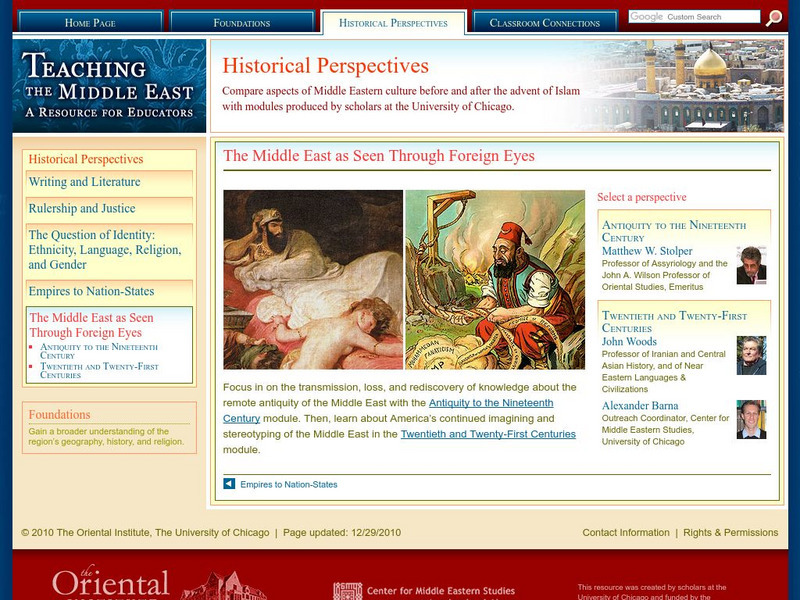
University of Chicago Library: Teaching the Middle East: Foreign Eyes
Two related learning modules consider Western perspectives on the Middle East, beginning with the Persian invasions of Greece (fifth century BC) and moving forward into the present time. Useful background on the history of wartime and...

TED Talks
Ted: Ted Ed: Does "The Wonderful Wizard of Oz" Have a Hidden Message?
In his introduction to "The Wonderful Wizard of Oz," L. Frank Baum claims that the book is simply an innocent children's story. But some scholars have found hidden criticisms of late-nineteenth-century economic policies in the book. Is...
Annenberg Foundation
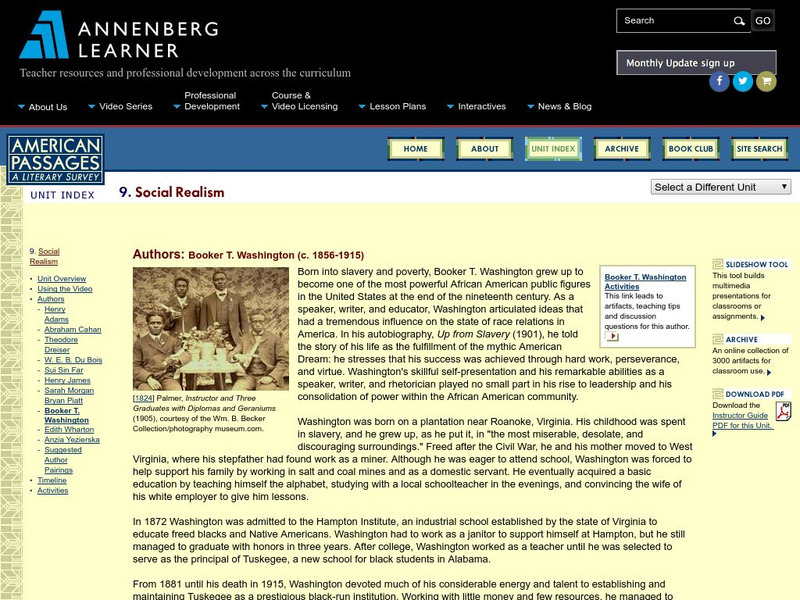
Annenberg Learner: American Passages: Social Realism: Booker T. Washington
Focused on his personal racial and civil philosophy, Booker T. Washington moved mountains making the public aware of the injustices and inequalities of the late nineteenth and early twentieth centuries. Click "Booker T. Washington...
California Digital Library
Loc: Sentiments Concerning the Chinese: Illustrations From Periodicals
The Chinese in California, 1850-1925 illustrates nineteenth and early twentieth century Chinese immigration to California through about 8,000 images and pages of primary source materials. Included are photographs, original art, cartoons...