Hi, what do you want to do?






Curated OER
Holidays--Martin Luther King Day
In this Martin Luther King Day worksheet, learners answer ten questions associated with Martin Luther King and his special day.

Curated OER
Precious Water: Is it a Need, a Right, or a Commodity?
Young scholars determine whether water is a need, a right, or a commodity. For this water lesson, students investigate land and water ecosystems through activities. Young scholars also discover water as a resource and energy source as...

Curated OER
Water Quality Survey: Monitoring the Sustainability of Pigeon Creek
High schoolers research the History of Pigeon Creek (or any watershed in your area). In this environmental science lesson, students conduct field tests such as pH and nitrates. They collect data and compare what they collected with other...

Curated OER
State Sovereignty and the Ethics of Intervention
Students study the history, ethics, politics and law of state sovereignty and its limits. In this investigative lesson students listen to a lecture, discuss then complete a few assignments.

Curated OER
Win-Win Discipline
High schoolers investigate methods to get along. In this philosophy instructional activity, students explore different methods to disarm an argument or confrontation they disagree with. They discuss aggression, rule breaking and...

Curated OER
Ions in the Environment
Pupils explain the importance of the five main biogeochemical cycles. In this chemistry lesson plan, students discuss how ions are transported in the environment. They design an experiment to collect data on eutrophication.

Curated OER
A Solution for Precipitation
Learners predict the product of chemical reaction using the solubility rules. In this chemistry lesson, students balance ionic equation. They perform a lab to check if their predicted products are correct.

Curated OER
Dog Aggression
For this trivia quiz, the information focuses on dog aggression. Students respond to 10 multiple choice questions and submit answers electronically via this interactive website.

Curated OER
Estuarine Habitats
Sixth graders study the important habitats, flora, fauna, and physical factors of coastal habitats. They compare the aquatic habitats to terrestrial habitats by researching and completing tables with the information.

Curated OER
Arsenic and Human Health
Ninth graders concentrate on arsenic poisoning as an example of the connections among health, geography, and geology as they develop a persuasive presentation about the dangers of arsenic in the drinking water, targeting a specific...

National Geographic
National Geographic: Encyclopedic Entry: Non Renewable Energy
A good primer on non-renewable energy sources. Covers the overall advantages and disadvantages, and discusses the different types and their pros and cons. Includes a slideshow with captions.
The Wonder of Science
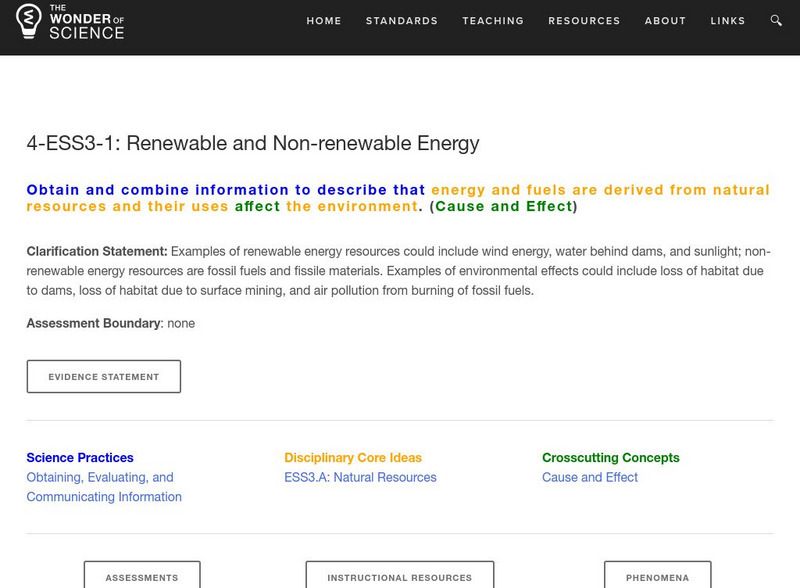
The Wonder of Science: 4 Ess3 1: Renewable and Non Renewable Energy
Work samples, phenomena, assessment templates, and videos that directly address standard 4-ESS3-1: renewable and non-renewable energy.

Other
Peak Oil: Non Renewable Resources Depletion Effects
A collection of graphs, tables, and diagrams that illustrate the global impact of natural resource depletion. (Published 2014)
Other
Biology Discussion: Natural Resources: Depletion Reasons, Types and Conservation
Discusses how the the natural resources of the world are being depleted at an alarming rate, and that humans depend on them for their survival. Elaborates on four main causes of resource depletion, and initiatives that could help to...
eSchool Today
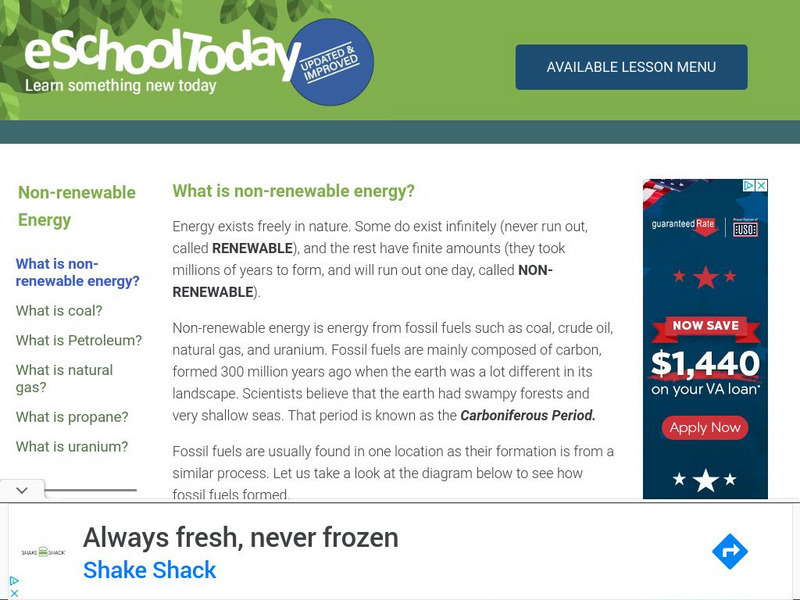
E School Today: Non Renewable Energy
Learn what non-renewable energy is and the different types.
Scholastic
Scholastic: Study Jams! Science: Energy, Light and Sound: Natural Resources
A slideshow and a short quiz on natural resources, the difference between renewable and nonrenewable resources, and the impact humans have on the Earth's natural resources.
University of Illinois
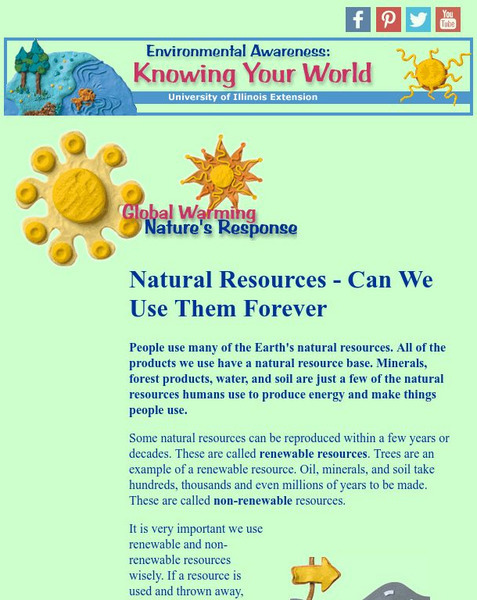
University of Illinois Extension: Schools Online: Knowing Your World: Natural Resources
This brief article emphasizing the importance of renewable and non-renewable resources urges readers to appreciate and not waste the earth's natural resources. Following the article, there is an activity, a "Mineral Search," through...
US Department of Energy
Natural Gas: Fueling the Blue Flame
Natural gas is a colorless and odorless fossil fuel that is used in almost half the homes for heat. Learn more about this non-renewable energy resource.
CK-12 Foundation
Ck 12: Renewable Versus Non Renewable Resources
[Free Registration/Login may be required to access all resource tools.] Discusses the differences between renewable and nonrenewable natural resources. Includes study and review questions, and links to additional resources.
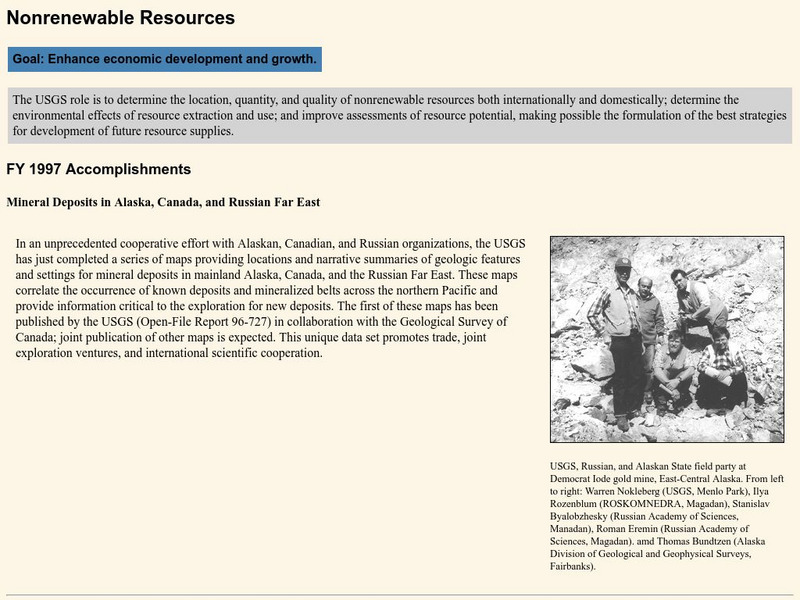
US Geological Survey
Non Renewable Resources
Learn how to enhance economic development and growth. Learn the role of the United States Geographic Survey on locating, quantifying and qualifying non-renewable resources.

E-learning for Kids
E Learning for Kids: Science: Denmark: What Are Natural Resources and Why Are They Important?
Learn about natural resources, both renewable and nonrenewable, and the impact humans have on the natural world.
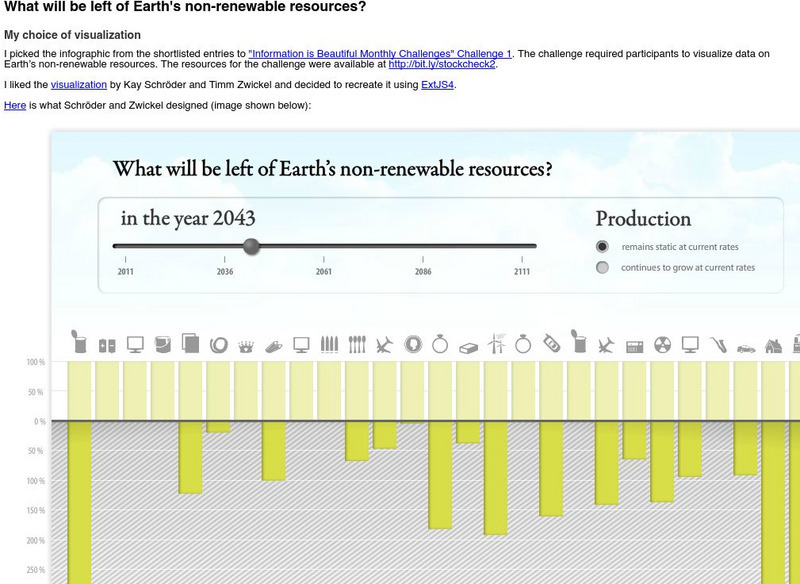
NC State University
Ncsu: What Will Be Left of Earth's Non Renewable Resources?
An interactive graph that predicts how many years until more than two dozen natural resources (e.g., chromium, oil, tin, coal, etc.) are depleted, based on current production rates or production that grows each year. Use the slider at...
Vision Learning
Visionlearning: Chemistry: The Nature of the Chemical Bond
This site talks about ionic, polar covalent, and non-polar covalent bonding.
Curated OER
National Park Service: Cuyahoga Valley: Nature and Science: Nonnative Species
Describes the impact of invasions of non-native plant and insect species in Cuyahoga Valley National Park in Ohio, including the gypsy moth and the emerald ash borer.
Other popular searches
- Drama Non Naturalism
- Drama+ Non Naturalism
- Non Naturalism Theater
- Non Naturalism Year 12
- Non Naturalism in Drama
- Non Naturalism Theatre
- Drama Non Naturalism