Hi, what do you want to do?





The Environmental Literacy Council
Environmental Literacy Council: For Students
Environmental Literacy Council wants to build a fundamental understanding of the systems of the world, both living and non-living, along with the analytical skills needed to weigh scientific evidence and policy choices in young people....
University of California
Ucmp: What Is "Good Science"?
A very good explanation of the scientific process and the differences between science and non-science. This is a concise and clearly written description.

Georgia Department of Education
Ga Virtual Learning: Ap Physics 1: Work, Energy, and Power
The mathematical model for the relationships between work and energy serves to model physical problems and, more importantly, predict natural and man-made phenomena. Students discover the relationships which serve as a powerful...
Chem4kids
Chem4 Kids: Helium
Here you can find lots of great information about helium. Learn about its electrons, where it exists in nature, and about the element itself!
Chem4kids
Chem4 Kids: Sulfur (S)
Here you can find some great information about the 16th element in the periodic table, "sulfur." Content focuses on sulfur's electrons, where you can find sulfur in nature and in the home, and how sulfur combines with other elements.

TeachEngineering
Teach Engineering: Environment
Through 10 lessons and more than 20 hands-on activities, students are introduced to the concept of an environment and the many interactions within it. As they learn about natural and human-made environments, as well as renewable and...
TeachEngineering
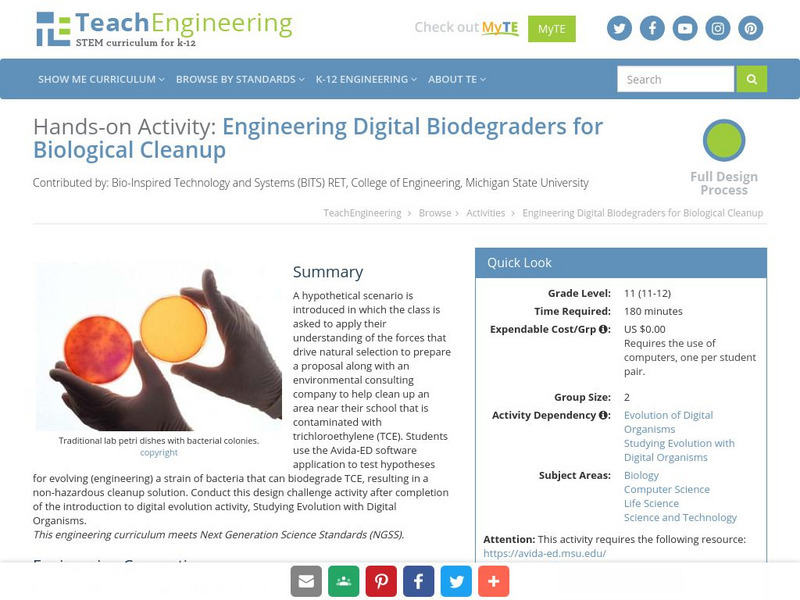
Teach Engineering: Evolving Tce Biodegraders
A hypothetical scenario is introduced in which the class is asked to apply their understanding of the forces that drive natural selection to prepare a proposal along with an environmental consulting company to help clean up an area near...
Other
Unicef: Voices of Youth
UNICEF's youth section provides information on how to help this famous non-profit with its mission, a forum, real-life stories from people in less-developed countries, educational games and "what do you think" questions, and materials to...

Other
Moorland School: Earth Science Zone: Fossils Into Fuels
Learn that fossilized remains of dead plants and animals can form fossil fuels that are used to power to your car! Website describes the properties of crude oil, natural gas, and hydrocarbons.
Other
League of Women Voters
This resource provides information about important issues, relating towards female voters.
US Energy Information Administration
U.s. Eia Energy Kids: Nonrenewable Energy Sources
This resource provides information about nonrenewable energy sources. There is specific information about each of these energy sources, and lots of maps, charts, tables, and graphs to further the understanding.
The Franklin Institute
As the Drill Bit Turns
Is the world running out of gas? Teach your students how their lives impact the depletion of non-renewable resources, specifically oil, and how the depletion of those resources will effect the future.
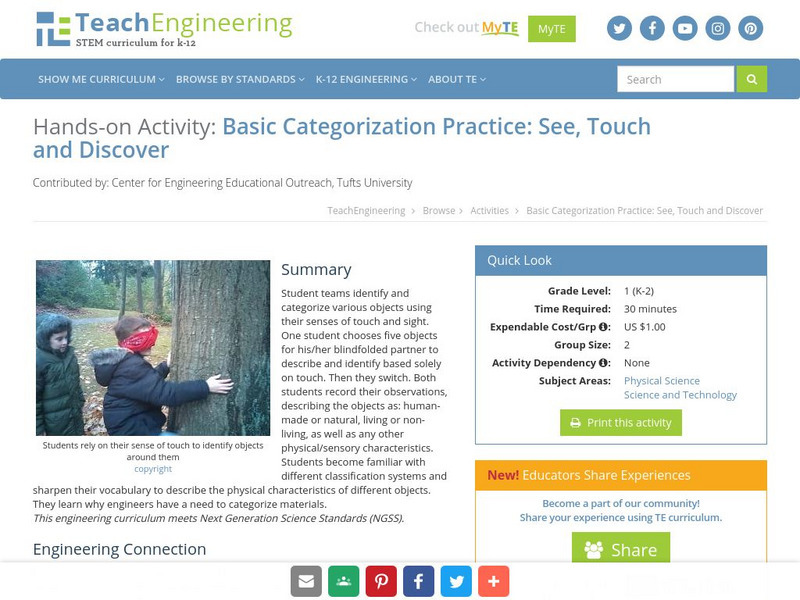
TeachEngineering
Teach Engineering: Touch and Discover
Students work in pairs or small groups to identify and categorize various objects. One student is blindfolded and the other student chooses five objects for their partner to identify. The blindfolded student has to describe and try to...
Energy4Me
Energy4me: Perforated Well Casing
How do you think adding holes to a well casing will influence the amount of petroleum or natural gas that a well can produce? This activity models the differences in production of a perforated and non-perforated well casing. After the...
Science Education Resource Center at Carleton College
Serc: Investigating Earth Materials: Collecting and Classifying
Activity investigates what Earth materials are made of. Students will go out and collect non-living earth materials that will fit in a small plastic bag then sort the material to discover ways of classifying what they have gathered....
Read Works
Read Works: Fact and Opinion 1st Grade Unit
[Free Registration/Login Required] A three-lesson unit on fact and opinion through which students learn how to identify opinions through signal words, identify facts in a non-fiction text, and use facts to help them formulate opinions of...
PBS
Pbs Learning Media: Out of Proportion
Students are asked to explain how natural disasters affect environmental health.
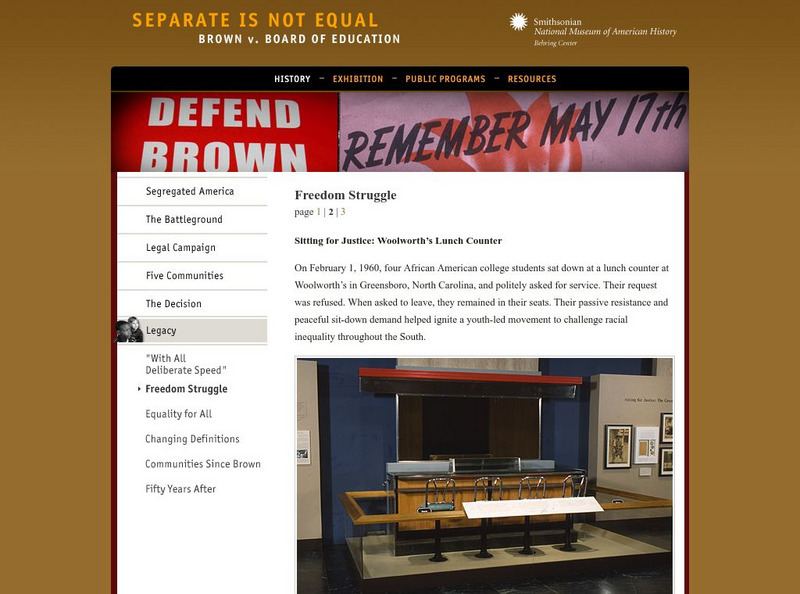
Smithsonian Institution
National Museum of American History: Separate Is Not Equal: Sitting for Justice: Woolworth's Lunch Counter
Read a brief description of the sit-in at the Woolworth lunch counter in Greensboro, North Carolina. This sit-in, passive and non-violent resistance to segregation laws, lasted for six months.
Natural History Museum
Natural History Museum: Meteorites
Brief article examines what meteorites are, the different types, and where they came from.
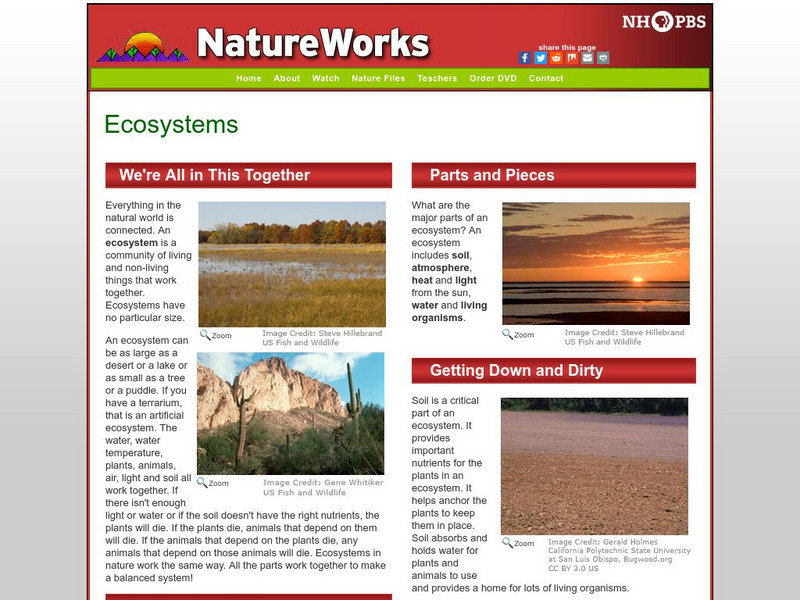
PBS
Nh Pbs: Nature Works: Ecosystems
How would you define an ecosystem? Check out this educational resource to learn more about the living and nonliving parts of different ecosystems.
E-learning for Kids
E Learning for Kids: Scotland: What Is the Difference Between Renewable and Nonrenewable Resources?
Looks at types of natural resources that can be used for energy, and the difference between renewable and nonrenewable energy sources.
Other
Center for Watershed Protection
Explore this non-profit organizations site for watershed information.
BioMan Biology
Bio Man Biology: Evolution and Classification Quizzes
A multiple-choice quiz on the mechanisms of evolution.
Other popular searches
- Drama Non Naturalism
- Drama+ Non Naturalism
- Non Naturalism Theater
- Non Naturalism Year 12
- Non Naturalism in Drama
- Non Naturalism Theatre
- Drama Non Naturalism