Hi, what do you want to do?






Curated OER
Lilting Limericks
Students discover the formula for writing limericks and use it to write their own poems.

Curated OER
Jabberwocky-Identifying Adjectives
Elementary learners identify adjectives in sentences. They read the poem "Jabberwocky" by Lewis Carroll and highlight the adjectives. A good supplemental lesson plan if you are studying Lewis Carroll and/or "Jabberwocky."

Pearson
Rumpelstiltskin
Classic fairy tales are great! They have memorable characters, present interesting story lines, and lend themselves to art projects. Grab a copy of "Rumpelstiltskin" and get ready to participate in several early literacy activities. The...

Curated OER
Tongue Twisters
Second graders read the poem, "Betty Botter" and give their opinion of it. They discover what a tongue twister is and read the poem out loud together. Then as a class they read "Peter Piper" and discuss the similarities of the two poems.

Curated OER
The Pied Piper Of Hamelin
Students participate in a lesson that covers the genre of narrative poetry. They examine the elements of a narrative poem while focusing upon the characterization. Students compare and contrast the characters while analyzing their...

Curated OER
Listening for Tone
Students read and listen to various poems as they are read by different readers using different tones. They read "Jabberwocky" and in groups, determine what they think the nonsense words in the poem mean. The groups compare thier ideas...

Curated OER
BASIC GRAMMAR REVIEW Using "Jabberwocky"
Students use the poem Jabberwocky to discover where they are weak in grammar. They rewrite the poem using standard dialect words instead of nonsense words.

Curated OER
Rhyme In Time
Students engage in a lesson plan that is concerned with the concept of rhyming and recognize them in different pieces of literature that includes songs, speech, and poetry. They also listen to music to make an auditory connection to the...

Curated OER
The Language of Our World
Students combine prefixes and suffixes to form nonsense words and sentences in the style of Lewis Carroll's "Jabberwocky." In this "Jabberwocky" lesson, students brainstorm ways to decode an unfamiliar word and apply these skills...

Curated OER
Word Family Activities and American Symbols
In this word family and American symbols instructional activity, students learn about word families and American symbols. They complete an activity in which they create real and nonsense words by combining sounds of the alphabet with 7...

Curated OER
Where Do We Begin?
Primary learners grasp sequence of events by discussing morning routines and reviewing the story of Little Red Riding Hood. They explore the necessity of correct order of events. As a class, create a story with a beginning, middle, and...

Curated OER
Parody
Expand your students' literary likings with this quick PowerPoint about parodies. A detailed definition of a parody on the second slide precedes different examples of parodies in pop culture. Tip: Show videos of famous parodies your...

Curated OER
Rock N Rhythm & Rhyme (Part One)
Students make flip books of rhyming words and match words together that are on cards. In this rhyming lesson plan, students read books and read individual words to identify rhyming words.

Curated OER
Alice's Adventures in Wonderland and Through the Looking-Glass Questions
In this reading comprehension activity, students respond to 9 short answer and essay questions based on Lewis Carroll's Alice’s Adventures Through the Looking Glass.

Curated OER
Intro to Parts of Speech
Students define eight parts of speech, classify words as specific parts of speech, describe their function, and explain how parts of speech help us to communicate more clearly.

Curated OER
Rhythm and Rhyming Long Rope Jumping
Students discuss the importance of rhythm in rope jumping. They practice turning, then jumping. Students discuss the various types of rhymes. They work in groups for a couple of classes, students rotate from chart to chart trying out...
University of Florida
Baldwin Library: More Nonsense by Edward Lear
This is an online photocopy of the original text of the children's book More Nonsense by Edward Lear (1888), a book of illustrated nonsense limerick poems.
National Endowment for the Humanities
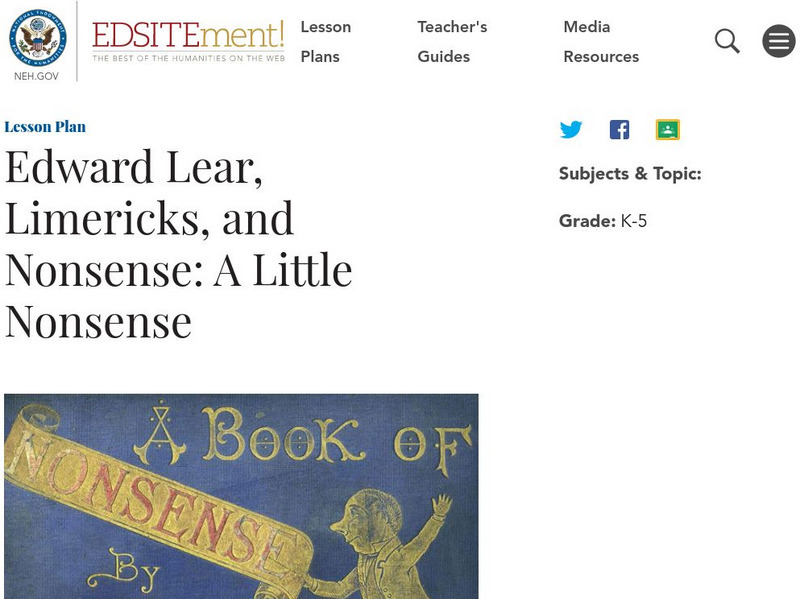
Neh: Edsit Ement: Edward Lear, Limericks, and Nonsense: A Little Nonsense
In this lesson plan, students will consider Edward Lear, Limericks, and Nonsense: A Little Nonsense. Worksheets and other supporting materials can be found under the Resources tab.
University of Florida
Baldwin Library: The Children's Nonsense Book
A scanned copy of the 1895 publication of The Children's Nonsense Book, a book of stories and poems for children.
University of Florida
Baldwin Library: A Book of Nonsense
A scanned copy of the 1875 publication of A Book of Nonsense by Edward Lear, a book of poetry for children.
University of Florida
Baldwin Library: Lear's Book of Nonsense
A scanned copy of the 1880 publication of Lear's Book of Nonsense by Edward Lear, a book of children's poetry.

University of Florida
Baldwin Library: Nonsense for Girls
A scanned copy of the 1880 publication of Nonsense for Girls by J. J. Jackson, a book of children's poetry.

CommonLit
Common Lit: Jabberwocky
CommonLit.org is a wonderful resource to use in a Language Arts classroom. Each text is accompanied by guided reading questions, assessment questions, and discussion questions. In addition, students can click on words to see the...
National Endowment for the Humanities
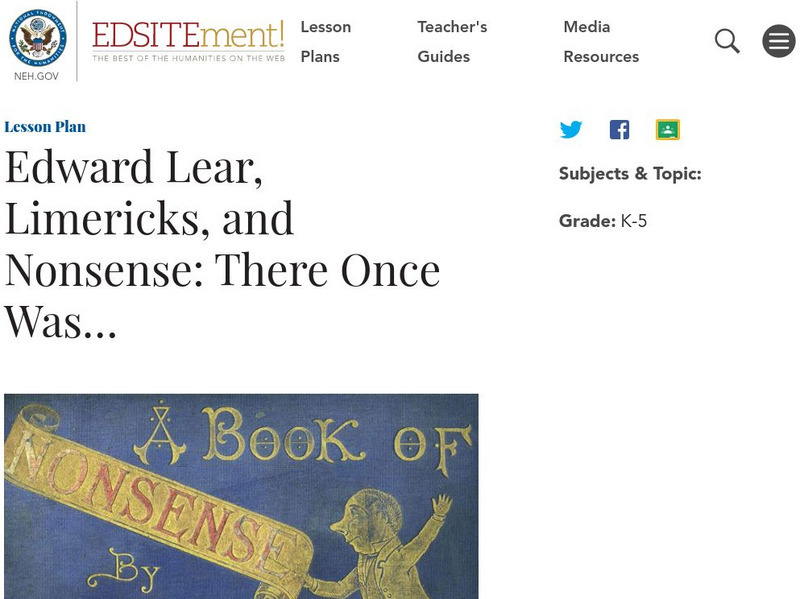
Neh: Edsit Ement: There Once Was...
Part 2 of this tutorial on limerick writing demonstrates the importance of form (meter and rhyme) in limerick poetry using the exemplary and amusing work of Edward Lear.