Hi, what do you want to do?





CK-12 Foundation
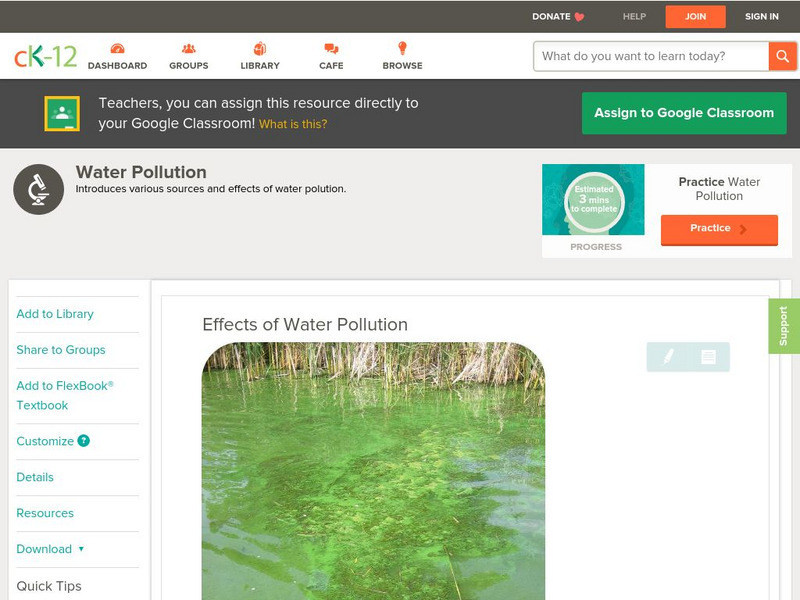
Ck 12: Life Science: Effects of Water Pollution
[Free Registration/Login may be required to access all resource tools.] Water pollutants can have an effect on both the ecology of ecosystems and on humans. As a result of water pollution, humans may not be able to use a waterway for...
CK-12 Foundation
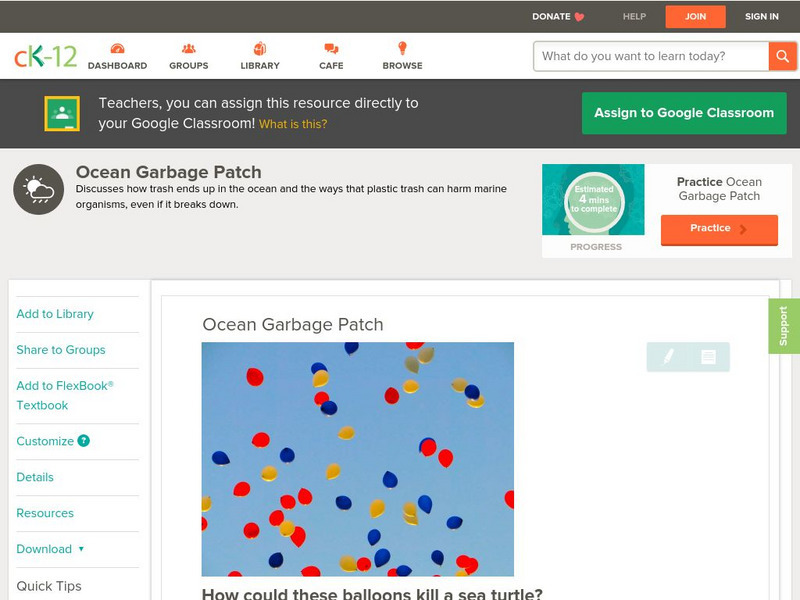
Ck 12: Earth Science: Ocean Garbage Patch
[Free Registration/Login may be required to access all resource tools.] How trash gets caught by ocean currents into certain locations.
![Noaa: Stressed Out! [Pdf] Lesson Plan](https://static.lp.lexp.cloud/images/attachment_defaults/resource/large/FPO-knovation.png "Noaa: Stressed Out! [Pdf] Lesson Plan")
NOAA
Noaa: Stressed Out! [Pdf]
In this lesson, young scholars investigate factors that affect the health of the oceans. These include overfishing, the destruction of habitats, the invasion of foreign species, the impact of pollution, and the increasing acidification....

CK-12 Foundation
Ck 12: Earth Science: Coastal Pollution
[Free Registration/Login may be required to access all resource tools.] How pollution creates dead zones in the ocean.

CK-12 Foundation
Ck 12: Earth Science: Coastal Pollution
[Free Registration/Login may be required to access all resource tools.] How pollution creates dead zones in the ocean.
SEDL
Oceans [Pdf]
This large PDF file integrates math, science, and language into several lessons about characteristics of the oceans. Topics include ocean currents, tides, density, marine life, and pollution.
TeachEngineering
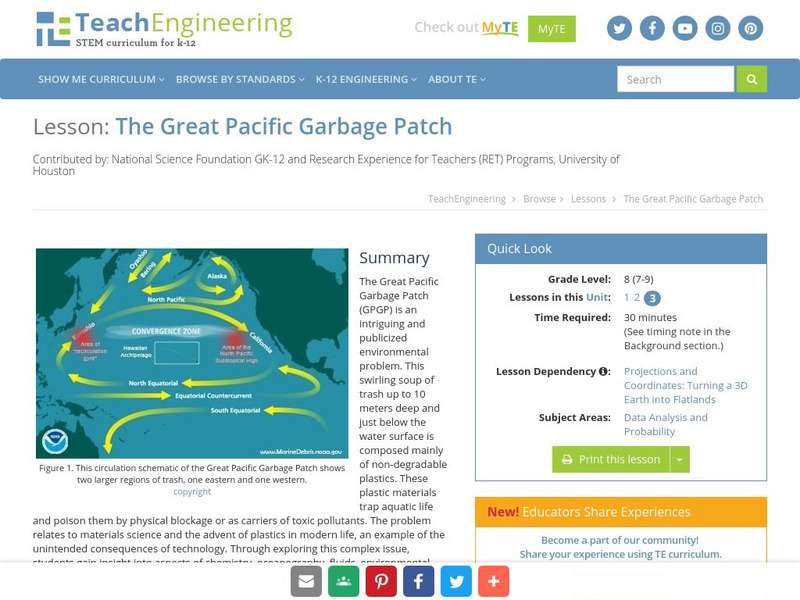
Teach Engineering: The Great Pacific Garbage Patch
The Great Pacific Garbage Patch (GPGP) is an interesting and somewhat publicized environmental problem. A swirling soup of trash up to 10 meters deep and just below the water surface is composed mainly of non-degradable plastics. These...

Scholastic
Scholastic Explorers: Ocean Life
This lesson plan explores how human activity has an impact on turtles, sea otters, and dolphins in different parts of the world. Your students will read field reports from the sites and evaluate data that is offered.