Hi, what do you want to do?





US National Archives
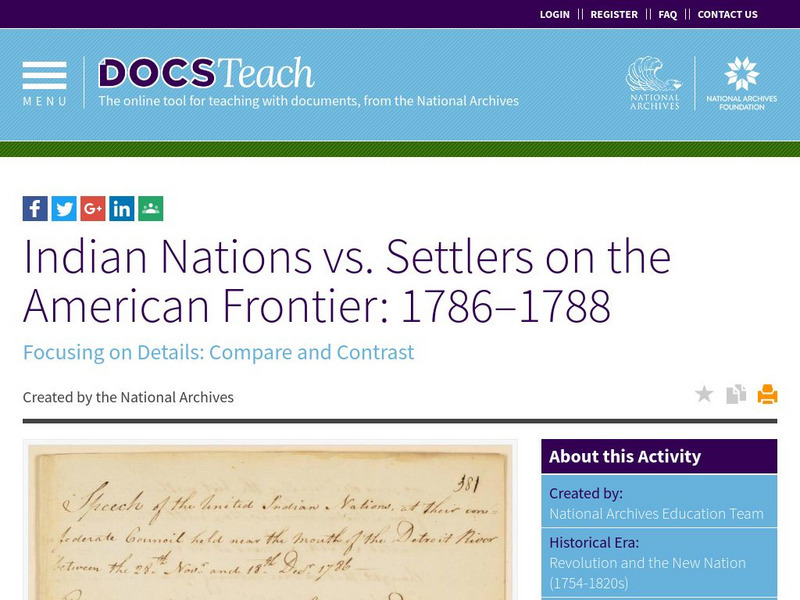
National Archives: Indian Nations vs. Settlers on the American Frontier
When the Revolutionary War ended, there was an ongoing conflict between the Native Americans and American settler in the Northwest Territory. Students will study two documents from each side of the issue and answer questions and/or hold...
US Army Center
U.s. Army Center of Military History: The American Revolution: First Phase
A military history of the first years of the Revolutionary War from Lexington and Concord to the Battle of Trenton. Included is information about the problems of maintaining the Continental Army and problems for the British Army.
Other
Mount Vernon Ladies' Association: Reporting the Revolutionary War
In today's fast-paced news cycle, we have multiple venues for learning about current events at any time during the day or night. During the revolution, they had one source (newspaper) that was only published once a week. Even with this...
National Archives (UK)
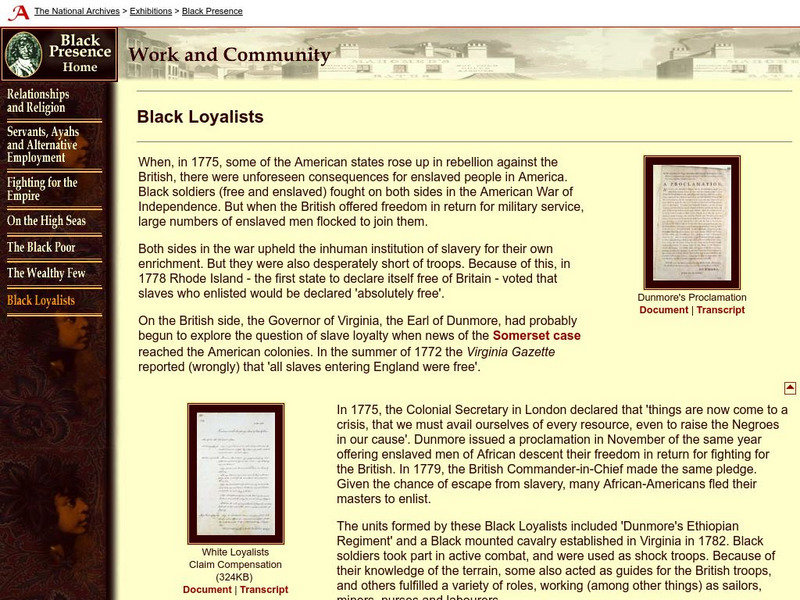
The National Archives: Black Loyalists
Both free and enslaved black soldiers fought on both sides fo the Revolutionary War. Learn about the Black Loyalists of Canada, and how some slaves earned their freedom through military service. Includes primary source documents.

OpenStax
Open Stax: Identity During the American Revolution
From a chapter on "America's War for Independence," this section of the chapter explains Loyalist and Patriot sentiments and identifies different groups that participated in the Revolutionary War.
British Library
British Library: The American Revolution: The Peace of Paris
The Peace of Paris Treaty was signed in 1783 between Britain, France, and America, ending the American Revolutionary War. It also established much of the border with Canada. This page gives a concise overview of the agreement and is part...
War Times Journal
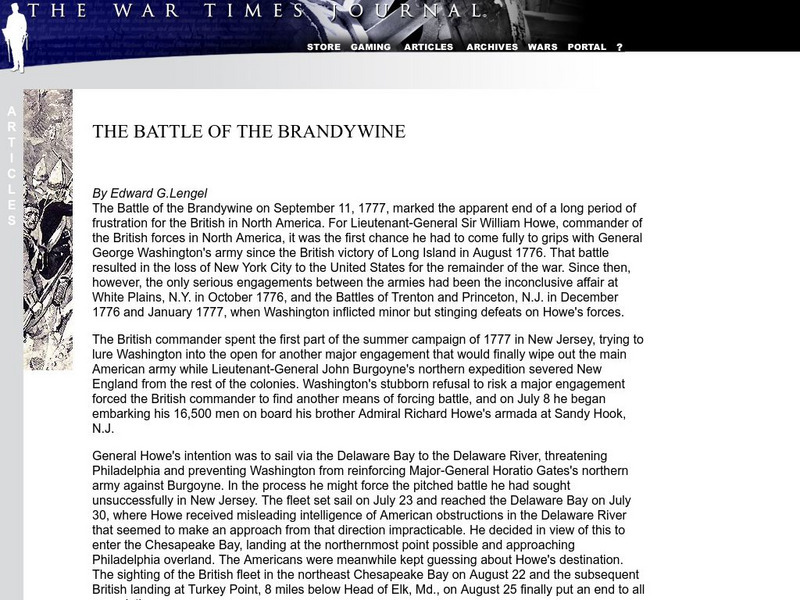
War Times Journal: The Battle of the Brandywine
A detailed article on the Battle of the Brandywine on September 11, 1777, that describes the military strategy and players in both the British and American armies. Be sure to click on the map that shows how the troops were drawn up.

Digital History
Digital History: Impact of the Revolution
These four Digital History excerpts from primary source documents attest to the impact the Revolutionary War did (and did not) have upon society and the status of and attitudes toward women and slaves in the newly established United States.
A&E Television
History.com: Continental Congress
From 1774 to 1789, the Continental Congress served as the government of the 13 American colonies and later the United States. The First Continental Congress, which was comprised of delegates from the colonies, met in 1774 in reaction to...
Other
Wpi Military Science/ Battle of Saratoga
Provides background information on the Battles of Saratoga with timeline of the military tactics employed in preparing for battle.
Other
Maps of the American Revolution
Although this is a "selling" site, it is a good resource that not only supplies images of maps of the times, but provides the background to the map - when it was published, what was going on at the time, etc.

Michigan State University
Michigan State University: American Revolution: Free Labor in the American Revolution
An essay on the make-up of the Continental Army. Soldiers came from the craftsman and laborer class. Read about the effect of their fight on the "American Revolution."

Houghton Mifflin Harcourt
Harcourt: Biographies: Paul Revere: (Spanish)
Paul Revere was a great patriot on horseback, but he did much more than that in the Revolutionary War. This resource uses popups for the photos. (In Spanish)
Michigan State University
Michigan State University: American Revolution: Patriotism/quaker Loyalism in a Pennsylvania Family
National Humanities Center provides an essay based on the correspondence of a Quaker Family in colonial Pennsylvania.
A&E Television
History.com: The Mariel Boatlift: How Cold War Politics Drove Thousands of Cubans to Florida in 1980
After Fidel Castro loosened emigration policies, some 125,000 Cubans landed on U.S. shores over a span of five months. The Mariel Boatlift of 1980 was a mass emigration of Cubans to the United States. The exodus was driven by a stagnant...

Library of Congress
Loc: American Revolution and Its Era: Maps & Charts
A few maps and some good text on the topography and its importance during both the American Revolution and the French and Indian War.
US Department of State
U.s. Dept of State: Human Rights Report on Colombia
The U.S State Department report for human rights issues in the country of Colombia, issued February 25, 2004.
Other
Worcester Polytechnic Institute: Military Science: Battle of Monmouth
This page begins with a summary of the history behind the battle and goes on to discuss key events in detail with links to maps and leaders in the war along with the military strategy involved.
US National Archives
Nara: Prologue Magazine: Women and Naturalization
A lengthy essay on George Washington proposing that his real accomplishments as first President of the U.S. and winner of the Revolutionary War have been overshadowed by the myths and stories of the Cherry Tree, teeth, and no lies....

Ducksters
Ducksters: American Revolution for Kids: Battle of Bunker Hill
Explore the Battle of Bunker Hill a major battle of the American Revolutionary War on this site.
Other
Schiller Institute: George Rogers Clark Captures Vincennes
Read an account of George Rogers Clark's campaign to capture Vincennes. Find out about the places he captured on his way to Vincennes, and the surrender of Col. Henry Hamilton.
University of New Brunswick (Canada)
Historical Context: American Revolution
This resource summarizes American-British military conflict during the late 18th century including Richard Montgomery and Benedict Arnold's attempt at converging on Quebec City and holding the city under siege.
Colonial Williamsburg Foundation
Colonial Williamsburg: Religion and Revolution
This essay discusses colonists who questioned the "Anglican establishment." It then explains how religion was used to convince colonists to support the war.