Hi, what do you want to do?






Better Lesson
Better Lesson: Writing an Opinion in Response to the Story
Students need to have lots of opportunities to share their opinions based on text. In this lesson, the teacher will read the story, Jack and the Beanstalk, multiple times before the students create their opinion. The detailed process of...
Better Lesson
Better Lesson: Introduction to Opinion Writing
Students' opinions are a crucial step in the foundation of good writing. After reading 'I will Never Not Ever Eat a Tomato', students will state their own opinion about a topic through writing.
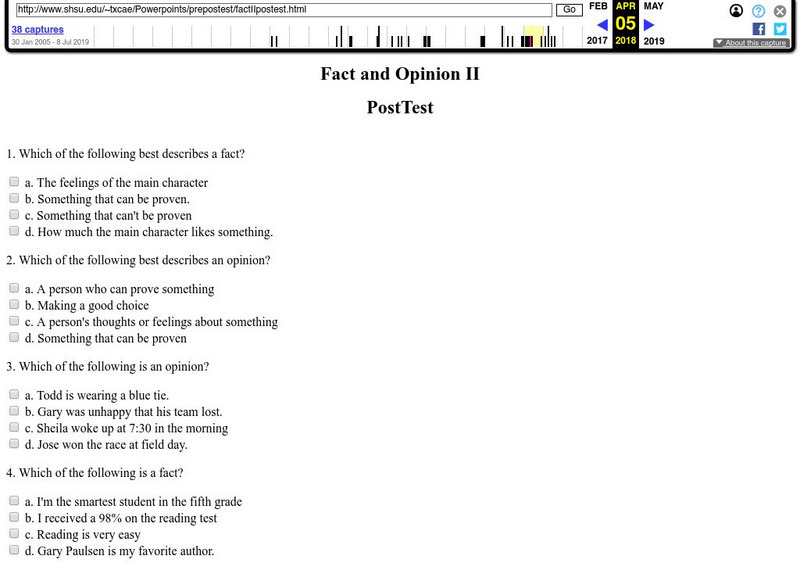
Sam Houston State University
Sam Houston State University: Fact and Opinion Ii Post Test
Students choose the fact and opinion statements in four multiple choice questions and then read two short texts and answer two multiple choice questions about facts and opinions presented in each. Answers are available when exercise is...
European Union
European Commission: Public Opinion Analysis
Interesting resource into the opinions of Europeans on 21st-century issues. View survey results over a 30 year period. Some surveys require the viewer to download them.
E Reading Worksheets
E Reading Worksheets: Fact and Opinion Lessons
In this learning module, students will learn more about the differences between facts and opinions. A PowerPoint presentation and related activity are provided to reinforce the topic of facts vs. opinions. This module is designed to...
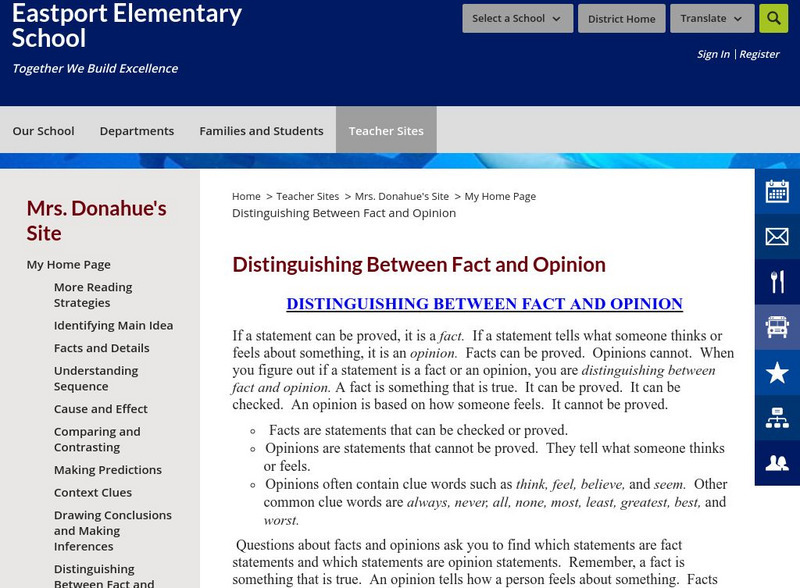
Other
Eastport Elem. Sc.: Mrs. Donahue's Site: Distinguishing Between Fact and Opinion
This is a teacher resource for students that focuses on how to separate fact from opinion. Includes questions to ask about a piece of text, examples, and links to online exercises to try.

Alabama Learning Exchange
Alex: The Bombing of Hiroshima Fact or Opinion
Eleventh graders will read "A Noiseless Flash" from Hiroshima, written by John Hersey with a partner and record facts (objective reporting) and opinions (subjective reporting) as given in the reading selection.
Other
Grade 1 Informative Writing Lessons
Authored by the Tsehai Russell and Della Wright, CLR fellows, this resource provides a 5-day unit of informative writing lessons. Focus lessons related to facts and opinions and paragraph writing. This series is supported by the Academic...
Social Security Administration
Social Security Online: 1937 Supreme Court Opinions
An in-depth discussion on the constitutionality of the Social Security Act and the 1937 Supreme Court decisions that helped settle it.

Texas Education Agency
Texas Gateway: Democracy Project: Honk if You Agree
In this extensive lesson, students will learn to identify issues of importance, form their opinions, and support those opinions with evidence and reason. They will also learn how to state their feelings in a persuasive manner.
World Wide School
World Wide School: Etext of Sartor Resartus
This site provides the complete etext for Thomas Carlyle's story, Sartor Resartus: The Life and Opinions of Herr Teufelsdrockh.
C-SPAN
C Span Classroom: Teaching About Campaign Finance
Learning module teaches students how political candidates fund their campaigns. Through wathcing videos and reading related articles on money in politics, students will form their own opinion and participate in classroom deliberations on...
iCivics
I Civics: News Literacy
Use this library of mini-lessons to teach students to recognize high-standards journalism so they can make informed judgments about the information coming at them and to help them identify and deal with misinformation, bias, opinion, and...
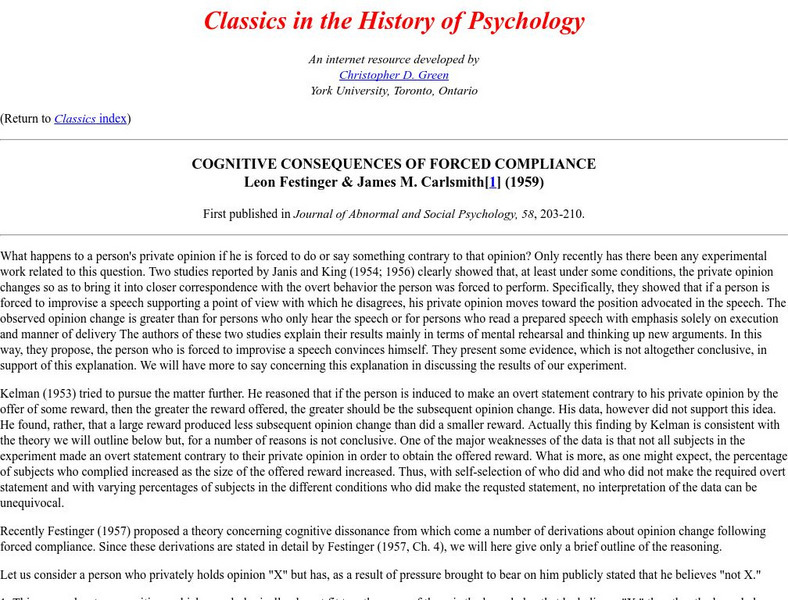
York University
Classics in History of Psychology: Cognitive Consequences of Forced Compliance
This page is a part of the Classics in the History of Psychology site. First published in 1959 this paper looks at what happens to a person's private opinion when he/she is forced to do or say something contrary to that opinion.
Digital History
Digital History: The War at Home
By the middle of the 1960s, American public opinion was beginning to favor US withdrawal from the Vietnam War. After the Tet Offensive in 1968 and Nixon's secret bombings of Cambodia, the majority of Americans were calling for complete...
Lumen Learning
Lumen: Boundless Communications: Contextual Factors to Consider
This instructional activity focuses on contextual factors to consider when analyzing your audience including physical contexts, values, beliefs, attitudes, and needs, audience opinion of you and your topic, and audience knowledge of your...

TED Talks
Ted: Ted Ed: How to Choose Your News
Damon Brown gives the inside scoop on how the opinions and facts (and sometimes non-facts) make their way into the news and how the smart reader can tell them apart. [4:48]

Pew Research Center
Pew Research Center: Global Indicators Database
About the Key Indicators Database: Pew Research Center conducts public opinion surveys around the world on a broad array of subjects ranging from people's assessments of their own lives to their views about the current state of the world...
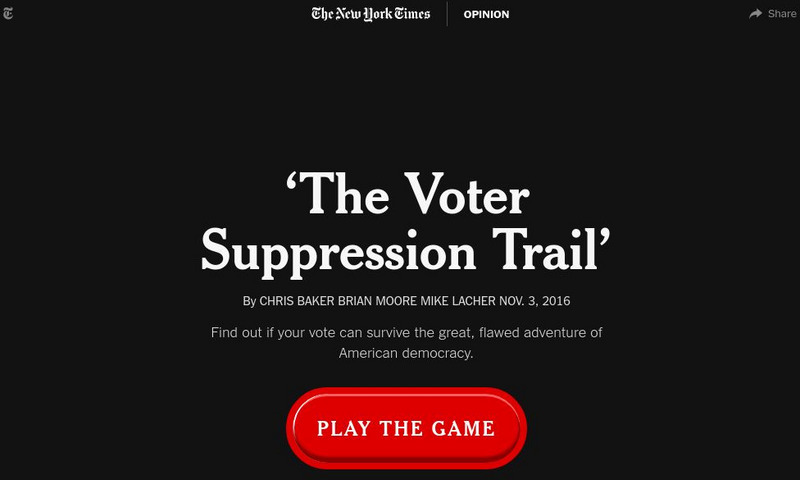
New York Times
New York Times: The Voter Suppression Trail
[Free Registration/Login Required] Great learning "game" to help people understand the difficulties many people face when they want to vote in the United States. Based on the infamous Oregon Trail video game, see if your selected person...
Woodrow Wilson International Center for Scholars
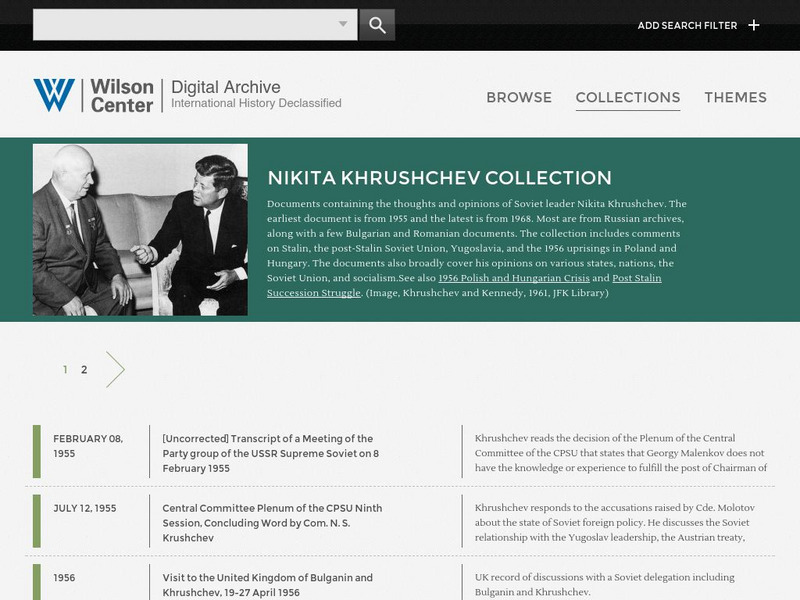
Woodrow Wilson Center: Digital Archive: Nikita Khrushchev Collection
Documents containing the thoughts and opinions of Soviet leader Nikita Khrushchev. Most are from Russian archives, along with a few Bulgarian and Romanian documents. The collection includes comments on Stalin, the post-Stalin Soviet...

University of Groningen
American History: Documents: The Marshall Cases:cherokee Nation v. Georgia
This resource presents the text of John Marshall's majority opinion in the Supreme Court case, Cherokee Nation v. Georgia.
PBS
Pbs Learning Media: Documenting Brown: Brown v Board of Education, 1954
The Supreme Court's landmark opinion overturned its earlier ruling in Plessy v. Ferguson and declared segregated schools unconstitutional.
PBS
Pbs Learning Media: Documenting Brown: Brown v Board of Education, 1955
The Supreme Court's opinion in Brown II reflects the struggle between federal and state governments on how and when school desegregation would occur.
Institute for Dynamic Educational Advancement
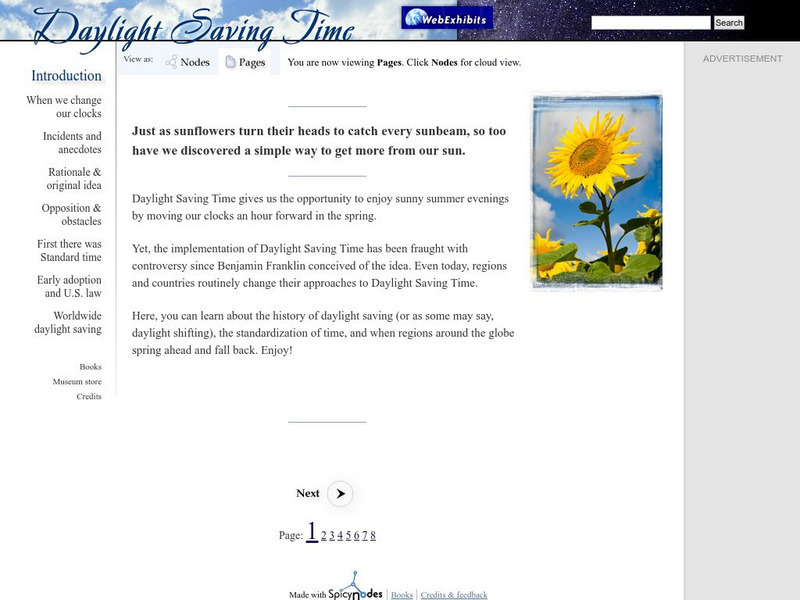
Web Exhibits: Daylight Saving Time
Why in the world do we turn our clocks forward in the Spring and back again in the Fall? Share with your students the rationale and history of the Daylight Saving Time concept from Benjamin Franklin through World War I and World War II...
Other popular searches
- Fact and Opinion
- Fact Opinion
- Fact Opinion Lesson Plans
- Fact or Opinion
- Fact vs. Opinion
- Fact and Opinion Passages
- Fact Opinion Worksheet
- Fact and Opinion Lessons
- Opinion Writing
- Teaching Fact vs. Opinion
- Fact vs Opinion
- Fact and Opinion Worksheets