Hi, what do you want to do?





American Association of Physics Teachers
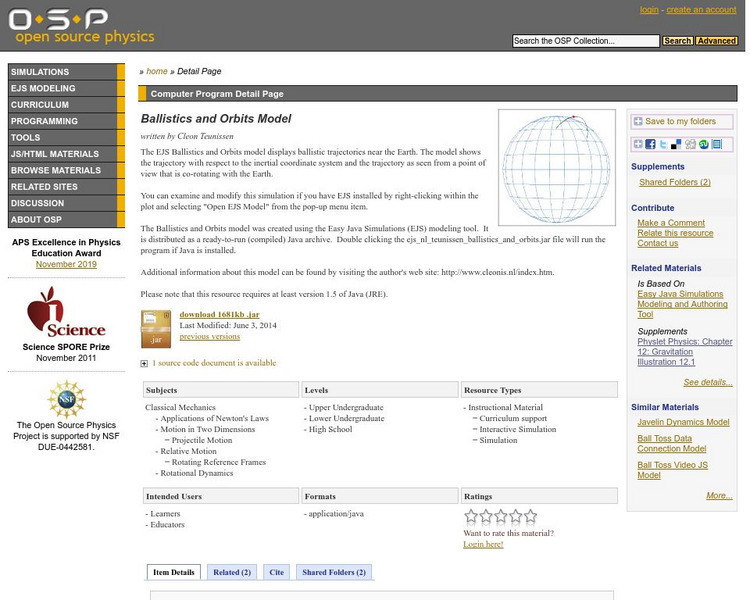
Com Padre Digital Library: Open Source Physics: Ballistics and Orbits Model
Experience a simulation of ballistic trajectories in relationship to Earth's orbit. Java 1.5 or more recent is required.
Harvard University
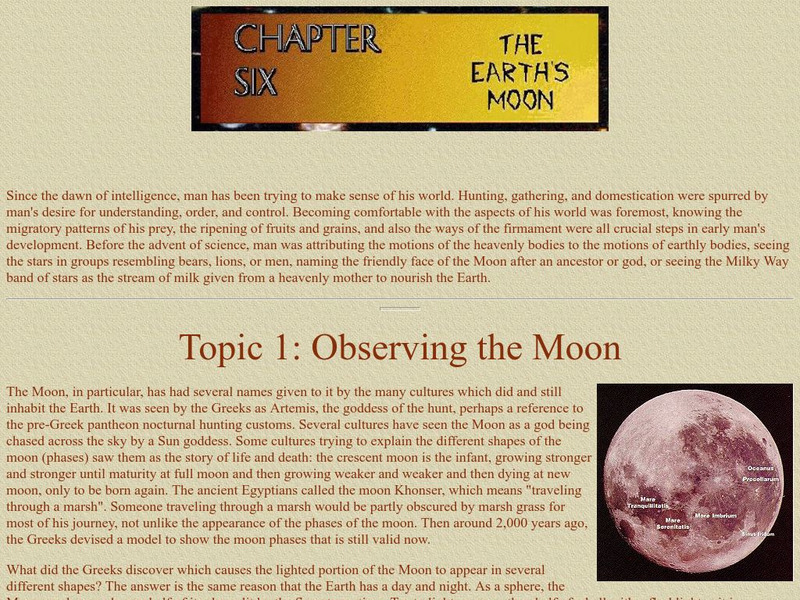
Harvard University: Eyes on the Sky, Feet on the Ground: The Earth's Moon
In this online textbook, students explore the phases of the moon, the moon's orbit, the origin of the moon, and the tides. Includes numerous inquiry-based activities.

E-learning for Kids
E Learning for Kids: Egypt: How Do the Sun, Moon and Earth Revolve Around Each Other?
Omar helps his parents sell things at the market. Join him while he learns about the relationship of the Sun, Moon, and Earth.

Other
Astro Methods: Earth's Nutation Visualized
Nutation is a small cyclical motion superimposed upon the steady 26,000-year precession of the Earth's axis of rotation. It is mainly caused by the gravitational effect of the 18.6-year rotation period of the Moon's orbit. The main...
NOAA
Noaa: Paleoclimatology Program: Astronomical Theory of Climate Change
Use this site to learn how the Earth's not-so-circular orbit around the sun has affected our climate over thousands of years, and continues to affect our climate now.
Extreme Science
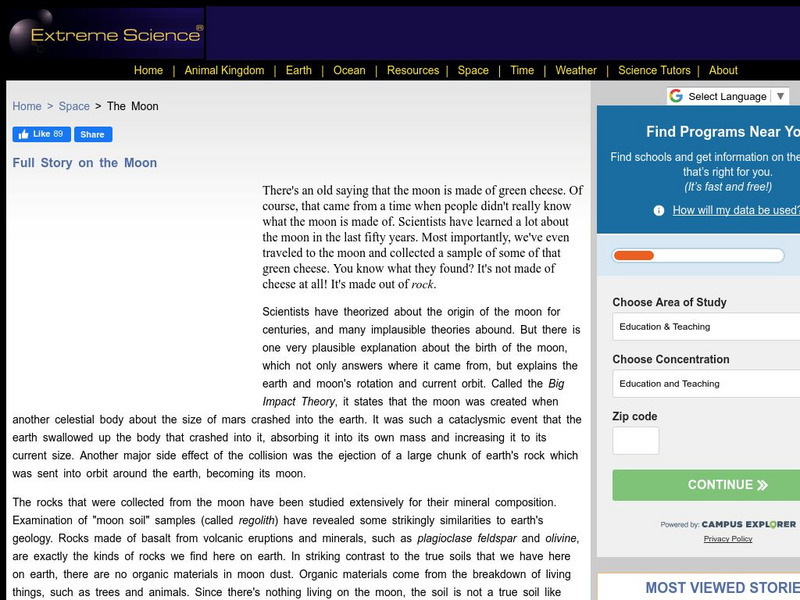
Extreme Science: The Moon
Read about the birth of Earth's moon, its composition, orbit, visible phases, and other interesting facts. Link to a virtual moon phase interactive which shows the current lunar phase and the phase on any date in the past or future.

PBS
Pbs Learning Media: Satellite Motion
Explore the motion of a satellite as it orbits the earth in this interactive simulation.
Physics Classroom
The Physics Classroom: Circular and Satellite Motion: The Inverse Square Law
Through illustrated examples and interactive practice, students explore Newton's ability to relate the cause for heavenly motion (the orbit of the moon about the earth) to the cause for Earthly motion (the falling of an apple to the...
Science Struck
Science Struck: Facts About the Atmosphere Layers
Provides information about the five layers of Earth's atmosphere. Also discusses the satellites that orbit the Earth in the atmosphere.

TED Talks
Ted: Ted Ed: Will Future Spacecraft Fit in Our Pockets?
When you picture a rocket, you might imagine a giant ship carrying lots of fuel, people and supplies. But what if the next wave of spacecraft were small enough to fit into our pockets? Dhonam Pemba details the future of microspacecraft,...

Ducksters
Ducksters: Astronomy for Kids: The Planet Earth
This site is astronomy for kids and teachers! Here students can learn about the planet Earth of the Solar System including fun facts, mass, day, year, and distance from the Sun.
NASA
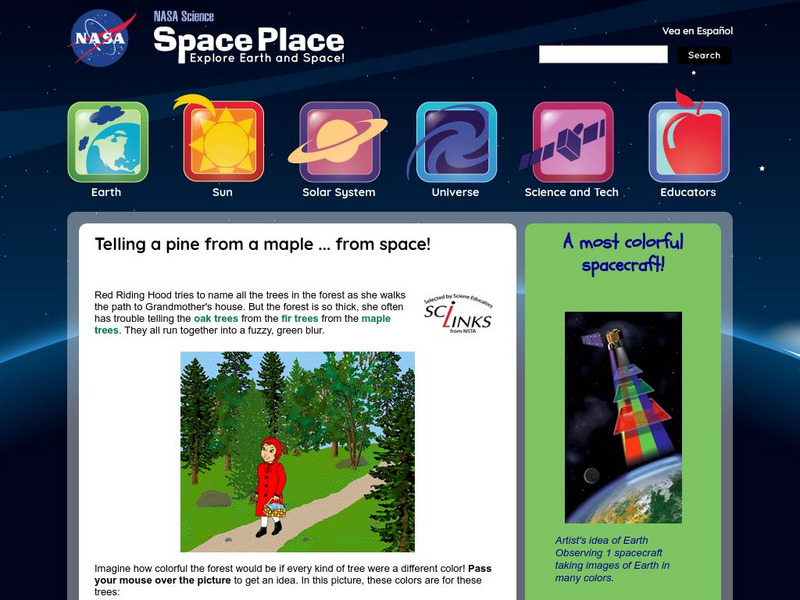
Nasa: The Space Place: Sorting Out Trees in the Forest
This site from the National Aeronautics and Space Administration provides fun information on the subject. "people can do their jobs even better if they have very accurate images of the ground. Oddly enough, the best way to see lots of...
Illustrative Mathematics
Illustrative Mathematics: G Mg Satellite
This task models a satellite orbiting the Earth in communication with two control stations located miles apart on Earth's surface. Students determine distances between various locations and, given a rate of travel, they determine the...
Rice University
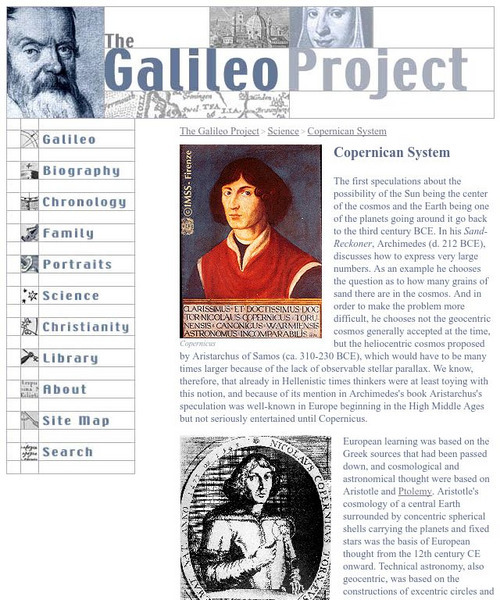
Galileo Project: The Copernican System
This site from The Galileo Project of Rice University contains information relating to Copernicus's sun-centered solar system theory. Pictures are provided throughout this article along with links to additional information.
McREL International
Mc Rel: Earth's Axis [Pdf]
A worksheet regarding the path of the Sun around the Earth and the Earth's tilt on its axis.
Other
Center for Science Education: Eye on the Sky: Motion of the Sun and Earth
Students model the interaction of the earth and the sun. The activity is designed for the playground. You will need chalk, but all the other worksheets are provided.
NASA
Nasa: Heliophysics: New Science of the Sun Solar System Connection
This site from NASA lists common and uncommon misconceptions about Sun-Earth Science. Site also provides links to activities and lesson plans as well as background reading.
Science and Mathematics Initiative for Learning Enhancement (SMILE)
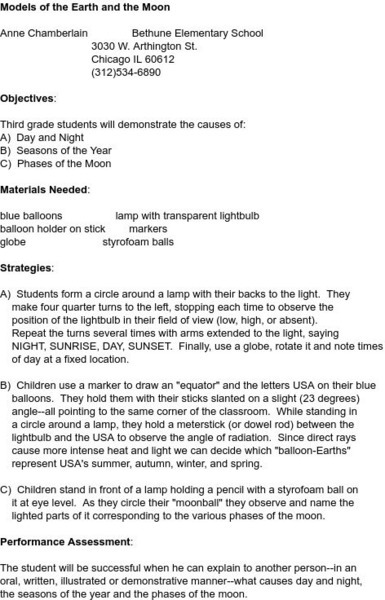
Smile: Models of the Earth and Moon
This lesson plan from the Illinois Institute of Technology demonstrates the causes of; day and night, seasons, and phases of the moon.With a few items, you help the elementary student discover why these phenomena occur.
NASA
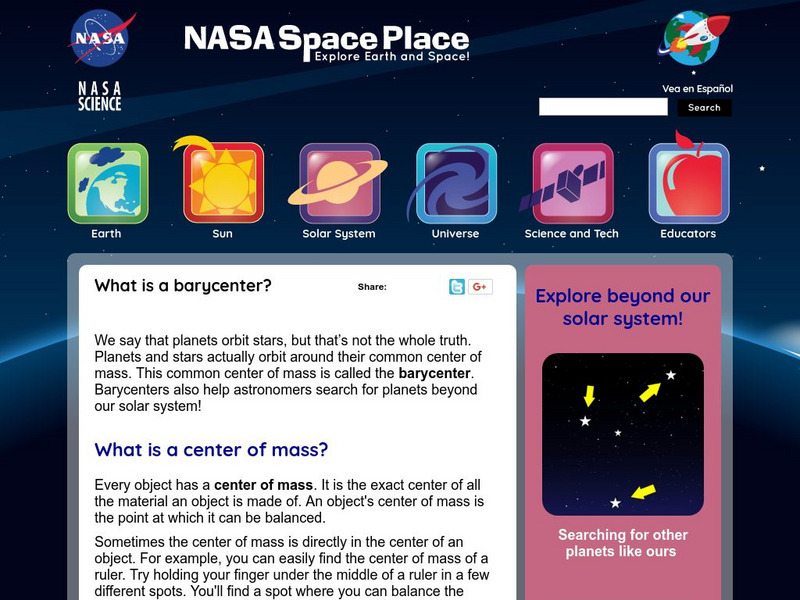
Nasa: The Space Place: What's a Barycenter?
This site from NASA helps in explaining a barycenter. "In the case of the Earth and the Sun, both bodies actually revolve, or spin, around the center of the mass between them. This point is called the barycenter."
Globio
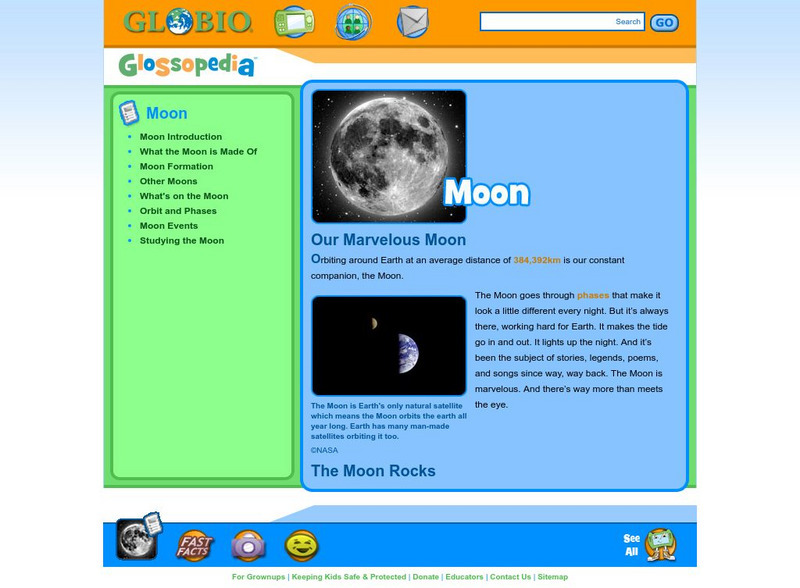
Glossopedia: Moon
Orbiting around Earth at an average distance of 384,392km is our constant companion, the Moon. This and a great deal more can be learned about our closest neighbor in this article by GLOBIO
NASA
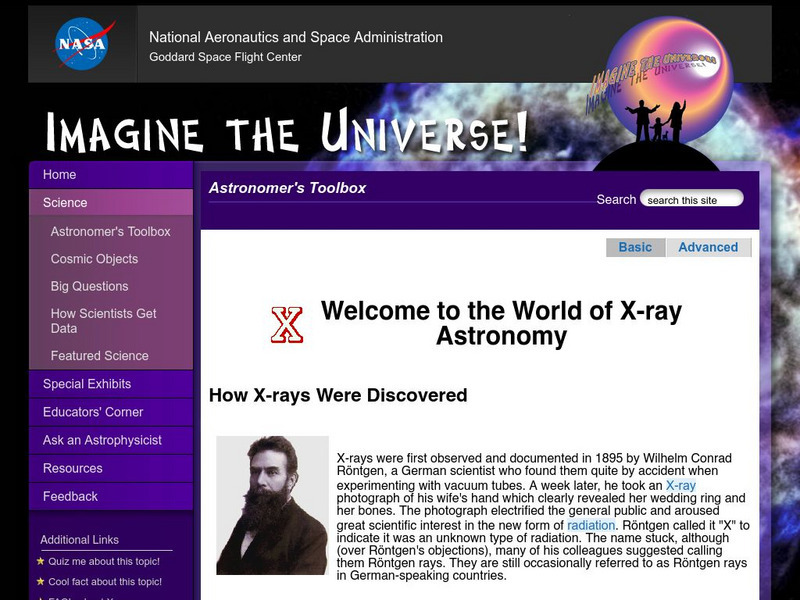
Nasa: Imagine the Universe: Welcome to the World of X Ray Astronomy
Site recounts how X-rays were discovered as well as who discovered them. Offers graphics, links to facts on this topic, a quiz, and teacher resources.
Utah Education Network
Uen: Trb 3:1: Investigation 4: Day and Night
A lesson for third graders in which they learn about the rotation of the Earth on its axis and how this movement creates day and night. They also examine the orbit of the moon about the Earth and the Earth's orbit around the sun.
Fourmilab Switzerland
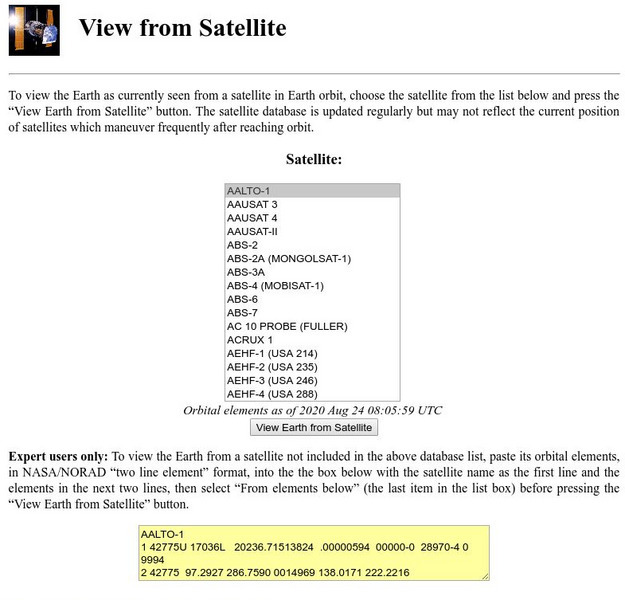
John Walker: View From Satellite
View images of the Earth taken by various satellites that are orbiting the Earth.

National Earth Science Teachers Association
Windows to the Universe: Junk in Space
Did you know that International Space Station used to release its trash into space? There is a lot of junk orbiting around Earth! In this game, you are asked to capture eleven examples of the junk that is floating in space but be careful...