Hi, what do you want to do?





MadSci Network
Mad Scientist: Why High Tide Away From the Moon or Sun?
An excellent and thorough answer to the often asked question about high tide "bulges" on the side of Earth facing away from the Moon or Sun.
Other
Spl Swiss Propulsion Laboratory
The Swiss Propulsion Laboratory is a non-profit organization whose primary goal is the development of means of lifting civilian payloads into low-earth orbit at reasonable prices.

TED Talks
Ted: Ted Ed: Reasons for the Seasons
Why do some regions experience full-time heat while others are reckoning with frigid temperatures and snow? And why are the seasons reversed in the two hemispheres? Rebecca Kaplan explains how the shape of the Earth's orbit around the...
Harvard University
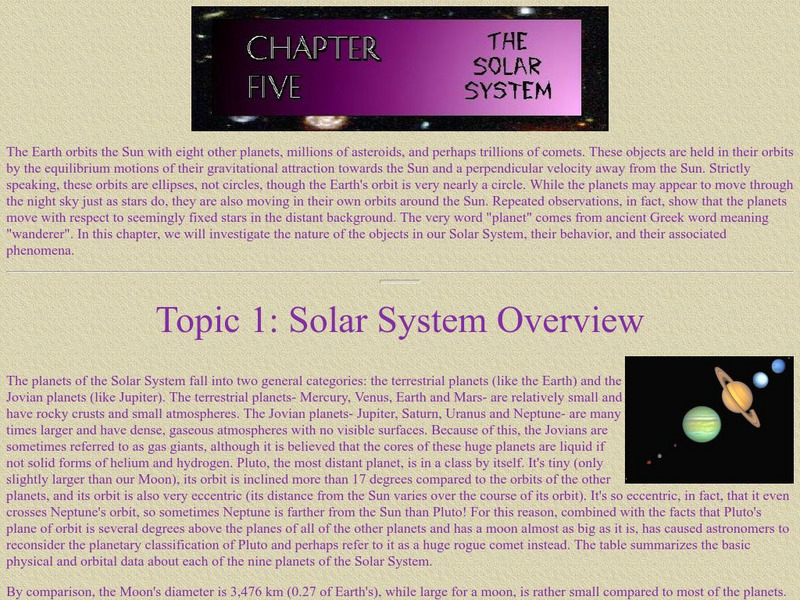
Harvard University: The Solar System
These hands-on activities are a great way for students to gain perspective on the relative sizes and distances of each planet, the relationship between the sun and Earth, and much more.
American Geosciences Institute
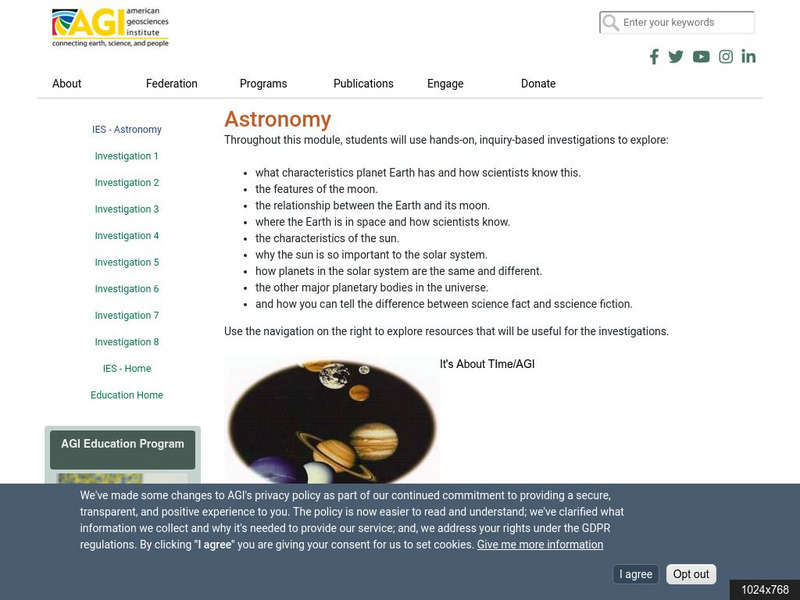
American Geosciences Institute: Astronomy
Eight hands-on lessons module in which students explore the characteristics of planet Earth, its moons, the sun, the solar system, planets, and the difference between science fact and science fiction.
NASA
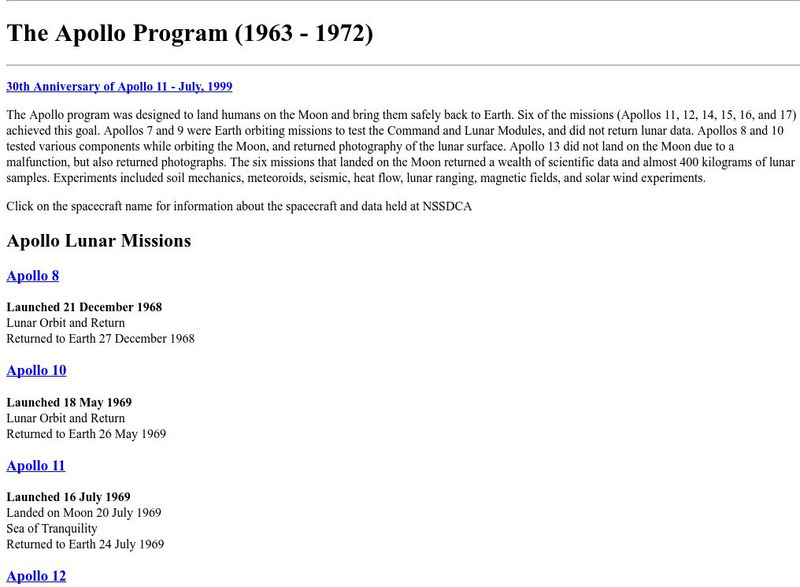
Nasa Space Science Data Archive: Apollo Program
This is an extensive online review of the 17 Apollo missions. Resources are organized by mission number and include descriptions, mission details, photographs, and scientific data sets.

NASA
Nasa Star Child: The Space Shuttle (Level 1)
This site provides a short description of the space shuttle and what it is used for, with diagrams and one quiz question.

Annenberg Foundation
Annenberg Learner: Moon Journal Activity
Students use the process of journaling to make discoveries about the moon. This activity involves having students write observations about the moon in a journal. Using their observations they go to an online resource and choose...
Science Museum, London
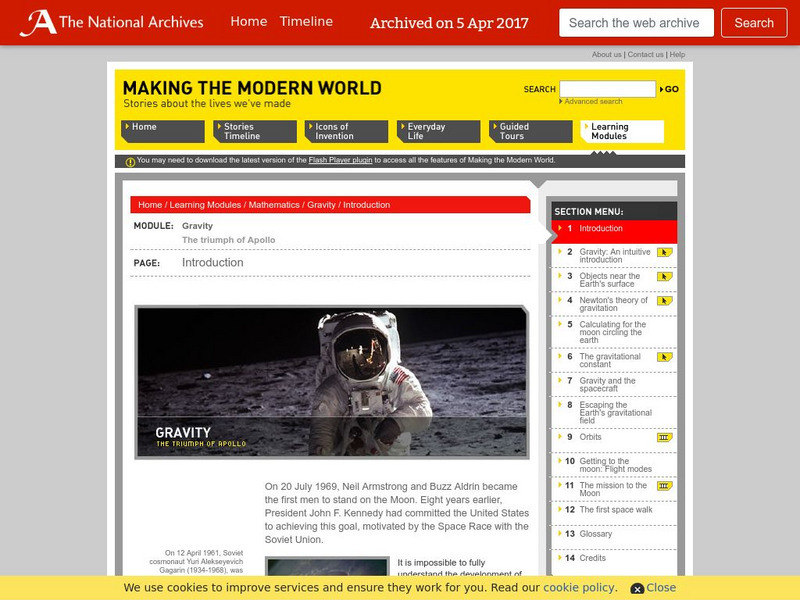
Making the Modern World: Gravity
The learning module helps students gain a deeper understanding of gravity. Some topics explored are orbits, the mission to the Moon, and the first space walk. Activities and videos are included.
Science Buddies
Science Buddies: Tracking Geomagnetic Storms in the Ionosphere
The Sun is the ultimate source of the energy that powers weather systems on Earth. Geomagnetic storms are sun-powered storms in the upper atmosphere, arising from energized particles that are periodically ejected by the Sun. Among other...

TeachEngineering
Teach Engineering: Plot Your Course Navigation
In this unit, students learn the very basics of navigation, including the different kinds of navigation and their purpose. The concepts of relative and absolute location, latitude, longitude and cardinal directions are discussed, as well...
Harvard University
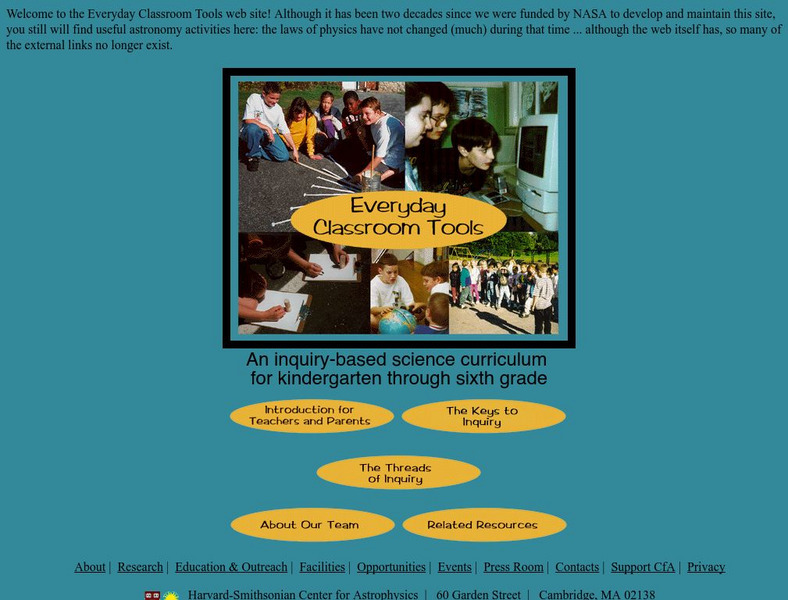
Harvard Smithsonian: Everyday Classroom Tools
The focus of this series of lessons is to engage students in an exploration of the world around them. The emphasis is on inquiry as students learn about the earth, sun, light, shapes and more.
PBS
Pbs Learning Media: All Planet Sizes
This illustration from the Lunar and Planetary Laboratory shows the approximate sizes of the planets relative to each other. Note that the planets are not shown at appropriate distances from the Sun.

American Association of Physics Teachers
Com Padre Digital Library: Open Source Physics: Newton's Mountain Model
A science simulation launches a projectile from the top of a mountain testing Newton's theory introduced in Principia.
NASA
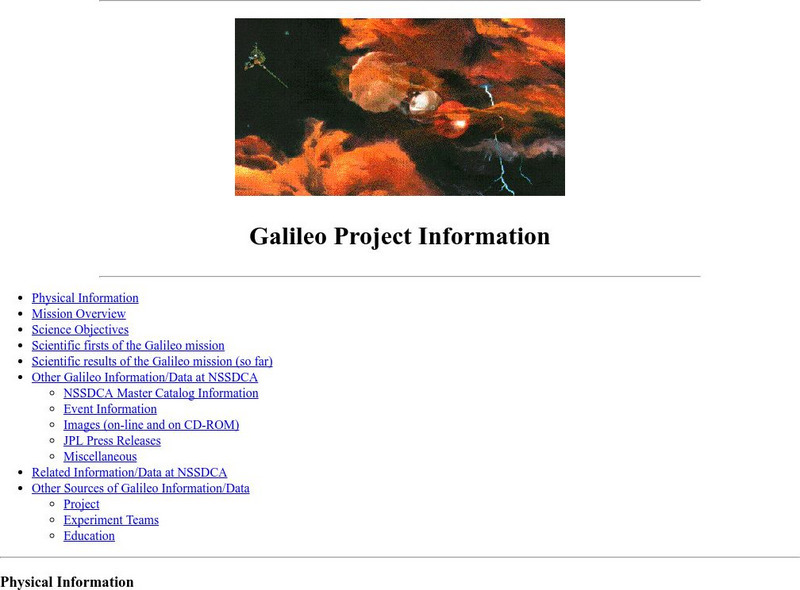
Nasa Space Science Data Archive: Galileo Project Information
This is the homepage of all of the archived information about and from the Galileo Mission. Included is data from the flybys of Venus, Earth, Moon, and Asteroids Gaspra and Ida, as well as the current data from Jupiter and its moons. See...
Other
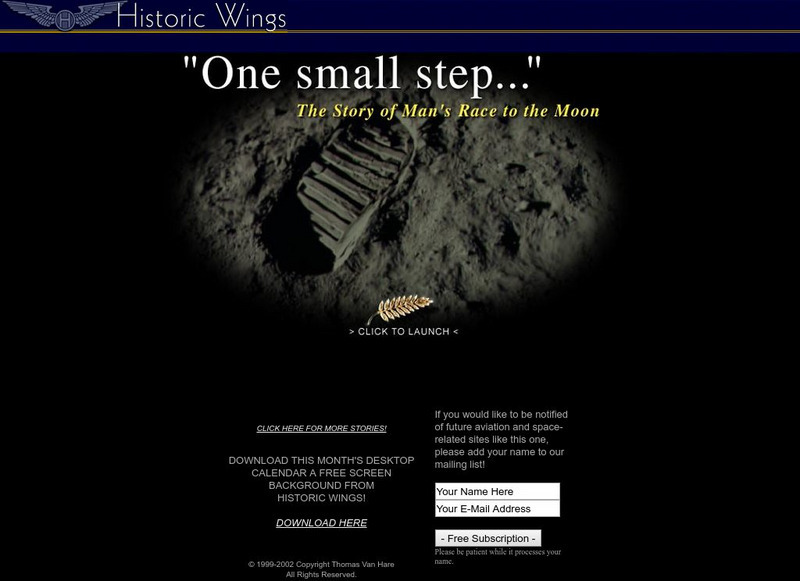
Historic Wings: "One Small Step" Race to the Moon
"One Small Step, The Race To The Moon" is a clear presentation of the story of the Moon landing program that the United States conducted during the 1960's and early 1970's. After launching the presentation click on the phases of the Moon...
University of Texas at Austin
Ut Austin Center for Space Research
The homepage of the Center for Space Research at the University of Texas whose mission is "to conduct research in orbit determination, space geodesy, the Earth and its environment, exporation of the solar system, as well as expanding the...
Physics Classroom
The Physics Classroom: The Apple, the Moon, and the Inverse Square Law
Describes the logic behind the development of Newton's law of universal gravitation. Beginning with Johannes Kepler and his three laws of planetary motion, content walks the reader through Newton's thought process and development of this...

National High Magnetic Field Laboratory
Magnet Academy: Oersted Satellite, 1999
Named in honor of Danish physicist Hans Christian Oersted, Denmark's first satellite has been observing and mapping the magnetic field of the Earth.
Curated OER
Nasa: Space Place: Astronaut in Earth's Orbit
Picture of the Earth with an astronaut flying around in orbit.
Kidport
Kidport: The Space Shuttle
Students can see actual photos of a space shuttle launching from earth as well as the people who now could go because of technology. Learn about some of the equipment and vehicles used to make it happen.
Kidport
Kidport: The Moon Landing
Travel back in history and see the first men on the moon. See photos of the crew, the launch, the landing and more.
Other
Bad Astronomy/phil Plait: Tides and Why Our Days Are Getting Longer
Why does the Moon always shows the same face to the Earth? Why is the Moon's rotation period the same as the length of time it takes to orbit the Earth? Why are there two tides a day? These questions and more are answered here.

Society for Science and the Public
Science News for Students: Small but Wise
Describes the WISE Project, which has an infrared telescope orbiting the Earth taking photographs of never before seen areas of space.