Hi, what do you want to do?






CK-12 Foundation
Ck 12: Plix: Orbital Motion: Distance
[Free Registration/Login Required] The meteor is orbiting one of the 3 planets in a circular orbit. Drag the point associated with each planet to the meteor to see its orbit around that planet.

Physics Aviary
Physics Aviary: Practice Problems: Orbital Motion of a Satellite
Students must calculate the period of a satellite moving around one of the bodies in our solar system.
Physics Aviary
Physics Aviary: Practice Problems: Orbital Motion of a Synchronous Satellite
Students must calculate the altitude of a satellite that is in a geosynchronous satellite going around the planet.
Physics Aviary
Physics Aviary: Practice Problems: Finding Mass of a Planet
Students must determine mass of a planet based on the orbital motion of a satellite around the planet.

University of Colorado
University of Colorado: Ph Et Interactive Simulations: Gravity and Orbits
An interactive simulation that teaches about gravitational force, circular motion, and astronomy by manipulating the sun, earth, moon, and a space station to observe the effects of gravity and orbital paths. This simulation can either be...
Massachusetts Institute of Technology
Mit: Open Course Ware: Orbits of Planets and Satellites
Students explore orbits of planets and satellites. Some topics examined in the activities are planetary motion, angular momentum of orbits, and Kepler's laws. The resource consists of video clips, lecture notes, practice problems, and...
Physics Classroom
The Physics Classroom: Circular and Satellite Motion: Principles for Satellites
Students explore how a satellite's motion is governed by the same physics principles and described by the same mathematical equations.
Physics Classroom
The Physics Classroom: Circular Motion Principles for Satellites
From The Physics Classroom. Uses easy- to-understand language to discuss how circular motion principles apply to the motion of satellites. Describes the tangential velocity and centripetal acceleration of a satellite. Includes many...
Physics Classroom
The Physics Classroom: Mathematics of Satellite Motion
The mathematics associated with the motion of satellites is described. Equations (for period, velocity, acceleration and force) are stated, symbols described, and sample problems solved. Includes five practice problems with solutions and...
American Association of Physics Teachers
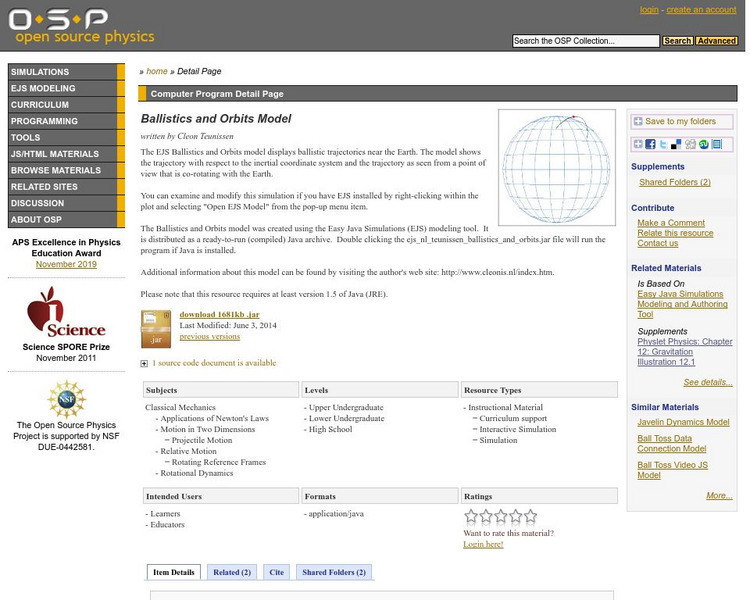
Com Padre Digital Library: Open Source Physics: Ballistics and Orbits Model
Experience a simulation of ballistic trajectories in relationship to Earth's orbit. Java 1.5 or more recent is required.
Illustrative Mathematics
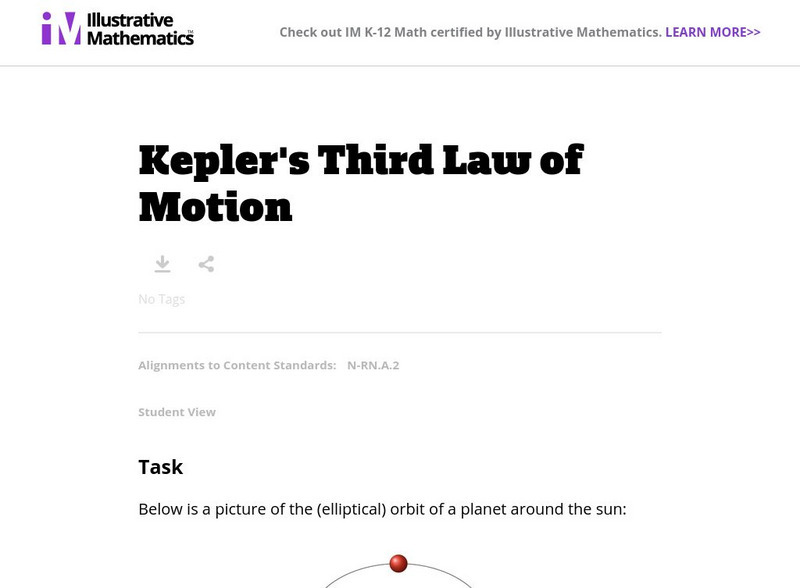
Illustrative Mathematics: N rn.a.2: Kepler's Third Law of Motion
The purpose of this task is to solve some expressions requiring fractional exponents in the modeling context of planetary motion. Aligns with N-RN.A.2.
Texas Instruments
Texas Instruments: Multiple Choice Planetary Motion Study Cards
Kepler's Laws 1,2,3 including eccentricity of elliptical orbits. Good for reviewing planetary motions (NYS Earth Science).
PBS
Pbs Learning Media: Earth in Motion: Seasons
This interactive activity from the Adler Planetarium explains the "reasons for the seasons." Featured is a game in which Earth must be properly placed in its orbit in order to send Max, the host, to different parts of the world during...
Physics Classroom
The Physics Classroom: Circular and Satellite Motion: Satellite Motion Math
In this interactive physics tutorial, students explore the variety of mathematical equations that describe the motion of satellites.
PBS
Pbs Learning Media: Satellite Motion
Explore the motion of a satellite as it orbits the earth in this interactive simulation.

NASA
Nasa: Kepler and His Laws
This site from NASA provides biographical details about the lives of Tycho Brahe and Johannes Kepler. Discusses Kepler's successes at developing laws of planeatry motion. States the three laws and discusses each one individually....

University of St. Andrews (UK)
University of St. Andrews: Orbits and Gravitation
A page describing the physics, mathematics, and historical figures associated with planetary motion, satellite motion, and universal gravitation.
Georgia State University
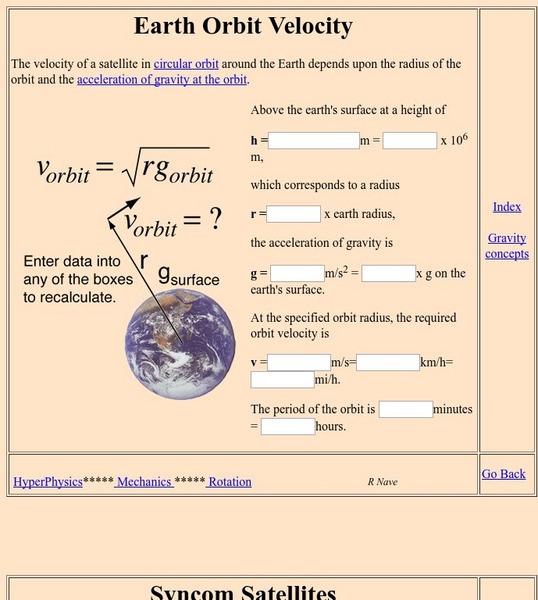
Georgia State University: Hyper Physics: Earth Orbit Velocity
A discussion and statement of an equation for orbital speed. An interactive JavaScript form allows the user to investigate the relationship between orbital height and orbital speed. A very good opportunity to practice and receive...
CK-12 Foundation
Ck 12: Fifth Grade Science: Earth Science: Earth's Motion in Space
[Free Registration/Login may be required to access all resource tools.] Discusses the motion of the Earth with its day and night cycle, the seasons, the Earth's orbit around the Sun, and its year-long cycle.
Harvard University
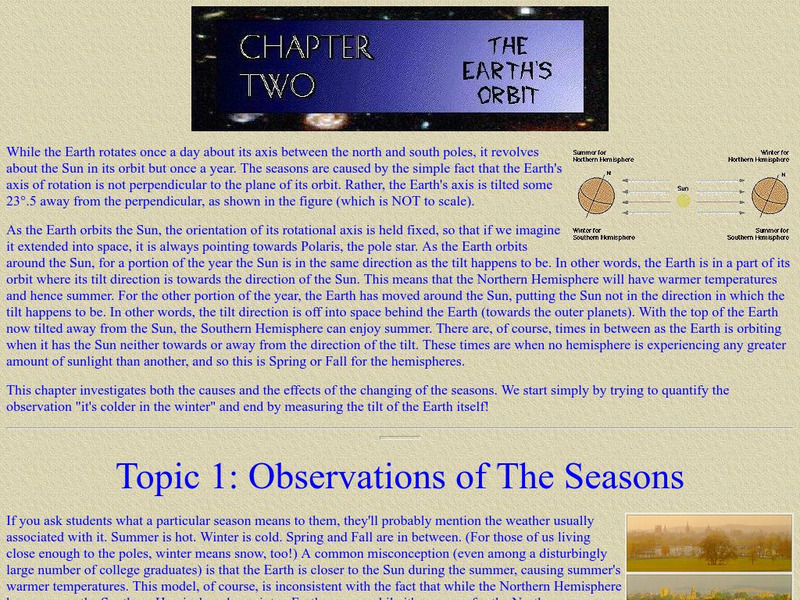
Eyes on the Sky, Feet on the Ground: The Earth's Orbit
Students perform many inquiry activities related to Earth's orbit. Included are recording daily temperatures, observing the sun's path over several weeks, tracking sunrise and sunset times, and angle of sunlight. Diagrams make lessons...
Physics Classroom
The Physics Classroom: Circular and Satellite Motion: Speed and Velocity
In this interactive module, describe and explain the motion of objects that either move in circles or can be approximated to be moving in circles. Kinematic concepts and motion principles will be applied to the motion of objects in...
Physics Classroom
The Physics Classroom: Circular and Satellite Motion: The Inverse Square Law
Through illustrated examples and interactive practice, students explore Newton's ability to relate the cause for heavenly motion (the orbit of the moon about the earth) to the cause for Earthly motion (the falling of an apple to the...
Georgia State University
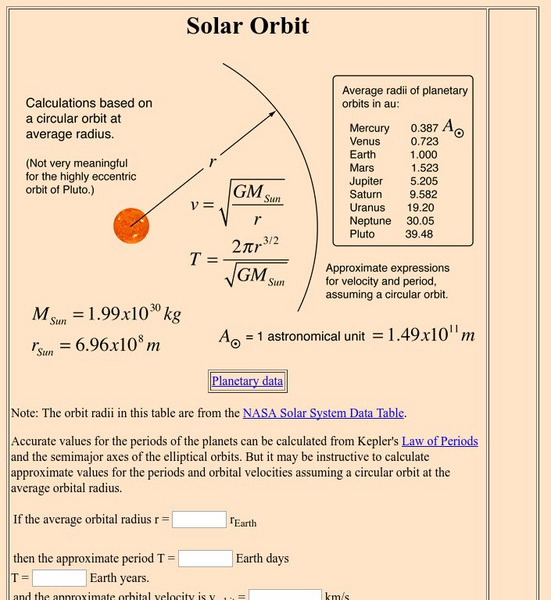
Georgia State University: Hyper Physics: Solar Orbit
A table listing the average radius of orbit for the nine planets about the sun; expressed in astronomical units. Data can be used to calculate the orbital speed or the orbital period.
Texas Education Agency
Texas Gateway: Satellites and Kepler's Laws: An Argument for Simplicity
By the end of this section, you will be able to state Kepler's laws of planetary motion, derive Kepler's third law for circular orbits, and discuss the Ptolemaic model of the universe.