Hi, what do you want to do?






CK-12 Foundation
Ck 12 Exploration Series: Simulations: Physics: Newton's Cannon
[Free Registration/Login Required] Learn about orbits and how an object can stay in orbit under the influence of gravity. By adjusting launch velocities users will understand how to successfully put a virtual satellite into orbit without...
Physics Aviary
Physics Aviary: Practice Problems: Jolly Gas Giant Problem
Students must calculate the mass of a planet based on the orbital motion of the moon going around the planet.
Texas Education Agency
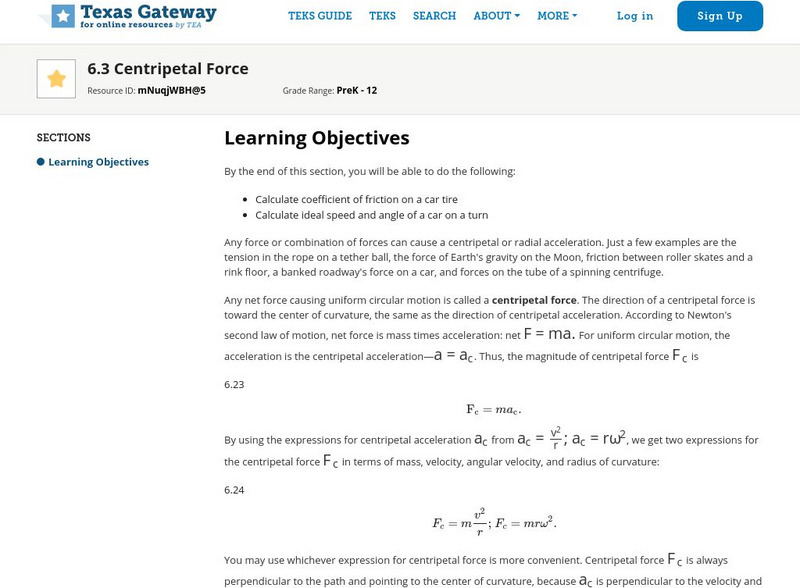
Texas Gateway: Uniform Circular Motion and Gravitation: Centripetal Forces
By the end of this section, you will be able to calculate coefficient of friction on a car tire and to calculate ideal speed and angle of a car on a turn.
NASA
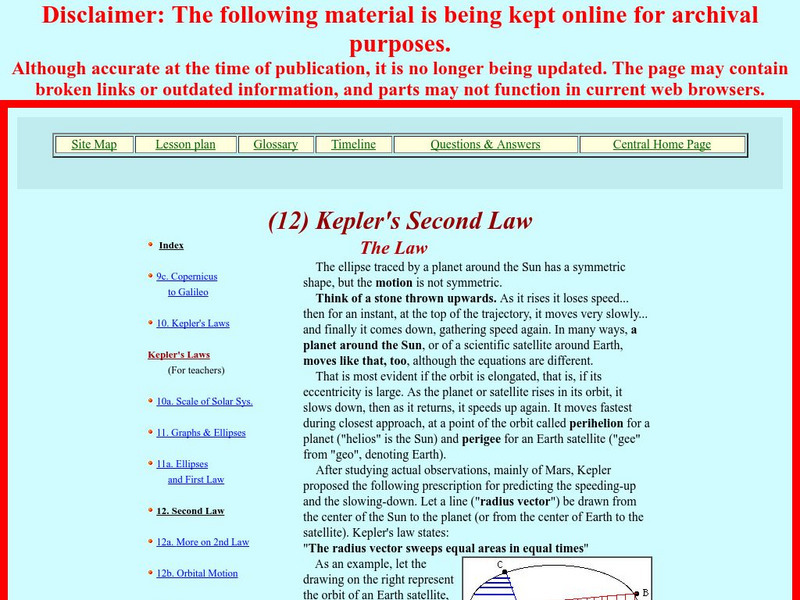
Nasa: Kepler's Second Law
This site from NASA states Kepler's second law of planetary motion and depicts its meaning with an informative diagram. Relates the law to conservation of energy principles and discusses the eccentricity of a satellite's (or a planet's)...
Physics Aviary
Physics Aviary: Practice Problems: Finding Speed of a Satellite
Students must determine speed of a satellite by timing the satellite for part of its orbit. Students must also determine the period of the orbit based on their timing.
CK-12 Foundation
Ck 12: Fifth Grade Science: Earth Science: Gravity
Do you know how gravity affects you? This module defines gravity and explains how gravity affects the motion of objects.
Physics Aviary
Physics Aviary: Satellite Lab
This lab is designed to allow students to explore different aspects of satellite motion. Students can vary the mass of the satellite, the orbital radius of the satellite and the body that the satellite is orbiting. Students can measure...
Physics Classroom
The Physics Classroom: Kepler's Three Laws
The three laws of planetary motion as described by Kepler are stated and elaborated upon. Useful graphics and an easy-to-understand language are used to explain the nature of planetary motion. Both conceptual and mathematical. Includes a...
Physics Classroom
The Physics Classroom: Circular and Satellite Motion: Weightlessness in Orbit
Through illustrated examples and practice problems, this interactive physics tutorial helps students clear up their possible misconceptions about weightlessness.
Physics Classroom
The Physics Classroom: Energy Relationships for Satellites
The orbits of satellites are described and an energy analysis is performed. Kinetic, potential and total mechanical energy are explained and applied to the motion of satellites.

Concord Consortium
Concord Consortium: Stem Resources: Launching a Satellite
Do you think you could fire an "unpowered" object into orbit? By controlling the angle and speed at which the satellite is launch, students will try to launch a satellite into space with this computer model. Activity includes questions...

Georgia State University
Georgia State University: Hyper Physics: Kepler's Laws
An outstanding page describing Kepler's three laws of planetary motion.
Curated OER
Cornell University: Orbital Motion and Kepler's Laws
At this site from Cornell University, Kepler's three laws of planetary motion are stated. There are brief explanations of each. The laws are applied to explain the features of planetary orbits as well as the motion of binary star...
Physics Classroom
The Physics Classroom: Circular and Satellite Motion: Energy in Satellites
Through interactive practice problems and illustrated examples, students explore energy relationships for satellites.
OpenStax
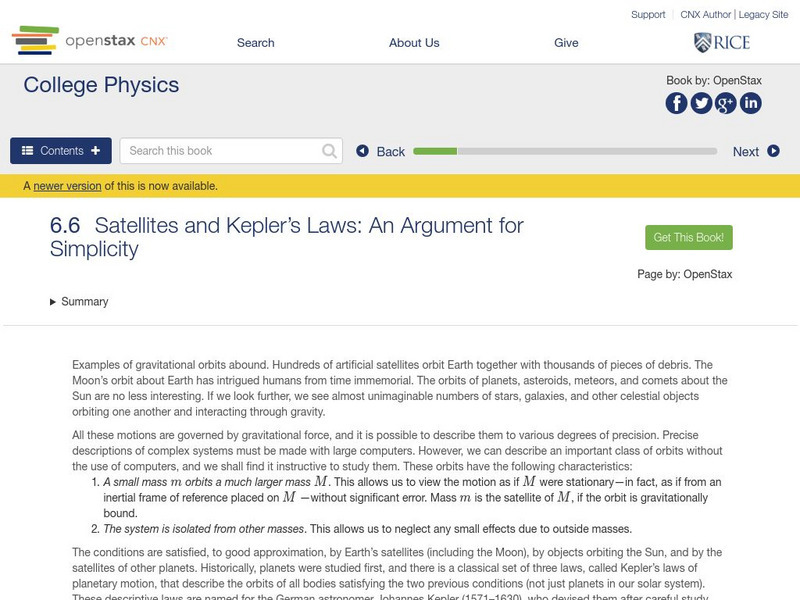
Open Stax: Satellites and Kepler's Laws: An Argument for Simplicity
In the following interactive students will begin to understand the laws of Kepler regarding planetary motion and derive the third law of Kepler for circular orbits. They will also discuss the Ptolemaic model of the universe.
Physics Classroom
The Physics Classroom: The Apple, the Moon, and the Inverse Square Law
Describes the logic behind the development of Newton's law of universal gravitation. Beginning with Johannes Kepler and his three laws of planetary motion, content walks the reader through Newton's thought process and development of this...
CK-12 Foundation
Ck 12 Exploration Series: Simulations: Physics: Journey to Mars
[Free Registration/Login Required] Learn about Kepler's Laws of motion by planning a trip to Mars using a Hohmann transfer orbit.
Utah Education Network
Uen: As the World Turns
Third graders use their bodies to act out the motions of earth.

Exploratorium
Exploratorium: Your Age on Other Worlds
How old would you be on Mars? Venus? Have fun plugging in your birthdate to see your age on other planets then read scroll down for a full explanation.
NASA
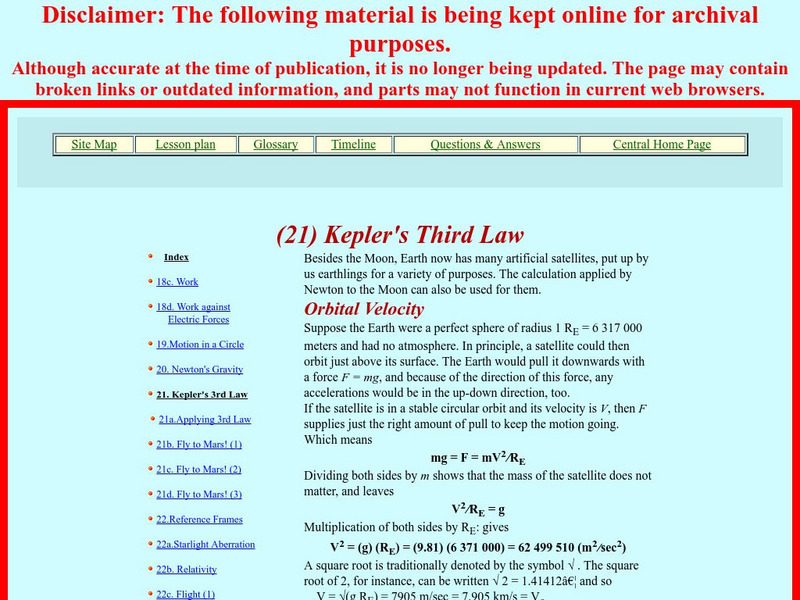
Nasa: Kepler's Third Law
This site from NASA states Kepler's third law of motion and extends it to develop an equation for the velocity of an orbiting planet.
Physics Classroom
The Physics Classroom: Kepler's Second Law
Kepler's second law of planetary motion is stated and explained. An animation of the orbit of a planet and an accompanying graphic assists in explaining the meaning of the law of equal areas.
Science and Mathematics Initiative for Learning Enhancement (SMILE)
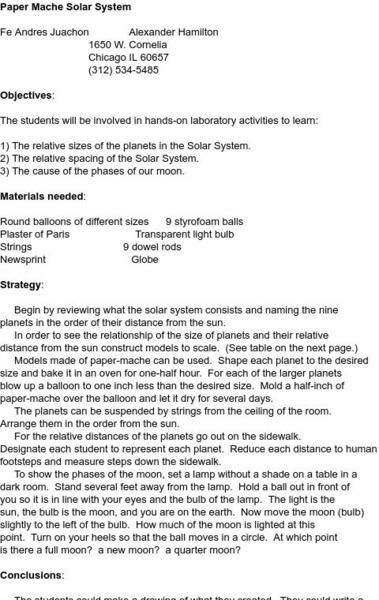
Smile: Paper Mache Solar System
This site from the Illinois Institute of Technology provides a set of directions for the creation of a solar system model out of paper mache. Includes orbital distances and planet diameters for the nine planets. Great idea for a student...
Massachusetts Institute of Technology
Mit: Open Course Ware: Courses: Physics: Classical Mechanics
College-level online course highlighting the study of classical mechanics. This course focuses on Newtonian mechanics, fluid mechanics, and kinetic gas theory. Course features include a 35 video lecture series by Walter Lewin. Also link...

American Association of Physics Teachers
Com Padre Digital Library: Open Source Physics: Newton's Mountain Model
A science simulation launches a projectile from the top of a mountain testing Newton's theory introduced in Principia.