Hi, what do you want to do?






Curated OER
GPS - The War Hero
Learners understand what the Global Positioning System (GPS) is and how it works. They discover the history of the development of GPS and how the military uses GPS. They realize why GPS was essential to the success of Operation Desert...

Curated OER
Planet Research
Students recognize that the other eight known planets, which revolve around the Sun, have characteristics and surface conditions that are different from Earth; and identify examples of those differences.

Curated OER
The Man Who Saw the Future: Arthur C. Clarke
Students are introduced to science fiction as an adjunct to learning about science. They tape into their creativity by combining science with aspects of the arts. They research real time data available on the Web about space, and Mars in...

Curated OER
Nature of Meteor Showers
Ninth graders describe, in general terms, the distribution of matter in space and
identify evidence for, and describe characteristics of, bodies that make up the solar system. They then investigate predictions about the motion,...

Curated OER
Cold War - The Space Race
In these Cold War worksheets, students read about the space race between the United States and Russia. Students also read about the first man on the moon and answer 8 questions about the texts.

Curated OER
Measuring the Speed of Light
Students explore physics by completing measurement problems in class. In this speed of light lesson, students discuss the importance of knowing the speed of light and how it affects many aspects of human life on Earth. Students identify...
NASA
Nasa: The Space Place: Orbits 'R' Us
Learn about how Earth orbits the sun and how satellites orbit the Earth. Discover the different types of satellites such as GOES and POES and what they are used to monitor.

Physics Classroom
The Physics Classroom: Satellite Motion
An animation depicting the path of projectiles launched at various launch speeds from the fictional Newton's Mountain. Accompanying text discusses satellite motion and the requirements of orbital motion. Links to further information is...
Physics Classroom
The Physics Classroom: Circular Motion Principles for Satellites
From The Physics Classroom. Uses easy- to-understand language to discuss how circular motion principles apply to the motion of satellites. Describes the tangential velocity and centripetal acceleration of a satellite. Includes many...
Illustrative Mathematics
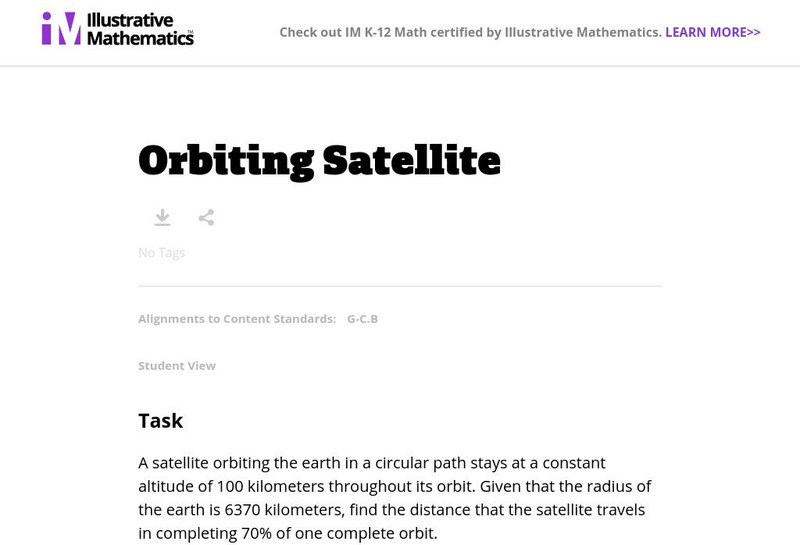
Illustrative Mathematics: G C Orbiting Satellite
A satellite is orbiting the Earth at a given height and students are asked to find the distance it travels to complete 70 percent of an orbit. This task provides a context for connecting an angle in radians to the arc length intercepted...
NASA
National Aeronautics and Space Administration: Scijinks: Satellites Technology
Describes satellites including what they are used for, important roles they play, how a weather satellite is built, and how a satellite stays in orbit using text and video of varying length.
Georgia State University
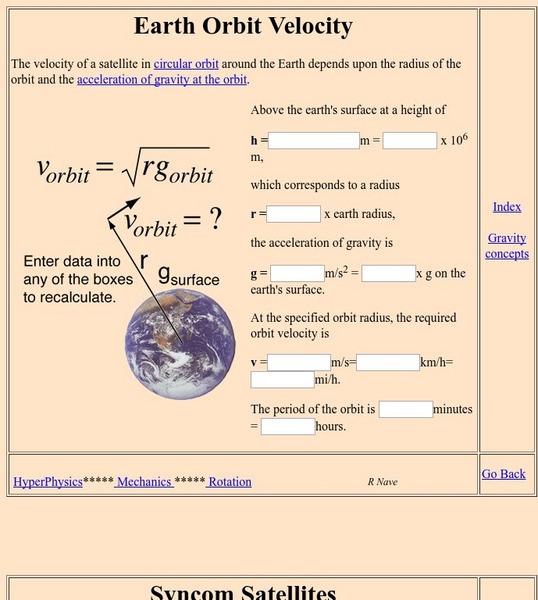
Georgia State University: Hyper Physics: Earth Orbit Velocity
A discussion and statement of an equation for orbital speed. An interactive JavaScript form allows the user to investigate the relationship between orbital height and orbital speed. A very good opportunity to practice and receive...
Physics Classroom
The Physics Classroom: Energy Relationships for Satellites
The orbits of satellites are described and an energy analysis is performed. Kinetic, potential and total mechanical energy are explained and applied to the motion of satellites.
Physics Classroom
The Physics Classroom: Mathematics of Satellite Motion
The mathematics associated with the motion of satellites is described. Equations (for period, velocity, acceleration and force) are stated, symbols described, and sample problems solved. Includes five practice problems with solutions and...

Cosmos 4 kids
Cosmos4 Kids: Exploration: Satellites
Learn about satellites .. early history, manned and unmanned, different kinds of orbits, and more. The brief, to the point text makes this site most suitable for younger researchers.
Cosmos 4 kids
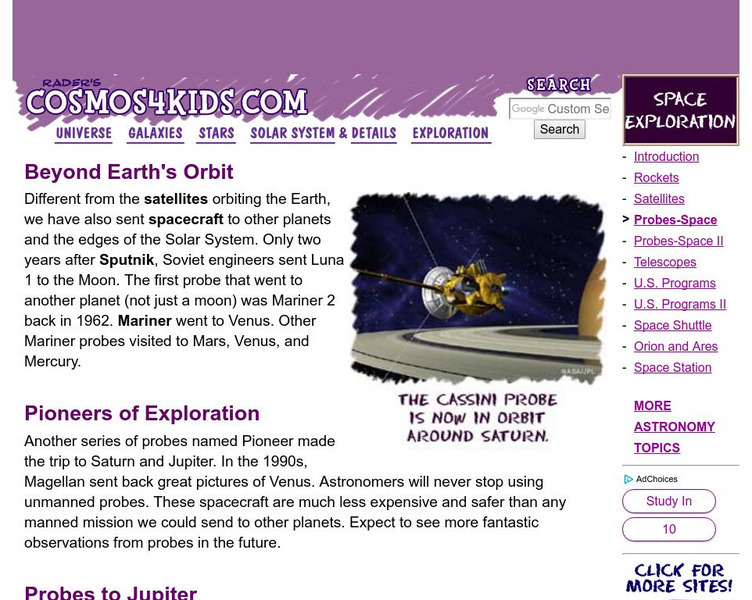
Cosmos4 Kids: Beyond Earth's Orbit
Learn about the different satellites that are probing the solar system on the website. Also included is a video that explores Astrobiology.
NASA
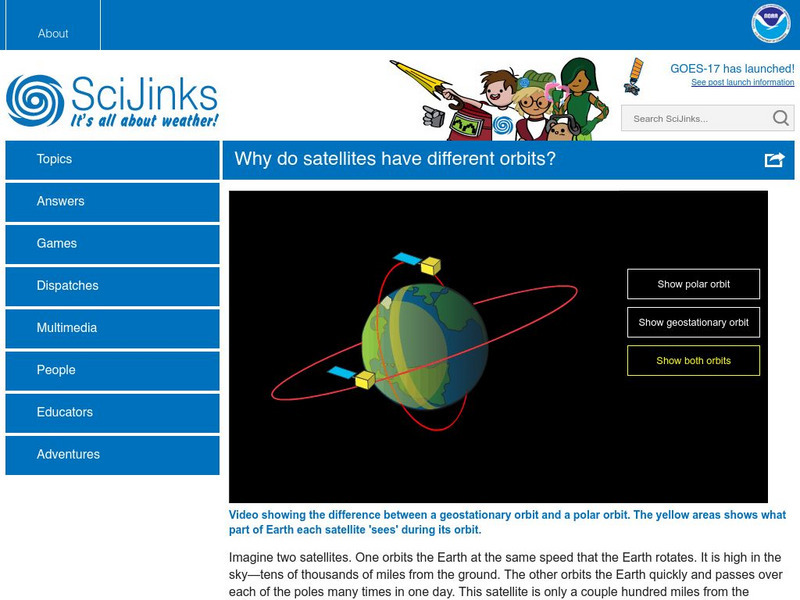
Nasa: Sci Jinks: Why Do Satellites Have Different Orbits?
Learn about two types of satellite orbits and why the difference is needed.
Physics Classroom
The Physics Classroom: Circular and Satellite Motion: Energy in Satellites
Through interactive practice problems and illustrated examples, students explore energy relationships for satellites.
Science Buddies
Science Buddies: Stargazing for Satellites
Did you know you can see many satellites with the naked eye? Try this activity and find out for yourself!
Texas A&M University
Ocean World: Satellite Oceanography
What does a satellite in space have to do with the oceans? Discover the answer to this question as well as uncover some interesting facts about satellites at this site.
OpenStax
Open Stax: Satellites and Kepler's Laws: An Argument for Simplicity
In the following interactive students will begin to understand the laws of Kepler regarding planetary motion and derive the third law of Kepler for circular orbits. They will also discuss the Ptolemaic model of the universe.
Texas Education Agency
Texas Gateway: Satellites and Kepler's Laws: An Argument for Simplicity
By the end of this section, you will be able to state Kepler's laws of planetary motion, derive Kepler's third law for circular orbits, and discuss the Ptolemaic model of the universe.

Concord Consortium
Concord Consortium: Stem Resources: Launching a Satellite
Do you think you could fire an "unpowered" object into orbit? By controlling the angle and speed at which the satellite is launch, students will try to launch a satellite into space with this computer model. Activity includes questions...
The Tech Interactive
Tech Museum: The Satellite Site!
An engaging look at satellites! What they are, what they do, and how they orbit. One interactive activity is building three different types of satellites.