Hi, what do you want to do?






Physics Classroom
The Physics Classroom: Kepler's Three Laws
The three laws of planetary motion as described by Kepler are stated and elaborated upon. Useful graphics and an easy-to-understand language are used to explain the nature of planetary motion. Both conceptual and mathematical. Includes a...
NASA
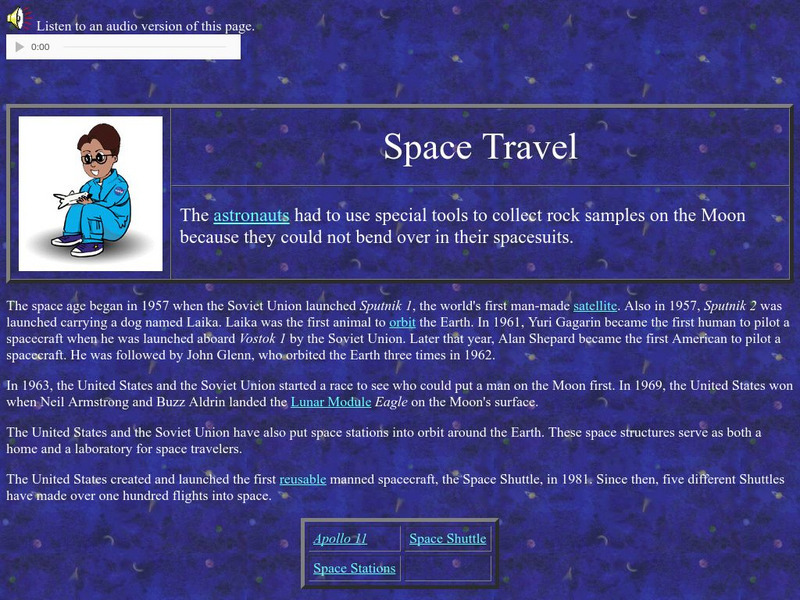
Nasa Star Child: Space Travel (Level 1)
Learn about the history of space travel. Audio content is included as well as vocabulary words linked to a glossary of terms.

Learn AP Physics
Learn Ap Physics: Physics B: Gravitation
A site dedicated to help students prepare for the AP Physics B test. This specific site reviews gravitation including Newton's Law of Gravity, orbits of planets and satellites, and Kepler's three laws. Site contains links to video...
NASA
Nasa: Cassini Huygens Mission
NASA site surveys the satellite Cassini's mission to Saturn as well as the ejection of the Huygens probe.
NASA
Nasa: The Galileo Mission
This site from NASA has information on the Galileo space mission, which launched in October 1989. In spite of technical problems, Galileo transmitted enormous amounts of new data, especially about Jupiter and its satellites and rings,...
Siteseen
Siteseen: American Historama: Sputnik
Detailed information on Sputnik, the first artificial satellite to orbit Earth, launched by the USSR on October 4, 1957.
Digital History
Digital History: The Space Race
In October 1957, the Soviet Union launched Sputnik 1, the world's first artificial satellite. The 184-pound, 22.5-inch sphere orbited the earth once every 96 minutes. Sputnik transmitted radio signals for 21 days and later burned up in...
TeachEngineering
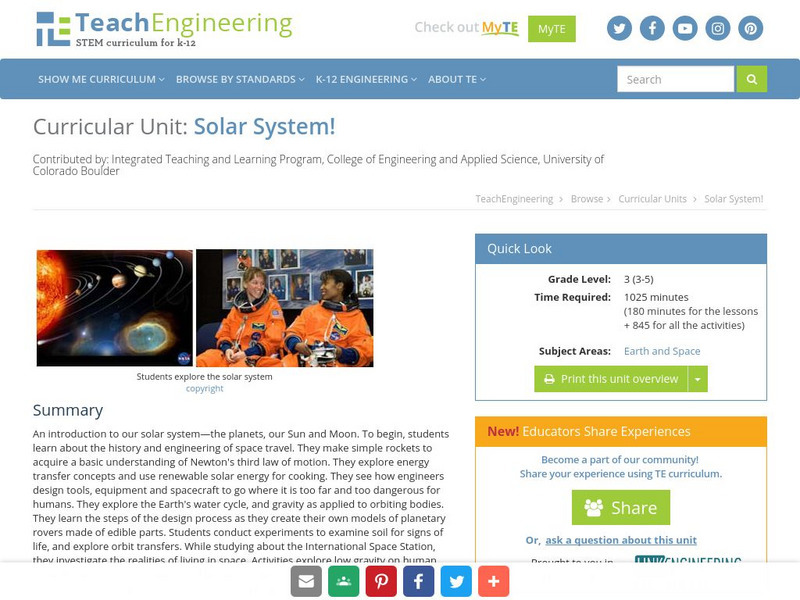
Teach Engineering: Solar System!
An introduction to our solar system: the planets, our Sun and our Moon. Students begin by learning the history and engineering of space travel. They make simple rockets to acquire a basic understanding Newton's third law of motion. They...

John F. Kennedy Presidential Library & Museum
John F. Kennedy Presidential Library and Museum: Space Program
In 1957 the Soviet Union launched the satellite Sputnik and had an astronaut orbit the moon a few years later. The U.S. was shocked and vowed to not be left behind. Examine how JFK rallied the country and Congress to get behind the race...
Digital Public Library of America
Dpla: Race to the Moon
In 1955, the US and the USSR each announced plans to launch a satellite into orbit. Thus began the race to the moon. Throughout the 1960s and 1970s, the American space program and its new classes of astronauts achieved breakthroughs in...

American Association of Physics Teachers
Com Padre Digital Library: Open Source Physics: Newton's Mountain Model
A science simulation launches a projectile from the top of a mountain testing Newton's theory introduced in Principia.
Fourmilab Switzerland
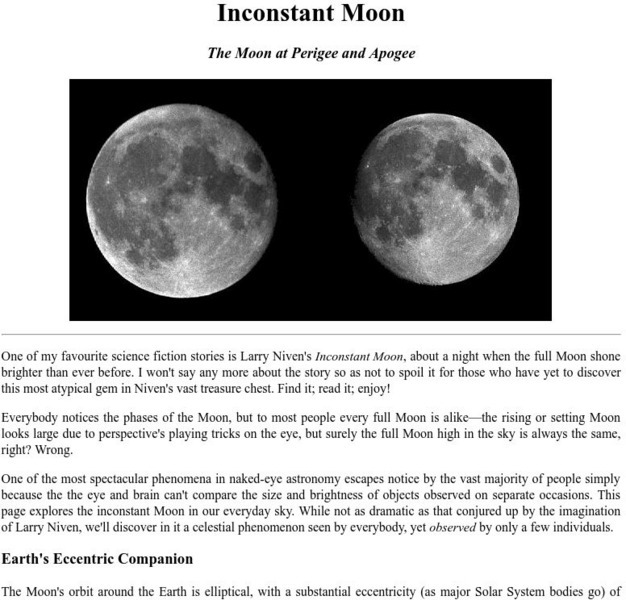
John Walker: Inconstant Moon: Moon at Perigee and Apogee
Most people think of every full moon as appearing the same, but careful observation allows us to see that sometimes the Moon appears larger than at others. This is caused by the elliptical orbit of our natural satellite.
American Museum of Natural History
American Museum of Natural History: O Logy: Train of Thought
Try out your ability to think like Einstein by working through two thought experiments that help explain how satellites stay in orbit and how the speed of light affects the universe.
Science Struck
Science Struck: Facts About the Atmosphere Layers
Provides information about the five layers of Earth's atmosphere. Also discusses the satellites that orbit the Earth in the atmosphere.
NASA
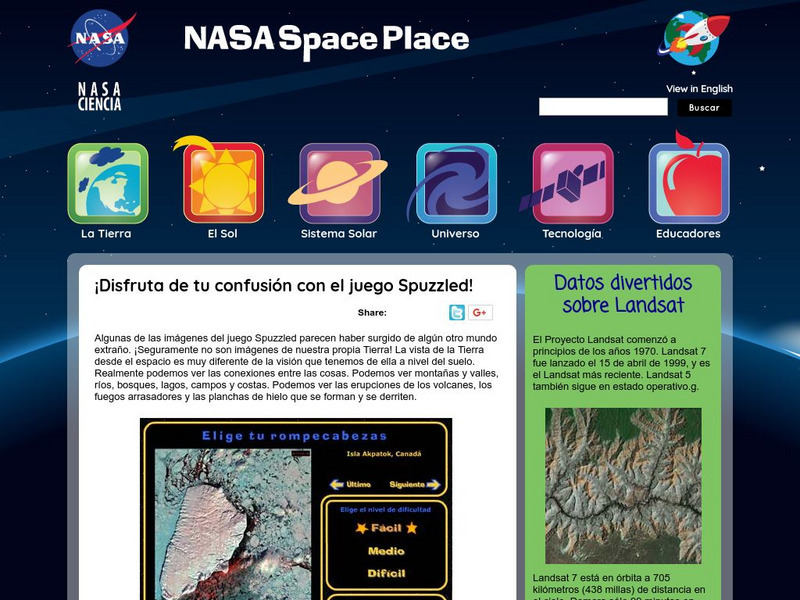
Disfruta De Tu Confusion Con El Juego Spuzzled!
NASA provides a challenging puzzle scrambler where students must rearrange 1 to 53 puzzle pieces to form a strange land view. Good resource information is also available as this site describes what Landsat satellites do and how they...
NASA
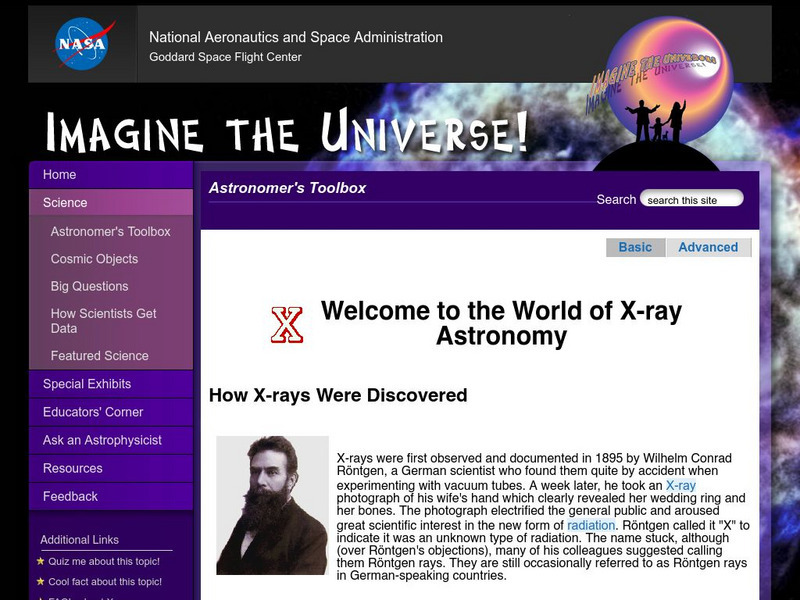
Nasa: Imagine the Universe: Welcome to the World of X Ray Astronomy
Site recounts how X-rays were discovered as well as who discovered them. Offers graphics, links to facts on this topic, a quiz, and teacher resources.

NASA
Nasa: Imagine the Universe: "Nasa Detects One of Closest"
Site provides the article, "NASA Detects One Of Closest And Brightest Gamma Ray Bursts." Provides links to learn more about gamma rays and black holes as well as other resources.
NASA
Nasa: Heliophysics: New Science of the Sun Solar System Connection
This site from NASA lists common and uncommon misconceptions about Sun-Earth Science. Site also provides links to activities and lesson plans as well as background reading.
Curated OER
Science Kids: Science Images: Nile River Delta
This is an amazing satellite image of the Nile River Delta as seen from orbit. Located in North East Africa, the Nile River is largely agreed to be the longest river in the world, reaching 6650 kilometres (4132 miles) in length. For more...