Hi, what do you want to do?






Curated OER
Dinner in a Woodland
After reading a short paragraph about what makes up a woodland habitat, fifth graders attempt to identify the primary consumers, secondary consumers, and third order consumers in two separate food chain scenarios. They also name a hawk's...

Annenberg Foundation
Gothic Undercurrents
Terror, mystery, excitement. American writers of the 19th century, including Nathaniel Hawthorne, Herman Melville, and Emily Dickinson, used these elements to create morally ambiguous tales that challenged the prevailing belief in...

Curated OER
Word Family Jamboree
Students explore rhyming words, beginning and ending sounds. In this word family lesson, students identify beginning and ending sounds. Students draw pictures of words and use phonetic spellings to write stories. Students use Dr. Seuss...

Curated OER
My Colorful Food Chain
Young scholars explore biology by participating in a dietary habit activity. In this food chain lesson, students discuss their own diets and the animals we feed upon daily. Young scholars create a poster demonstrating the animals that we...

Curated OER
Lewin Project
Learners discuss the criteria for the Lewin Project. They practice writing using their emotions and feelings. They write to find a voice in their pieces. They share their ideas with the class.
Math Science Nucleus
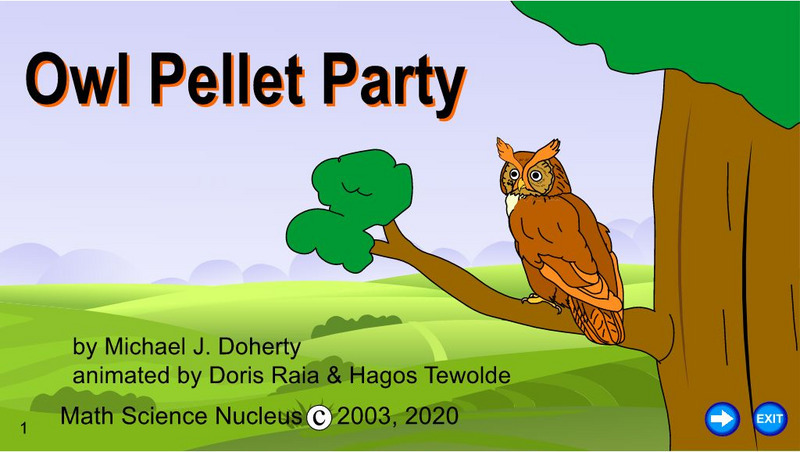
Math/science Nucleus: Owl Poem Animation
This animation told in a storybook format explores the food cycle generated by the owl. It begins with the owl's consumption of food, then the food provided other animals through that consumption and so on.

Other
Owl Editing: Understanding the Meaning of Poetry
This OWL Editing page provides a chart that breaks down the factors to analyze when trying to understand poetry's deep meanings.
Online Writing Lab at Purdue University
Purdue University Owl: Sound & Rhyme
This lesson discusses the use of sound in poetry, mainly focusing on the use of rhyme. Various kinds of rhyme are defined (rhyme scheme, perfect rhyme, forced rhyme, slant rhyme, masculine rhyme, feminine rhyme, visual rhyme, and...
Repeat After Us
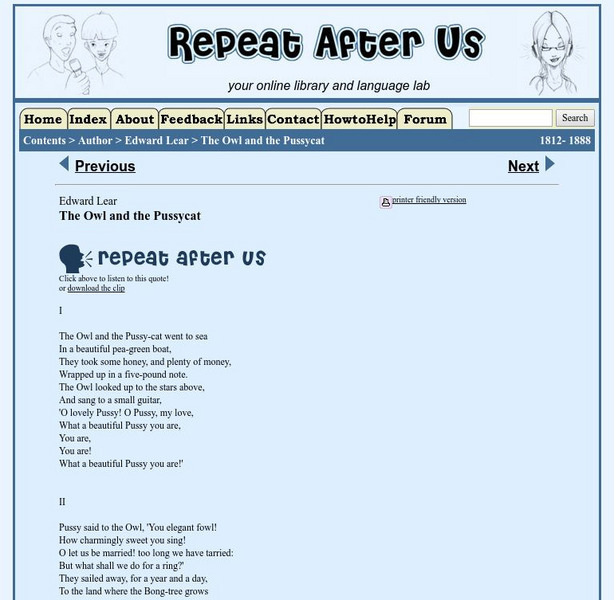
Repeat After Us: "The Owl and the Pussycat" by Edward Lear
This site offers the text and audio of the poem "The Owl and the Pussycat" by Edward Lear. Great for students to practice reading poetry aloud at an appropriate rate and with expression.

Alabama Learning Exchange
Alex: Nocturnal Animals Lesson #4: Owls
During this lesson plan, students will visit various Internet sites to learn facts about owls. They will use this information to draw a picture of the owl food chain, dissect owl pellets, and write a poem about owls.
Online Writing Lab at Purdue University
Purdue University Owl: Creative Writing
An introduction to creative writing with links to more information on the following topics: Fiction Writing Basics, Pattern and Variation in Poetry, Pattern and Variation: Aural, Pattern and Variation: Visual, characters and Fiction...
British Library
British Library: Discovering Literature: What Is the Owl and the Nightingale About?
"The Owl and the Nightingale" is one of the earliest substantial texts to be written in Middle English. Read an overview of this poem and view additional resources such as articles and collection items.
Online Writing Lab at Purdue University
Purdue University Owl: Quotation Marks
Learn about how to use quotation marks correctly to quote poetry, prose, and long and short quotes. Also, find guidelines on using quotation marks when writing dialogue and when using other punctuation.
abcteach
Abcteach: Birds
[Free Registration/Login Required] Come and check out this resource featuring printable materials on birds. This site includes poems, shape books, questions for reading comprehension and more.
Online Writing Lab at Purdue University
Purdue University Owl: Meter & Scansion
Handout from the Purdue University writing lab that explains poetic meter and scansion. Explains several terms, including the following: syllabic, accentual, accentual-syllabic, quantitative, scansion, accented, unaccented, poetic foot,...
Education.com
Education.com: Words That Make Us Feel: A Lesson on Sensory Language
[Free Registration/Login Required] After this lesson centered around the book Owl Moon, learners will be able to identify words and phrases that suggest feelings and appeal to the senses.
Lumen Learning
Lumen: Models for Literary Analysis
Explore these links to see models for literary analysis including a model analysis of poetry. "Types of Papers: Literary Analysis" from Roane State OWL and "Deep Desires that Transcend Time" by Alyssa Ensminger, from Roane State OWL....
National Endowment for the Humanities
Neh: Edsit Ement: There Once Was...
Part 2 of this tutorial on limerick writing demonstrates the importance of form (meter and rhyme) in limerick poetry using the exemplary and amusing work of Edward Lear.

Annenberg Foundation
Annenberg Learner: American Passages: Modernist Portraits: Wallace Stevens
Wallace Stevens is featured in this succinct biography for his modernistic poetry which draws upon his theory regarding the importance of perception. See "Wallace Stevens Activities" for related resources.

Academy of American Poets
Poets.org: Edward Lear
Resource provides a brief biographical overview of Edward Lear including information on his life and links to selected poems. A column of links to additional reading information on Lear is also provided.
Academy of American Poets
Poets.org: John Haines
This note on the poet John Haines includes an example of one of his verses.