Hi, what do you want to do?






Curated OER
Genetic Research: Decisions to be Made
Students examine the genetics involved in the human genome. They brainstorm the advantages and disadvantages to this discovery. They research different experts opinion and write a case study which addresses an ethical dilemma.

Curated OER
Evidence for Evolution
In this evidence of evolution worksheet, students review notes given by referring to the Nelson Biology text, chapter 11/13. Students read the notes and the specified pages in the text.

Curated OER
Discovering Owls
Students are introduced to different types of owls and owl pellets. They list several adaptations that benefit the owls. Students identify the various species of owl that live in Wisconsin. Students discuss owl pellets and identify the...

Curated OER
Beaver Ecology
Students explore the lives of bgeahvers. They identify the physical and behavioral adaptations that help beavers survive in their environment. Students compare and contrast how beavers influence the ecology of both forest and aquatic...

Curated OER
Using Your Senses
In this using your senses worksheet, learners read a 1 page article on senses and then connect 6 body parts to their actual senses by drawing a line from one to the other.

Curated OER
Music
Third graders study sound waves and vibrations. They sing a silly round in three parts.

Curated OER
The Five Senses - Barefoot Walking Trip
Students go outside and take a little barefoot walking trip. They talk to each other about their experiences on the trip to help them remember everything they can. They go on a walk for at least 15 minutes. Ask questions during the trip.

Curated OER
Understanding the Epidemiologic Triangle through Infectious Disease
Students examine the epidemiologic triangle. For this disease lesson, students discuss infectious disease as they study how they spread and discover their families' experiences with them. Students research Internet sites to complete...

Curated OER
Vocal Exploration
Students explore vocal anatomy. For this biology/music lesson, students first learn vocabulary associated with the voice and body. They then use straws, microphones and recorders to differentiate between high and low pitches and...

Curated OER
Our Five Senses
Students explore the five senses through hands-on and Internet activities.

Curated OER
African Music
In this music worksheet, students read an excerpt about African Music. Once completed, they respond to eight short answer questions related to the reading. Students also imagine that they are an African musician and suggest how they...

Physics Classroom
The Physics Classroom: The Human Ear
Informative article on the human ear. Describes the parts and function of the ear. Explains how the ear functions when listening to music.
Other
Deafness Research Uk: How the Ear Works
A collection of several images explains how the ear makes us hear sound.
Other
Footprints Science: The Ear
This site illustrates all of the parts of the human ear. The student may drag and drop labels to identify the correct parts of the ear.
Other
Siemens Science Day: Life Science: Hear Ye! Hear Ye! [Pdf]
Through this hands-on science activity, students make a model of the human ear as well as explore the parts of the ear and their roles in transferring sound.
University of New South Wales (Australia)
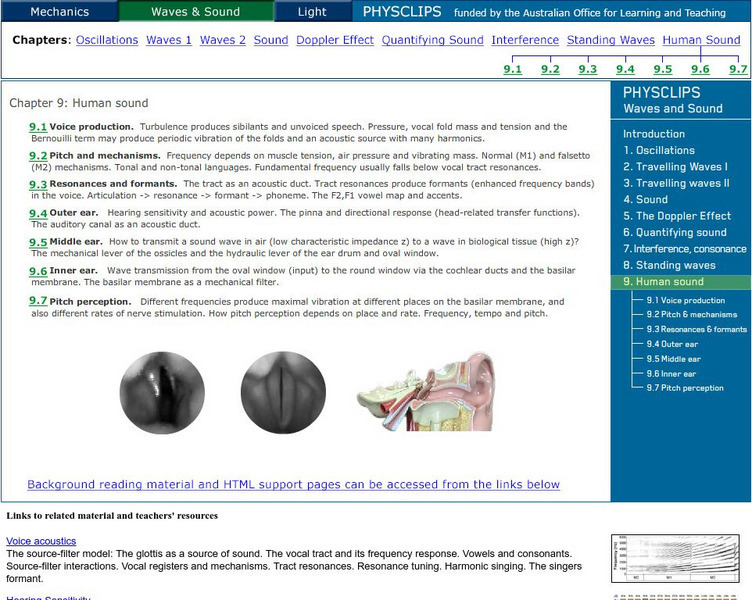
University of New South Wales: School of Physics: Physclips: Human Sound
Get all the information you need to know about human sound in this learning module. Module covers voice production, ear's part in hearing, resonances, and pitch.
The Franklin Institute
Franklin Institute: Music to Our Ears
Part of a larger site on the armonica, an instrument created by Ben Franklin. Introduce yourself to the human ear. This section looks at how sound is collected and transmitted and provides diagrams of the parts of the auditory pathway...
Soft Schools
Soft Schools: Ear Cross Section
An interactive labeling exercise on parts of the human ear.
Curated OER
Merriam Webster: Visual Dictionary Online: Structure of the Ear
Illustration of the ear, with parts labeled.

Khan Academy
Khan Academy: Activities: The Evolutionary Causes of Biodiversity
An activity where students use peppers to explore reproductive potential and natural selection in part 1. In part 2, students look at traits such as dimples, tongue rolling, thumbs, ear lobes, and widow's peak to investigate individual...

Khan Academy
Khan Academy: The Fuller Brooch
The Fuller Brooch is the earliest known personification of the Five Senses. This splendid circular brooch is made from hammered sheet silver. The center part is decorated with five figures who represent the five human senses. In the...