Hi, what do you want to do?






PBS
Why Do We Have Seasons?
Explore the reason for the seasons! An interactive lesson allows learners to explore the earth's rotation from the viewpoint of four cities at different latitudes. It provides descriptive information at eight points during the orbit...

CK-12 Foundation
Sedimentary Rock Classification: How Old is That Layer?
A timely resource illustrates the effects of the passing years on sedimentary rock formation! Young geologists discover just how long it takes to create shale, slate, and other sedimentary rocks. The interactive also shows...

Howard Hughes Medical Institute
How the Body Uses Fat
Not all fat is bad—eating good fats actually helps with weight loss. Learn how the body uses fat through a 27-slide presentation that breaks down the path fat takes from entering to exiting the body. Understanding why fat is helpful and...

Cold Spring Harbor Laboratory
Genes Can Be Turned On and Off
Regulations exist in many places from business to schools, but what about in our genes? Learn about gene regulation with an online interactive. It uses an animation to introduce the topic, many photographs of the scientists best known...
American Museum of Natural History
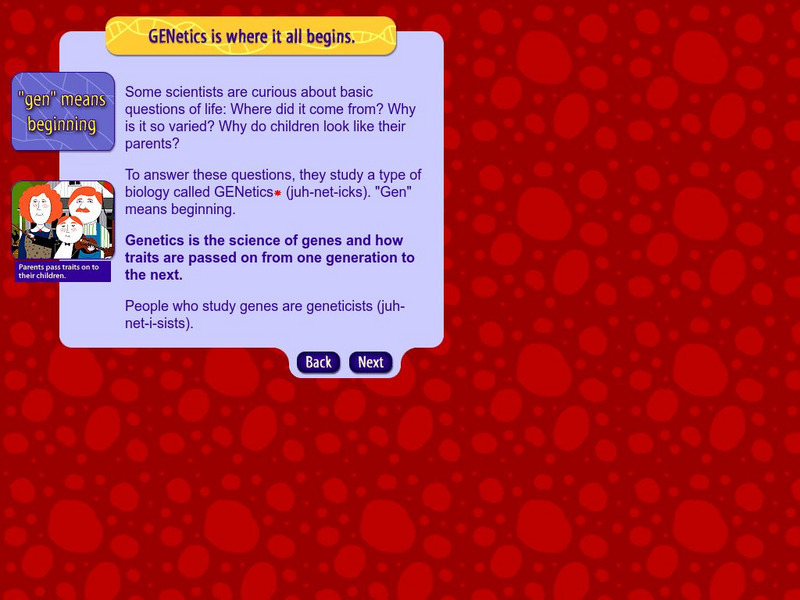
American Museum of Natural History: O Logy: What's the Big Idea? Genetics
Find an overview of genetics--the science of genes--in a click-through series of short perspectives on the topic.
American Association of Physics Teachers
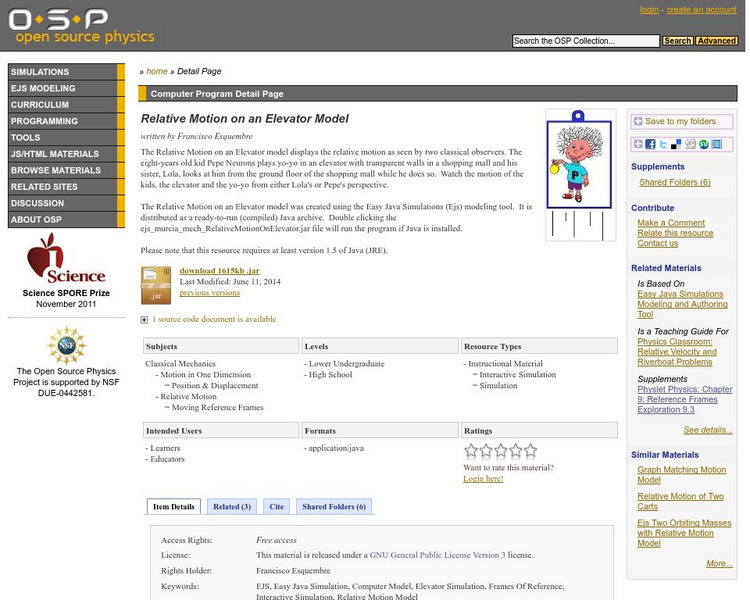
Com Padre Digital Library: Open Source Physics: Relative Motion on Elevator Model
What would happen if you played with a yo-yo in a moving elevator? This simulated exercise lets users observe what happens from two perspectives, one being the person playing with the toy and the other being on the outside of a glass...