Hi, what do you want to do?






Khan Academy
Khan Academy: Three Ways to End a Sentence
There are three types of terminal punctuation: a period, an exclamation point, and a question mark.
TESL Journal
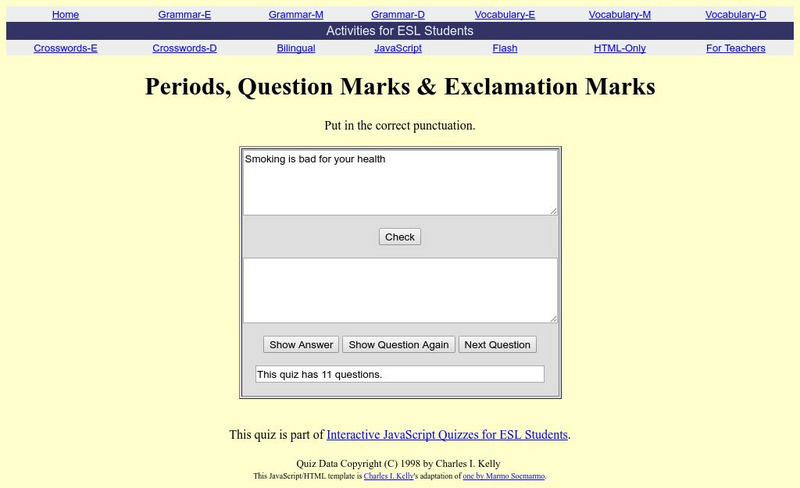
Activities for Esl Students: Periods, Question Marks & Exclamation Marks
Focus students' understanding of punctuation with this language arts skill-building site. Explore the usage of periods, questions marks and exclamation marks through this interactive activity that ask students to read a sentence and...
ACT360 Media
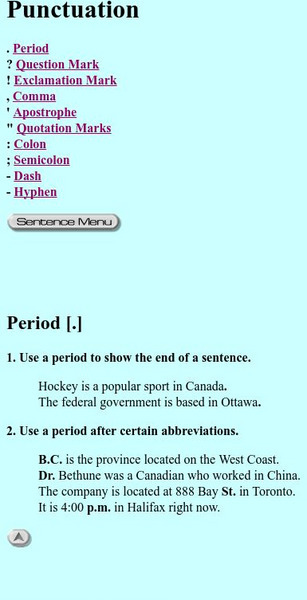
Writing Den: Punctuation
A brief description of the rules, usage, and examples of the each type of punctuation used when building a sentence.

ClassFlow
Class Flow: Ending Punctuation
[Free Registration/Login Required] Developed for first grade students to review ending punctuation marks:., ?, and ! Activotes are used at the end to test understanding. Students learn the correct terms for telling, asking, and...

Roy the Zebra
Roy the Zebra: Reading Games: Full Stop Game 1 (Beginner)
This game helps young readers learn how and where to place periods at the end of sentences. They are to click on and drag a snail to where the period belongs; the snail spins and turns into a period.
Roy the Zebra
Roy the Zebra: Reading Games: Full Stop Game (Beginner)
This reading game is designed for young readers to learn how and where to place periods at the end of sentences. They are to click on and drag a snail to where the period belongs; the snail spins and turns into a period.
Roy the Zebra
Roy the Zebra: Reading Games: Full Stop Game (Beginner)
This reading game is designed for young readers to learn how and where to place periods at the end of sentences. They are to click on and drag a snail to where the period belongs; the snail spins and turns into a period.
Roy the Zebra
Roy the Zebra: Reading Games: Full Stop Game (Beginner)
This game is designed for young readers to learn how and where to place periods at the end of sentences. They are to click on and drag a snail to where the period belongs; the snail spins and turns into a period.
Roy the Zebra
Roy the Zebra: Reading Games: Full Stop Game (Beginner)
This reading game is designed to teach young readers about how and where to place periods at the end of sentences. They are to click on and drag a snail to where the period belongs; the snail spins and turns into a period.
Roy the Zebra
Roy the Zebra: Reading Games: Full Stop Game 1 (Advanced)
This reading game provides practice separating sentences using end marks. Young readers click on and drag snails to where periods belong at the end of sentences in a short passage; the snails spin and turn into periods.
E Reading Worksheets
E Reading Worksheets: End Mark Worksheets
In this learning module, students will learn more about end marks and the four types of sentences. Worksheets are provided to reinforce the four types of sentences and punctuation marks. This module is designed to support Tier I, Tier...
Sophia Learning
Sophia: Semicolons Rule!
This tutorial focuses on semicolons; it provides two audio clips: one explaining how semicolons are different from periods and commas and the other explaining how to use semicolons with conjunctive adverbs. It also provides in slideshow...
University of Ottawa (Canada)
University of Ottawa Hyper Grammar: Quotation Marks
The University of Ottawa developed this site about quotation mark usage. Discusses using quotation marks to set off dialogue, titles, short works, and special terms. Also instructs learners in using quotation marks with other forms of...
Roy the Zebra
Roy the Zebra: Reading Games: Full Stop Game 4 (Advanced)
This reading game presents young readers with a three-sentence passage. They are to read it, determine where they need to come to a full stop, and click and drag a snail to that spot. The snail spins and makes a period. They can undo and...
Roy the Zebra
Roy the Zebra: Reading Games: Full Stop Game 5 (Advanced)
This reading game presents young readers with a three-sentence passage. They are to read it, determine where they need to come to a full stop, and click and drag a snail to that spot. The snail spins and makes a period. They can undo and...
Love To Know Media
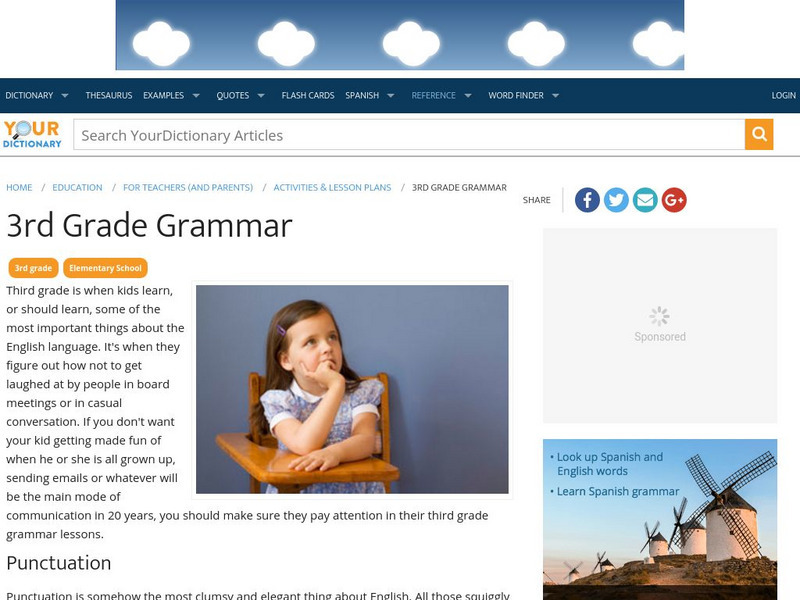
Your Dictionary: 3rd Grade Grammar
This article focuses on the grammar and punctuation that third graders need to learn including the parts of speech (nouns, verbs, adverbs, and prepositions), punctuation marks (question mark, exclamation points, and periods), and the...
Application Magazine
Aplicaciones: Ortografia Interactiva De Signos De Puntuacion
Which punctuation do we use? Here you will find seven different set of exercises so you can test your knowledge of when to use a period, a comma, a colon or parentheses.
Sophia Learning
Sophia: Quotations Within Quotations: Lesson 4
This lesson introduces the punctuation rules for including a quotation within a quotation. It is 4 of 4 in the series titled "Quotations within Quotations."
PBS
Pbs Learning Media: Peacock
This Nature video segment features the beautiful bird known for its iridescent tail, the peacock.
Sophia Learning
Sophia: "i.e." vs. "e.g."
This slideshow lesson focuses on the use of "i.e." and "e.g." including similarities and differences between them, the specific meanings of each, and how to use them in writing including the proper punctuation.
Roy the Zebra
Roy the Zebra: Reading Games: Full Stop Game 3 (Advanced)
This reading game presents young readers with a three-sentence passage. They are to read it, determine where they need to come to a full stop, and click and drag a snail to that spot. The snail spins and makes a period. They can undo and...
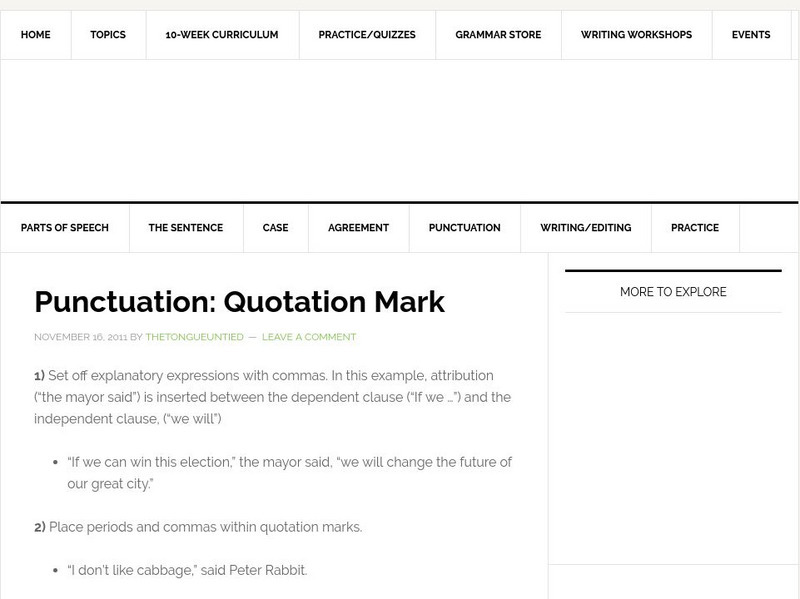
The Tongue Untied
The Tongue Untied: Quotation Marks
Learn more about using quotation marks properly through this informative resource. Students and teachers will benefit from this helpful site.
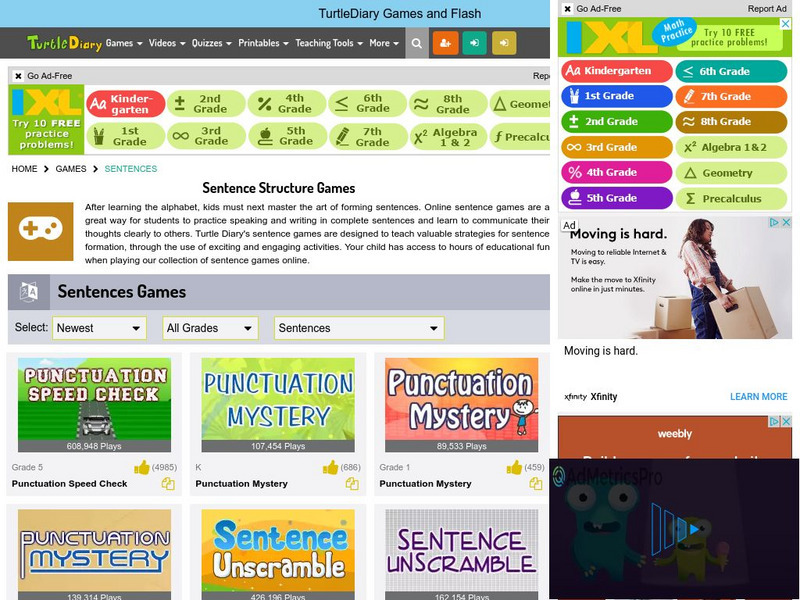
Turtle Diary
Turtle Diary: Sentence Structure Games
A collection of games for students to work on forming sentences. These games give students strategies for sentence formation.
Other
Kim's Korner: Color Coded Parts of Speech Kinesthetic Lesson Plan
Students can brush up on their knowledge of the parts of speech when they do this lesson. This site contains a kinesthetic lesson plan that caters to children with all types of learning styles.