Hi, what do you want to do?






Towson University
It's a Gassy World!
How much does your class know about the relationship between climate change and carbon dioxide? Science scholars explore the nature of greenhouse gases and rising ocean temperature through demonstrations, research, and experiments. The...

Chem Tutor
Chemtutor: Walking Up the Phase Change Graph
Good exercise graphing a phase change graph from solid to liquid to graph. Includes temperatures and all energy changes for water through this process.
University Corporation for Atmospheric Research
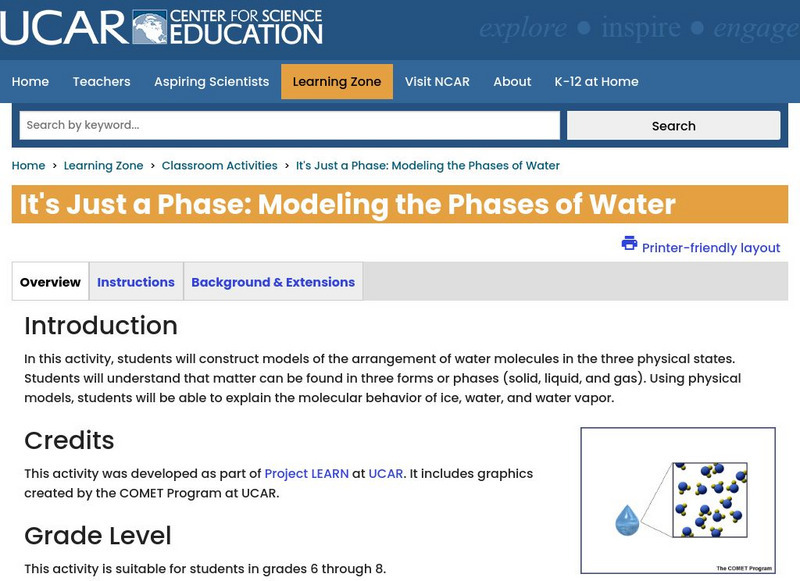
Ucar: Just a Phase: Water as a Solid, Liquid, and Gas
This site helps students construct a model of the arrangement of water molecules when present as solid, liquid or gas. Includes background information, lesson plans, links to standards and assessment ideas.
New York University
New York University: States of Water
Use this resource to learn about the three different phases of water; solid, liquid, and gas. What happens to water as it changes into a solid or gas? Includes short and easy to do activity.
Frostburg State University
Frostburg State Chemistry Online: Water Bond Angles & Phase Changes
Describes the bond angle of the water molecule during the transition from liquid to gas state. Also provides several examples and explanations for responses and answers given.
University of Sydney (Australia)
University of Sydney: Structure and Properties of Materials/thermal Physics
An exhaustive set of "lecture notes" on various topics in thermal physics (including thermal expansion). Explanations are well done and more interesting than most. Includes both a mathematical and conceptual treatment of topics. Humor,...
Chem Tutor
Chem Tutor: States of Matter
A very descriptive site that allows students to understand the different states of matter at the atomic level. Also discusses the process of phase changes and displays phase change graphs. Thermochemistry is also touched upon for high...
Scientific American
Scientific American: What Is an Exothermic Reaction
Scientific American magazine, in the person of Dr. Gerald R. Van Hecke, gives a wonderfully complete answer to this question. Complete with very many hot words for additional background. And a wonderful NASA launch photo.