Hi, what do you want to do?





CK-12 Foundation
Ck 12: Limiting Reactant and Percent Yield
[Free Registration/Login may be required to access all resource tools.] Students will compare theoretical yield to actual yield, and then investigate what happens when one reactant runs out before the other reactants are fully consumed....
TeachEngineering
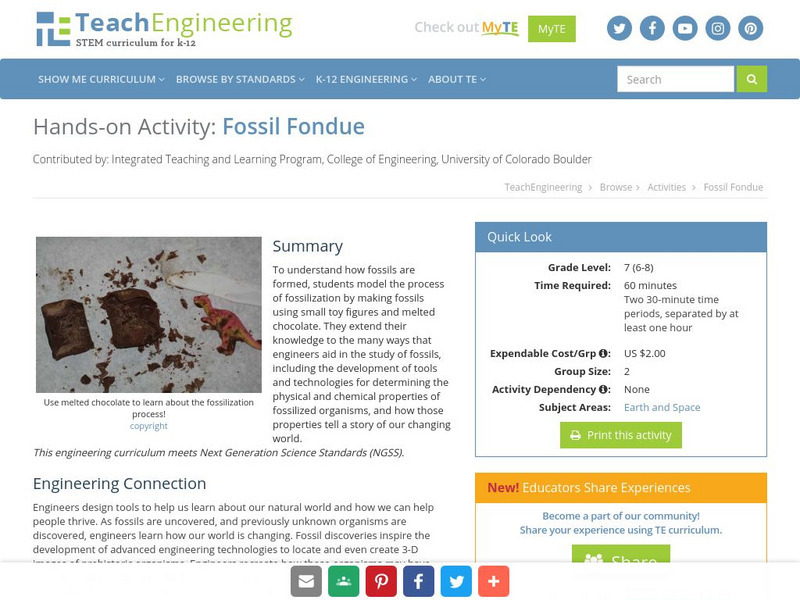
Teach Engineering: Fossil Fondue
To understand how fossils are formed, students model the process of fossilization by making fossils using small toy figures and melted chocolate. They extend their knowledge to the many ways that engineers aid in the study of fossils,...
![Maryland Science Center: Create a Kitchen Chemistry Kit [Pdf] Activity](https://static.lp.lexp.cloud/images/attachment_defaults/resource/large/FPO-knovation.png "Maryland Science Center: Create a Kitchen Chemistry Kit [Pdf] Activity")
Maryland Science Center
Maryland Science Center: Create a Kitchen Chemistry Kit [Pdf]
Instructions for how to safely create a chemistry set using basic ingredients found around the home. Provides two experiments to try, one involving a physical change and the other a chemical change.
Science and Mathematics Initiative for Learning Enhancement (SMILE)
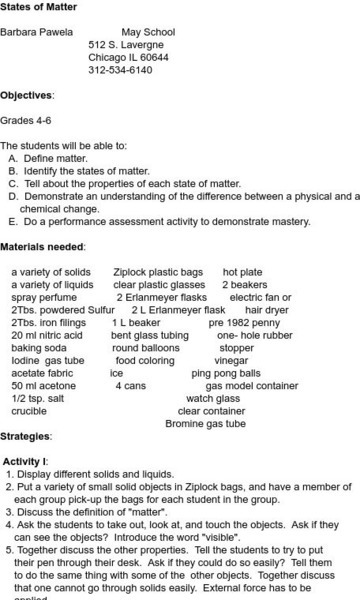
Smile: States of Matter
A comprehensive lesson plan site that contains a number of activities to aid in teaching about the states and properties of matter and the difference between a physical and chemical change.
ArtsNow
Arts Now Learning: States of Matter [Pdf]
In this lesson, students will move and generate choreography to understand different states of matter.

Concord Consortium
Concord Consortium: Stem Resources: Baggie Chemistry
Observe chemical and physical changes with this lab using everyday household items. Lab includes procedure and online data collection tool where answers can be saved and graded by teacher.
Read Works
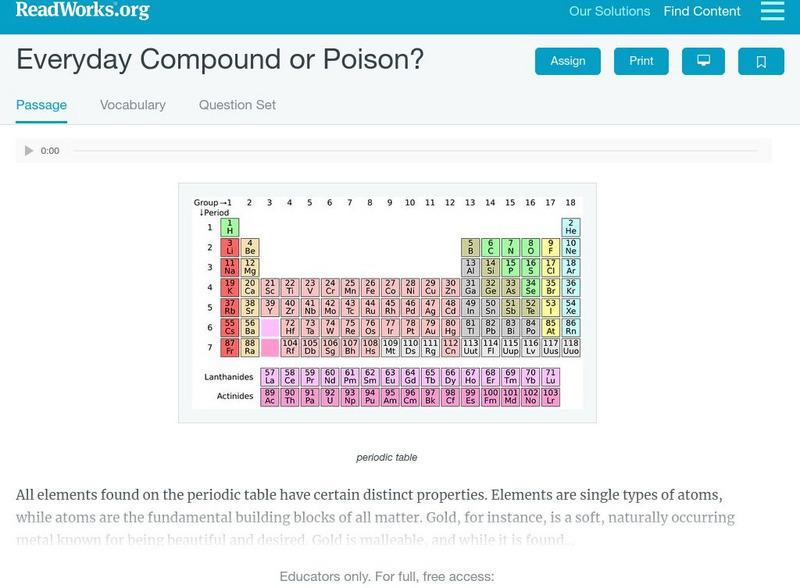
Read Works: Everyday Compound or Poison?
[Free Registration/Login Required] An informational text about how chemicals can be combined to form safe or unsafe compounds. A question sheet is available to help students build skills in reading comprehension.
Center of Science and Industry
Cosi Columbus: A Swell Activity With Beans [Pdf]
Learn about absorption in this hands-on science experiment. Includes full list of materials, procedures, and scientific explanation of what happens to different types of beans as they soak in water in a test vial.
Other
The Science House: Dancing Spaghetti
The chemical change of matter is illustrated in this lab experiment when spaghetti is placed in a solution of baking soda and vinegar. Watch the spaghetti rise to the surface and sink again once the gas is released.
CK-12 Foundation
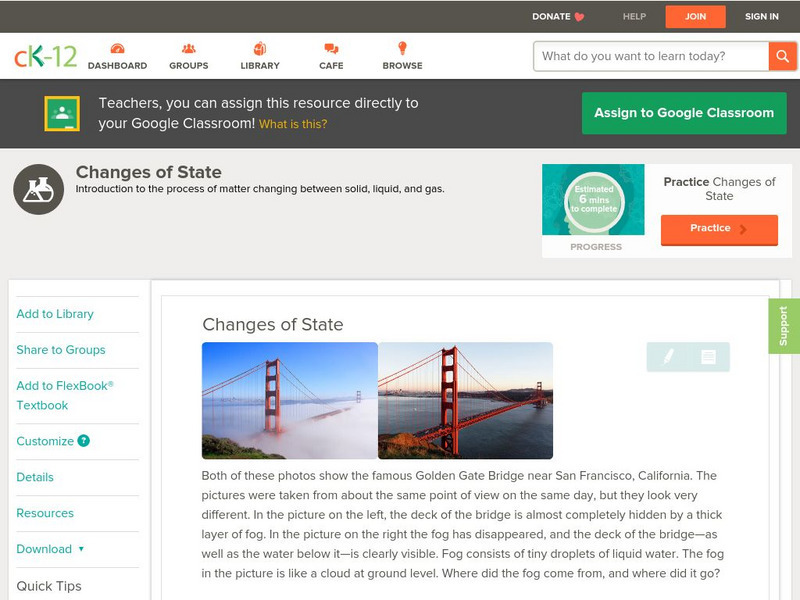
Ck 12: Physical Science: Changes of State
[Free Registration/Login may be required to access all resource tools.] Definition of a change of state and the physical processes that cause it.

Chem4kids
Chem4 Kids: Chemical vs. Physical Changes
Identify chemical and physical changes and the differences between the two.
Science Education Resource Center at Carleton College
Serc: Does Salt & Vinegar Have an Effect on Pennies?
During this lab students will experiment to see whether a salt and vinegar solution can clean a tarnished penny. Included on site is lesson plan and student worksheet.
Science Education Resource Center at Carleton College
Serc: Polymers & Plastics: Classification & Models
Students will use their prior knowledge about changes of matter including physical and chemical changes to examine and categorize various types of plastics (polymers). They will identify how their chemical properties allow them to have...
CK-12 Foundation
Ck 12: Fourth Grade Science: Physical Science: Forms and Changes of Energy
[Free Registration/Login may be required to access all resource tools.] Discusses different forms of energy and how energy changes form.
Other
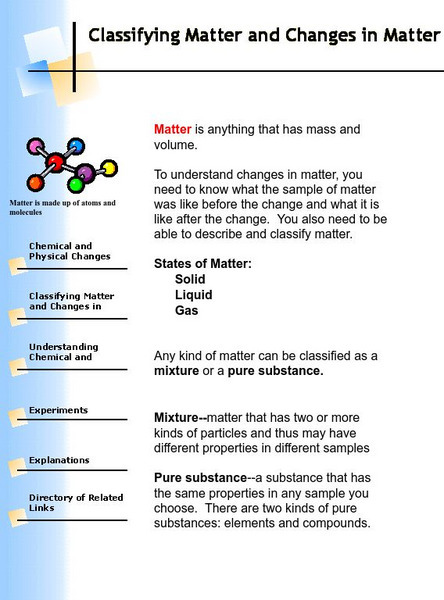
Classifying Matter and Changes in Matter
Learn to identify changes in matter and explain what happens as matter changes. The lesson is supplemented with several experiments to reinforce key concepts.

ClassFlow
Class Flow: Changing States
[Free Registration/Login Required] Through this unit children consolidate their ideas about changes of state which can be reversed. They use their understanding to explain a range of familiar phenomena.

Scholastic
Scholastic: Dirtmeister's Science Lab: Matter
Step into Dirtmeister's Science Lab as he explores the challenge question: "How can you force a physical change in matter?" Learn about matter, make your predictions and then do the experiment.
Science Education Resource Center at Carleton College
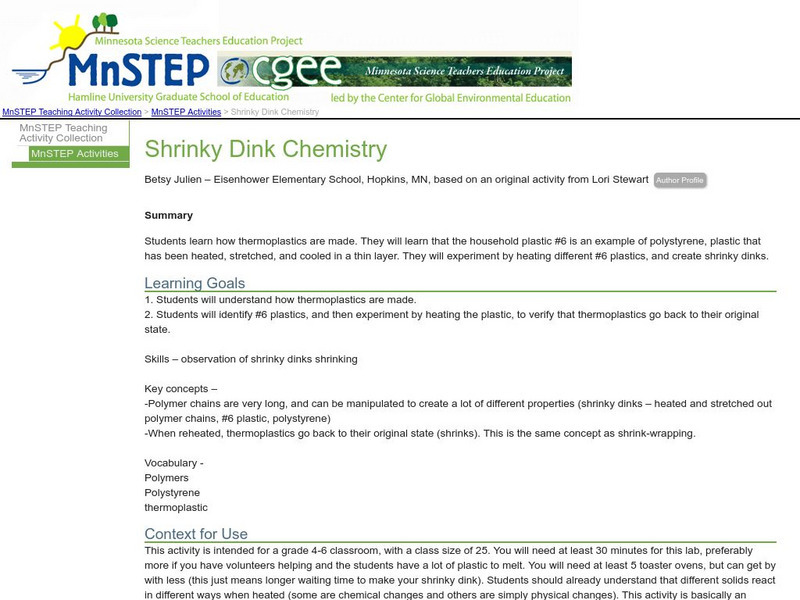
Serc: Mn Step: Shrinky Dink Chemistry
In this lesson, young scholars first learn about thermoplastics, and about polystyrene in particular, which is a #6 plastic. They will then heat different #6 plastics to create shrinky dinks. As they are heated, they shrink, which is a...
Maryland Science Center
Maryland Science Center: One Ring to Rule Them All [Pdf]
A simple experiment to create a secret message using invisible ink, in honor of J.R.R. Tolkien's birthday and the Ring in The Lord of the Rings.
The Wonder of Science
The Wonder of Science: 5 Ps1 4: Mixing Substances
Does mixing two or more substances result in new substances? This site contains work samples, phenomena, assessment templates, and videos that contain content to covers mixing substances.
Other
Educational Innovations: Diaper Polymer Activities [Pdf]
What can you do with diaper polymer? Check out these six quick student experiments involving the chemical used in diapers.
Utah Education Network
Uen: Diaper Inquiry
Learners investigate the technology of a diaper. They consider various physical traits of a diaper and then come up with an investigation to test some of these traits.
Maryland Science Center
Maryland Science Center: Shrinky Dink Charms [Pdf]
Use recycled plastic to make shrinky dink jewelry and decorations.
NOAA
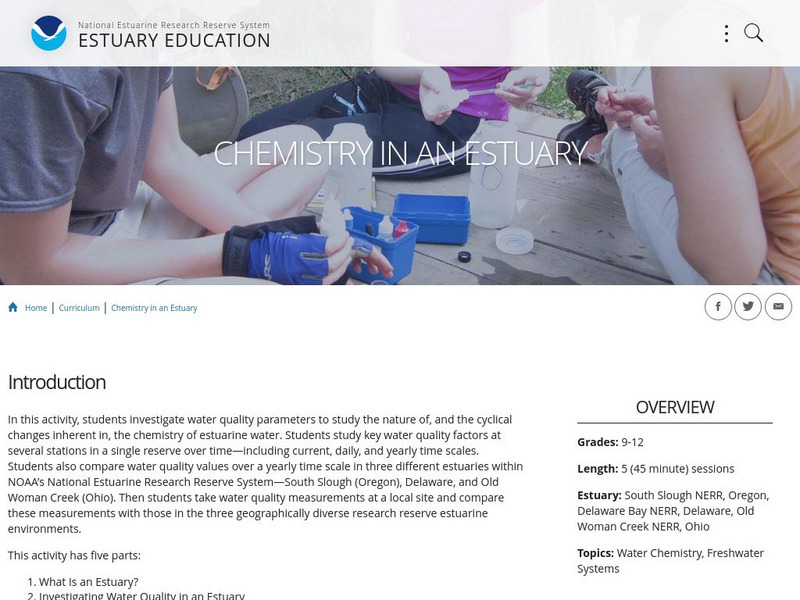
Noaa: Estuaries 101 Curriculum: Chemistry in an Estuary
This activity introduces students to the complex chemistry of estuarine water. Students investigate how chemical and physical water quality factors-pH, temperature, dissolved oxygen, and salinity-change and interact over varying time...