Hi, what do you want to do?





Sophia Learning
Sophia: Graphing in Science
Students will learn how to use appropriate and different procedures, tools, measurements, graphs and mathematical analyses to describe and investigate natural and designed systems in a physical science context.
Exploratorium
Exploratorium: Science Snacks: Snacks From a Z
Here is a monumental list of ideas for science fair projects and experiments, organized alphabetically. Every one of them is a link to a full page, with pictures, of information about the idea. This site is a goldmine.

Florida State University
Florida State University: Magnet Lab: Timeline of Electricity and Magnetism: 1750 1774
With his famous kite experiment and other forays into science, Benjamin Franklin advances knowledge of electricity, inspiring his English friend Joseph Priestley to do the same.
Other
Institute of Physics: Estimating the Size of a Molecule Using an Oil Film
Help your students understand the scale of nanosize objects with this activity. By placing a drop of oil on top of another, students will estimate the size of an oil molecule. Includes activity instructions, analysis questions and...
Lawrence Berkeley National Laboratory
Berkeley Lab: The Man, His Lab and Legacy
Learn about the life and work of physicist Lawrence Berkeley.
National High Magnetic Field Laboratory
Magnet Academy: Gerd Binnig
Gerd Binnig co-developed the scanning tunneling microscope (STM) with Heinrich Rohrer. The STM allowed scientists entry into the atomic world in a new way and was a major advance in the field of nanotechnology. For their achievement,...
National High Magnetic Field Laboratory
Magnet Academy: Heike Kamerlingh Onnes
Heike Kamerlingh Onnes was a Dutch physicist who first observed the phenomenon of superconductivity while carrying out pioneering work in the field of cryogenics. An important step on the way to this discovery was his success in...
National High Magnetic Field Laboratory
Magnet Academy: Isidor Isaac Rabi
Isidor Isaac Rabi won the Nobel Prize in Physics in 1944 for his development of a technique for measuring the magnetic characteristics of atomic nuclei. Rabi's technique was based on the resonance principle first described by Irish...
Science Education Resource Center at Carleton College
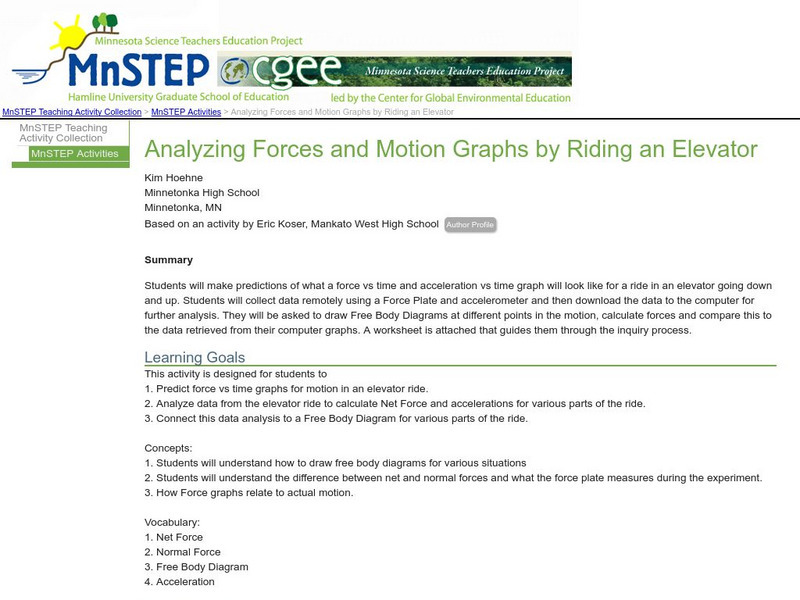
Serc: Analyzing Forces and Motion Graphs by Riding an Elevator
A high school physics lab on classical mechanics in which students study force versus time and acceleration versus time. Students need access to an elevator to complete the experiments. A lab handout is provided.
National High Magnetic Field Laboratory
Magnet Academy: Heinrich Friedrich Emil Lenz
At the turn of the 19th century, scientists were beginning to gain a rudimentary understanding of electricity and magnetism, but they knew almost nothing about the relationship between the two. Baltic German physicist Heinrich Lenz took...
National High Magnetic Field Laboratory
Magnet Academy: John Daniel Kraus
For a man whose career involved the entire known universe, John Kraus had a remarkably insular upbringing. He was born and raised in Ann Arbor, Michigan, and earned his bachelor's, master's and doctoral degrees in physics, all at the...
National High Magnetic Field Laboratory
Magnet Academy: James Clerk Maxwell
James Clerk Maxwell was one of the most influential scientists of the nineteenth century. His theoretical work on electromagnetism and light largely determined the direction that physics would take in the early twentieth century. Indeed,...

National High Magnetic Field Laboratory
Magnet Academy: Jean Charles Athanase Peltier (1785 1845)
Although he didn't start studying physics until he retired from the clock-making business at age 30, French native Jean Peltier made immense contributions to science that still reverberate today. Even with the primitive tools available...
National High Magnetic Field Laboratory
Magnet Academy: Timeline of Electricity and Magnetism: 1880 1889
Nikola Tesla and Thomas Edison duke it out over the best way to transmit electricity and Heinrich Hertz is the first person (unbeknownst to him) to broadcast and receive radio waves.
National High Magnetic Field Laboratory
Magnet Academy: Timeline of Electricity and Magnetism: 1850 1869
The Industrial Revolution is in full force, Gramme invents his dynamo and James Clerk Maxwell formulates his series of equations on electrodynamics.
National High Magnetic Field Laboratory
Magnet Academy: Timeline of Electricity and Magnetism: 1830 1839
The first telegraphs are constructed and Michael Faraday produces much of his brilliant and enduring research into electricity and magnetism, inventing the first primitive transformer and generator.
National High Magnetic Field Laboratory
Magnet Academy: Timeline of Electricity and Magnetism: 1820 1829
Hans Christian Orsted's accidental discovery that an electrical current moves a compass needle rocks the scientific world; a spate of experiments follows, immediately leading to the first electromagnet and electric motor.
National High Magnetic Field Laboratory
Magnet Academy: Timeline of Electricity and Magnetism: 1775 1799
Scientists take important steps toward a fuller understanding of electricity, as well as some fruitful missteps, including an elaborate but incorrect theory on animal magnetism that sets the stage for a groundbreaking invention.
National High Magnetic Field Laboratory
Magnet Academy: Timeline of Electricity and Magnetism: 1700 1749
Aided by tools such as static electricity machines and Leyden jars, scientists continue their experiments into the fundamentals of magnetism and electricity.
National High Magnetic Field Laboratory
Magnet Academy: Timeline of Electricity and Magnetism: 1930 1939
New tools such as special microscopes and the cyclotron take research to higher levels, while average citizens enjoy novel amenities such as the FM radio.
National High Magnetic Field Laboratory
Magnet Academy: Timeline of Electricity and Magnetism: 1600 1699
The Scientific Revolution takes hold, facilitating the groundbreaking work of luminaries such as William Gilbert, who took the first truly scientific approach to the study of magnetism and electricity and wrote extensively of his findings.
National High Magnetic Field Laboratory
Magnet Academy: Timeline of Electricity and Magnetism: 1900 1909
Albert Einstein publishes his special theory of relativity and his theory on the quantum nature of light, which he identified as both a particle and a wave. With ever new appliances, electricity begins to transform everyday life.
National High Magnetic Field Laboratory
Magnet Academy: Timeline of Electricity and Magnetism: 1890 1899
Scientists discover and probe x-rays and radioactivity, while inventors compete to build the first radio.