Hi, what do you want to do?






National Institute of Open Schooling
General Characteristics of the p-Block Elements
The 20th installment in a series of 36 focuses on the characteristics of the p-block elements. Learners discuss, read about, and answer questions pertaining to the occurrence of these elements in nature, their electron configurations,...

Chapman University
The Standard Model Poster
Chemistry classes will appreciate this color-coded, single-page reference sheet for The Standard Model of particle physics. It is divided into two main sections: elementary particles and compound particles, both with their antiparticles....
Simon Fraser University
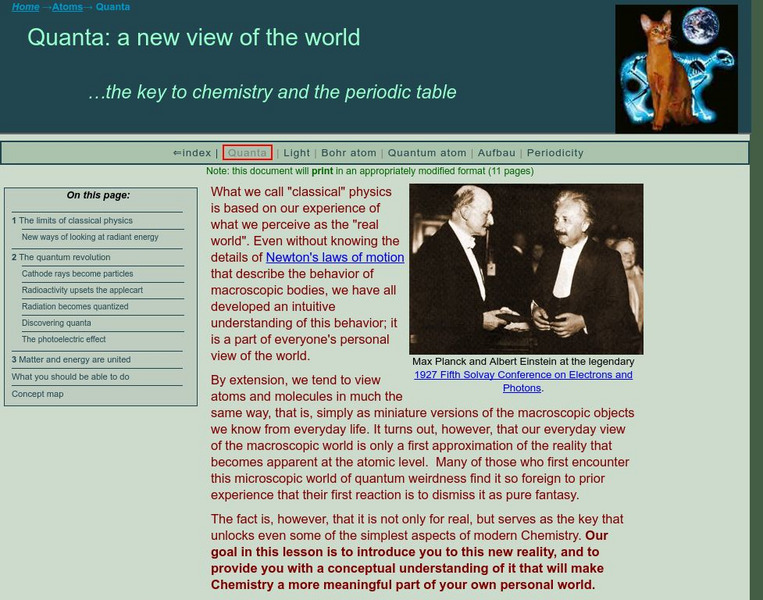
Chem1 Virtual Textbook: The Limits of Classical Physics
Acting as a subtopic of the General Chemistry Virtual Textbook's section on Atoms and the Periodic Table, this site discusses the limits associated with classical physics. Topics covered include light and heat with additional information...
Other
Laws of Physics: Atoms and the Periodic Table
An overview of the differences between the metal and non metal groups. Includes a lot of information on the periodic table and has a plethora of graphs.

University of Colorado
University of Colorado: Physics 2000: Elements as Atoms: Quantum Numbers
Each electron has a set of quantum numbers that specify it's location, orbital, and energy in a unique manner.
University of Colorado
University of Colorado: Physics 2000: Elements as Atoms: Electron Clouds and Energy Levels
An explanation of the different types of atomic orbitals, how they are filled according to the Pauli Exclusion Principle, and how many electrons can fit in each electron shell.
University of Colorado
University of Colorado: Physics 2000: Elements as Atoms: Spin
A basic explanation of spin and how it relates to electrons and quantum numbers.
Wikimedia
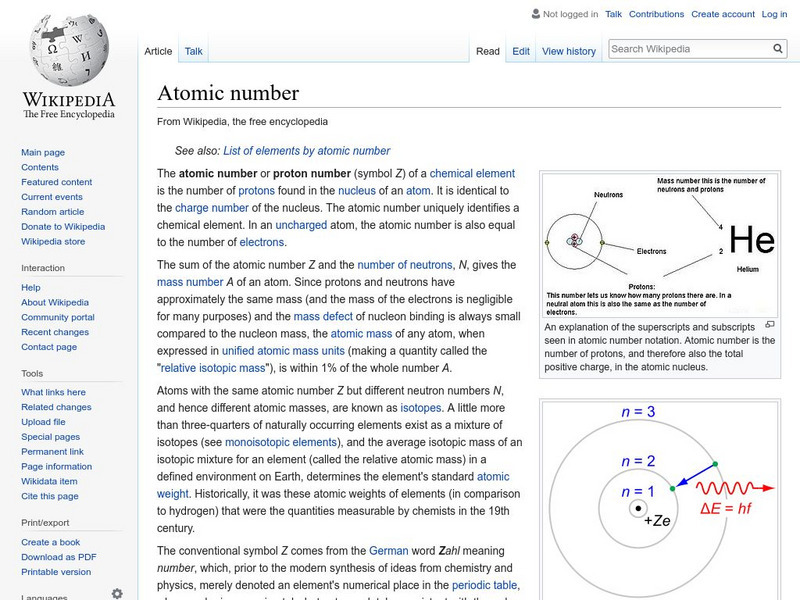
Wikipedia: Atomic Number
Wikipedia provides the definition of the term, "Atomic number," a term used in chemistry and physics to represent the number of protons in the nucleus of an atom.

National High Magnetic Field Laboratory
Magnet Academy: Enrico Fermi
Enrico Fermi was a titan of twentieth-century physics. He outlined the statistical laws that govern the behavior of particles that abide by the Pauli exclusion principle and developed a theoretical model of the atom in his mid-twenties....