Hi, what do you want to do?






Physics Classroom
The Physics Classroom: Momentum and Collisions: Collision Carts Activity 1
A virtual collision track with colliding or exploding carts allows students to explore elastic and inelastic collisions. They can vary the mass of the two carts and their pre-collision velocities. An accompanying activity sheet which...
Physics Classroom
The Physics Classroom: Momentum and Collisions: Collision Carts Activity 2
A virtual collision track with colliding or exploding carts allows students to explore elastic and inelastic collisions. They can vary the mass and velocities of the two carts. An accompanying activity sheet which focuses on elastic...
Physics Aviary
Physics Aviary: Practice Problems: Energy on Incline Level 2
Students must predict the distance a box will move up an incline based on energy conservation. There will be friction present and some of the original KE will turn into heat.
Physics Aviary
Physics Aviary: Practice Problems: Power of Motor for Billy on Hill (Level 1)
Students must determine the power that is being exerted by a motor to pull a person up a frictionless incline.
Physics Aviary
Physics Aviary: Practice Problems: Billy on Hill (Level 2)
Students must predict the distance traveled by a person on a sled. The person will start with potential energy due to gravity and then lose some energy on a hill. They will then lose the remaining energy on a level surface. You have to...
Physics Aviary
Physics Aviary: Atwood Machine Lab
This lab was designed to have students practice the Atwood lab prior to doing it for real. Students can adjust the masses and the planet and then collect position vs. time data and velocity vs. time data.
Physics Aviary
Physics Aviary: Practice Problems: Forces on Incline Problem Medium
Students must find out force normal on an object on an incline at the angle at which the object is first about to slip.
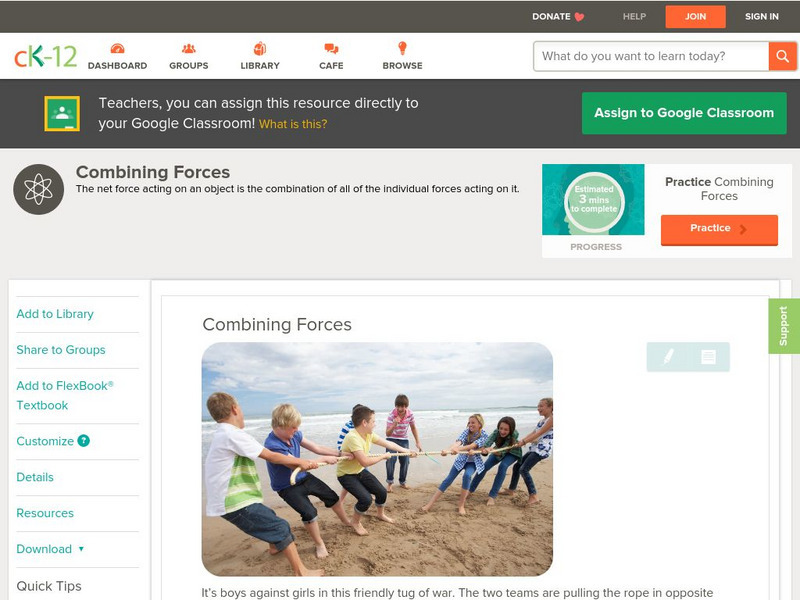
CK-12 Foundation
Ck 12: Physical Science: Combining Forces
[Free Registration/Login may be required to access all resource tools.] Featurea the definition of combining forces: Pulling down and pushing up, forces acting in opposite directions, forces acting in the same direction.
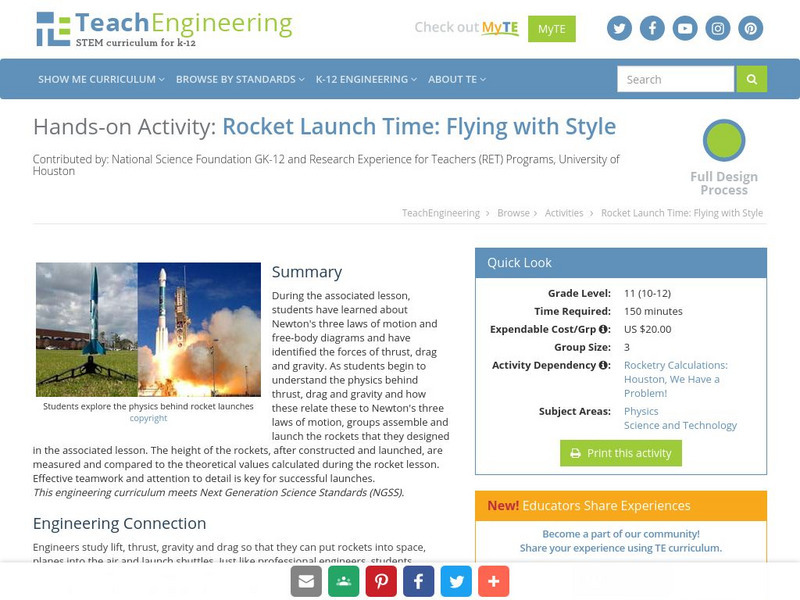
TeachEngineering
Teach Engineering: Flying With Style
As students begin to understand the physics behind thrust, drag, and gravity and how these relate these to Newton's three laws of motion, groups assemble and launch the rockets that they designed in the associated lesson.

OpenStax
Open Stax: Applications of Statics, Including Problem Solving Strategies
From a chapter on Statics and Torque in a Physics textbook. This section of the chapter discusses how statics can be applied in the real world, and strategies for solving statics problems. Includes a question, two exercises, and a...
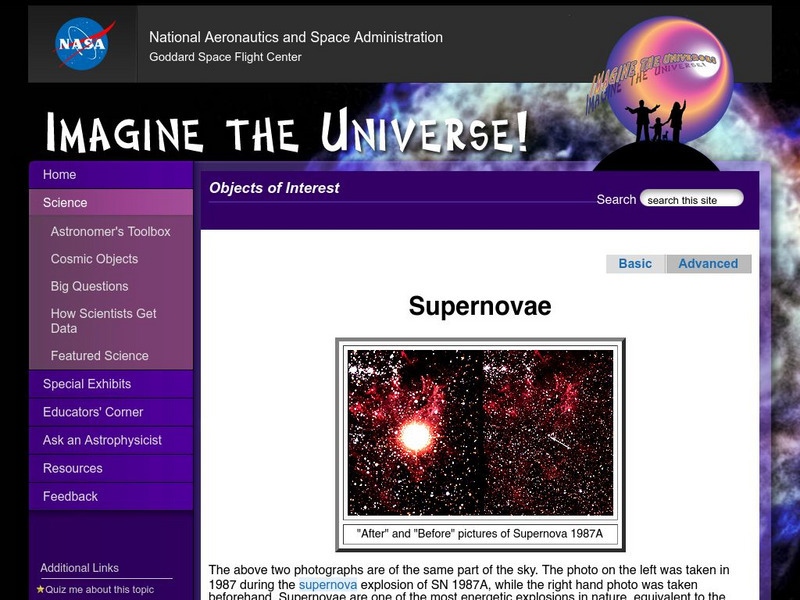
NASA
Nasa: Imagine the Universe: Supernovae (Advanced)
Supernovae are divided into two basic physical types, including a description of supernova types and how they are classified based on the existence of hydrogen spectral lines. Definitions of key terms are provided.
Science Buddies
Science Buddies: Back and Forth to Go Forward: A Snake on Wheels?
Have you ever ridden on a Roller Racer or Plasma Car? These are ride-on toys that you move ahead by moving the steering mechanism back and forth. You've probably seen skateboarders "slaloming" on level ground to keep rolling, it's...
Georgia State University
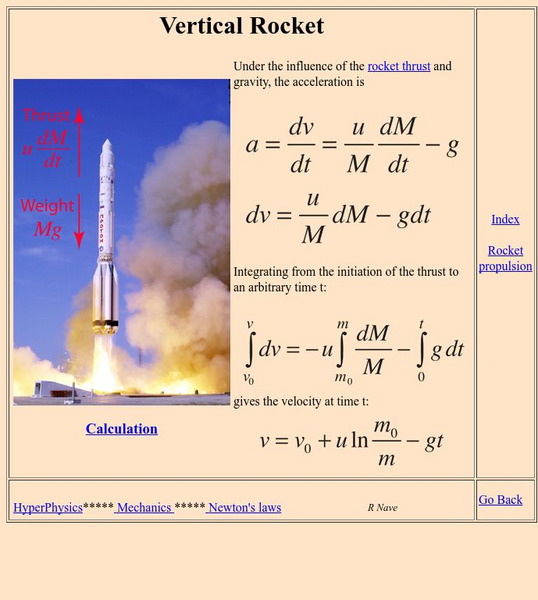
Georgia State University: Hyper Physics: Rockets
HyperPhysics site with dealing with the mathematics of rocket flight. The site is interactive and allows the user to input data. This is a rather high level site and, while any student could use it to get answers, to understand some of...

American Association of Physics Teachers
Com Padre Digital Library: Open Source Physics: Ballistics and Orbits Model
Experience a simulation of ballistic trajectories in relationship to Earth's orbit. Java 1.5 or more recent is required.
Texas Education Agency
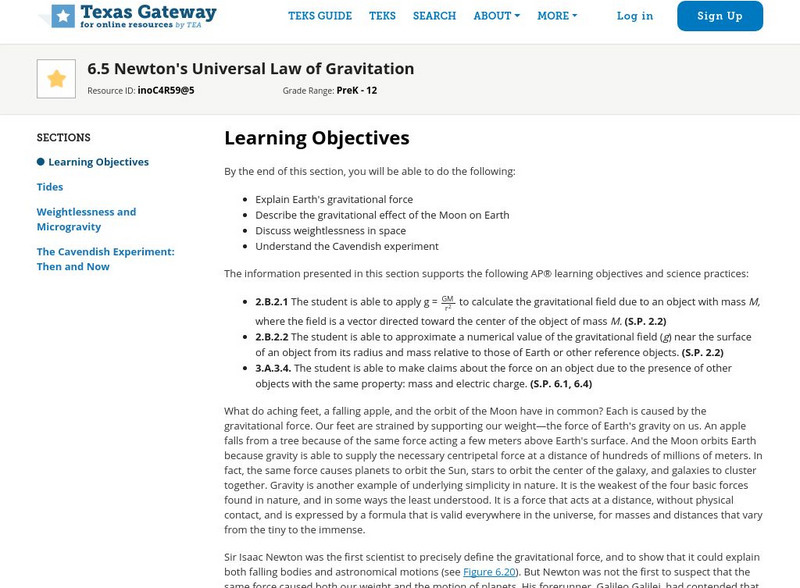
Texas Gateway: Newton's Universal Law of Gravitation
By the end of this section, you will be able to explain Earth's gravitational force, describe the gravitational effect of the Moon on Earth, discuss weightlessness in space, and understand the Cavendish experiment.
OpenStax
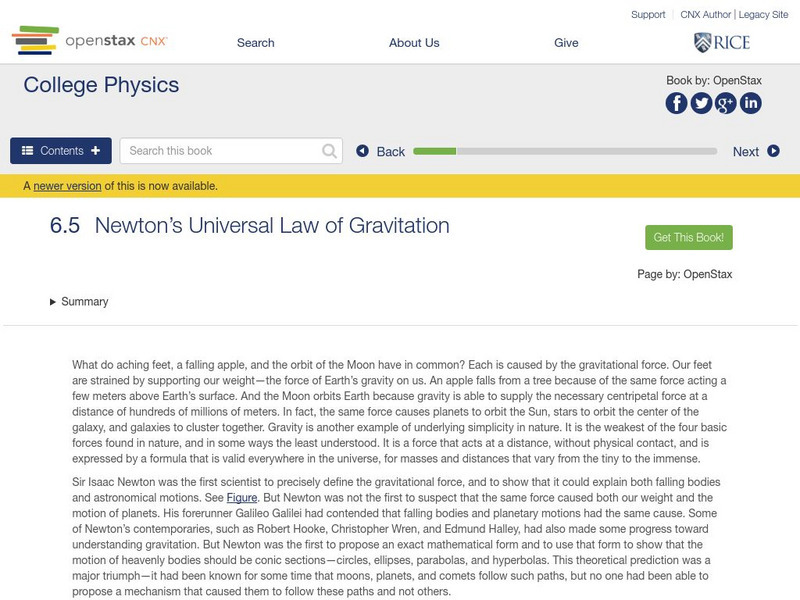
Open Stax: Newton's Universal Law of Gravitation
In the following interactive students will explain Earth's gravitational force and describe the gravitational effect of the Moon on Earth. They will discuss weightlessness in space and examine the Cavendish experiment.

TeachEngineering
Teach Engineering: The Science of Swinging
Learners learn what a pendulum is and how it works in the context of amusement park rides. While exploring the physics of pendulums, they are also introduced to Newton's first law of motion - about continuous motion and inertia.
Texas Education Agency
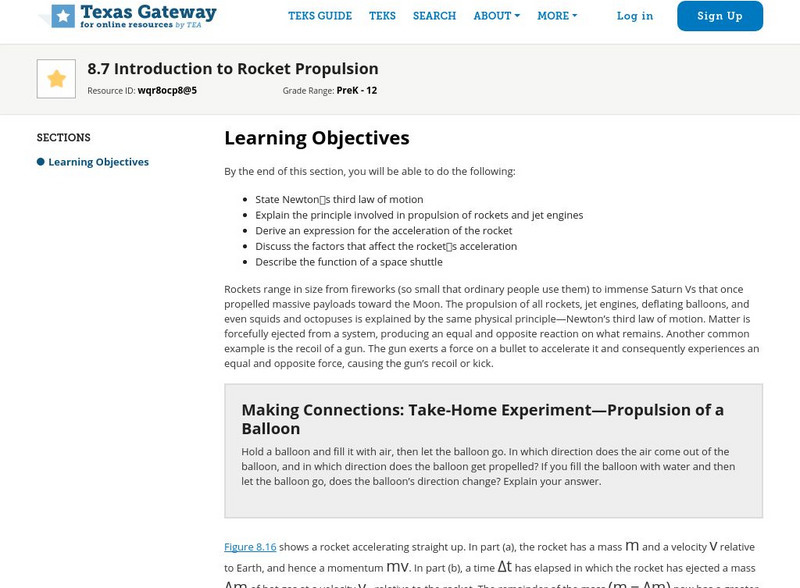
Texas Gateway: Linear Momentum and Force: Introduction to Rocket Propulsion
By the end of this section, you will be able to state Newton's third law of motion, explain the principle involved in propulsion of rockets and jet engines, derive an expression for the acceleration of the rocket , discuss the factors...
CK-12 Foundation
Ck 12 Exploration Series: Simulations: Physics: Collisions
[Free Registration/Login Required] This sim explains the concept of elastic and inelastic collision using two bumper cars. A PDF worksheet and a video tutorial are also available. [3:40]
TeachEngineering
Teach Engineering: Into Space!
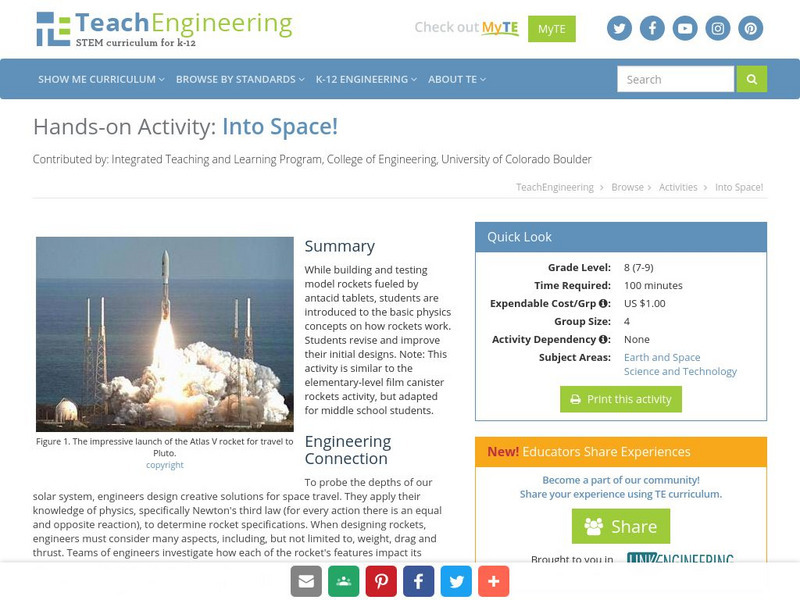
While building and testing model rockets fueled by antacid tablets, students are introduced to the basic physics concepts on how rockets work. Students revise and improve their initial designs. Note: This activity is similar to the...
Other
Bscs: Forces and Motion Content Background Document
In this document, we will try to answer a fundamental question of physical science, "Why do things start to move, slow down, speed up, stop moving or change direction?" In answering these core questions we can develop concepts that can...
University of Minnesota
University of Minnesota: Mechanics Problems: Force Problems
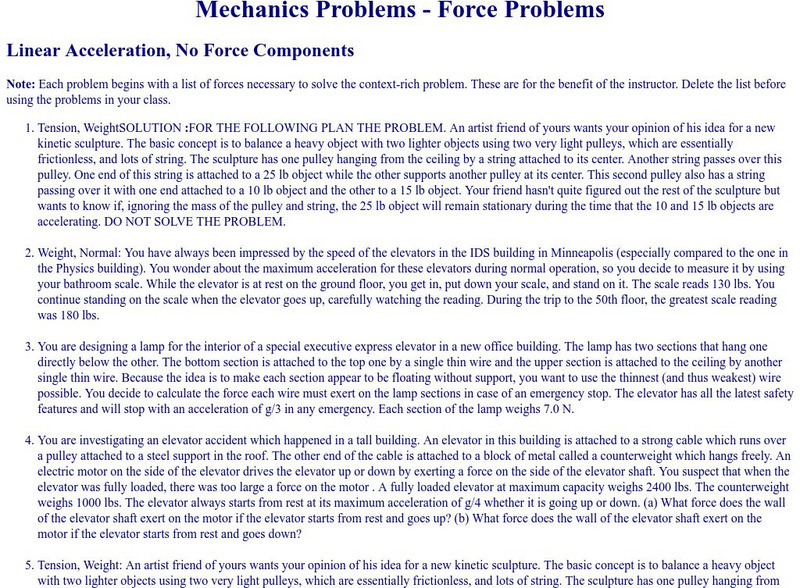
This University of Minnesota site provides a series of contextually rich, real-world problems demonstrating force and Newton's second law of motion.
Physics Classroom
The Physics Classroom: Circular and Satellite Motion: Centripetal Force
Through illustrated examples and practice problems, students explore the centripetal force requirement. So for an object moving in a circle, there must be an inward force acting upon it in order to cause its inward acceleration.
Physics Classroom
The Physics Classroom: Vectors: Forces in Two Dimensions: Addition of Forces
In this tutorial, examine the effect of forces acting at angles to the horizontal, such that the force has an influence in two dimensions- horizontally and vertically.