Hi, what do you want to do?






Curated OER
Falling Objects
High schoolers examine the velocities of two different falling objects. They produce distance vs. time and velocity vs. time graphs using a Motion Detector and a CBL 2 to collect experimental data. Learners analyze and interpret the...

Curated OER
Tubularastic Roller Coaster
Students observe the effect of gravity on objects. They use tubing and other materials to simulate a roller caster. Afterward, they create a journal to write their observations and summaries.

Curated OER
Hit and Run
Pupils explore data collection in this lesson. They investigate distance vs. time and velocity vs. time graphs using information collected with a CBR 2 to simulate the reconstruction of an accident.

Curated OER
Galileo Galilei Questions for Study
In this online interactive philosophy worksheet, students respond to 10 short answer and essay questions about Galileo's contributions to science.

Curated OER
Let's Outrage the Bull
Students study kinetic and potential energy. In this energy instructional activity, students in grades K-2 understand the differences between kinetic and potential energy. Students in grades 3-5 demonstrate that kinetic and potential...
OpenStax
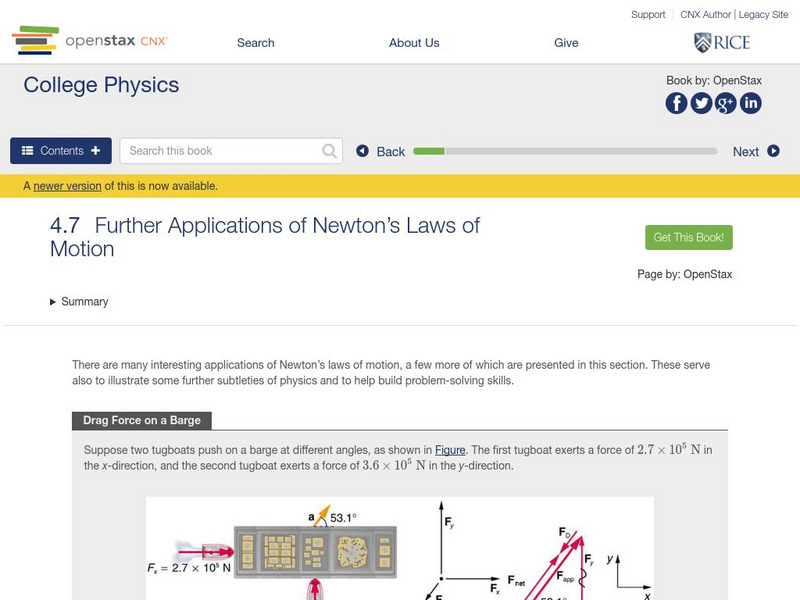
Open Stax: Further Applications of Newton's Laws of Motion
In the following interactive students will begin to apply problem-solving techniques to solve for quantities in more complex systems of forces. They will also integrate concepts from kinematics to solve problems using Newton's laws of...
Georgia Department of Education
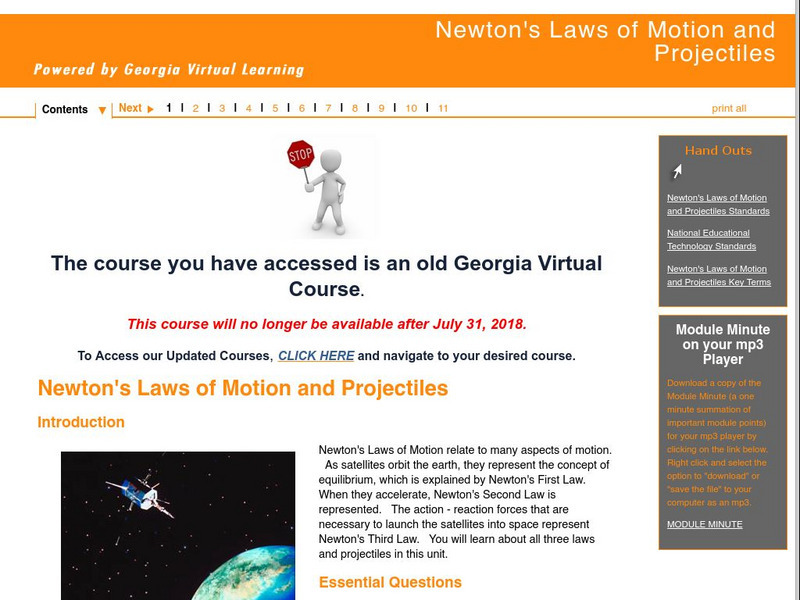
Ga Virtual Learning: Newton's Laws of Motion and Projectiles
Through informational text, interactive activities, practice problems, online labs, virtual simulations, and video clips, students learn about Newton's Laws of Motion.
Texas Education Agency
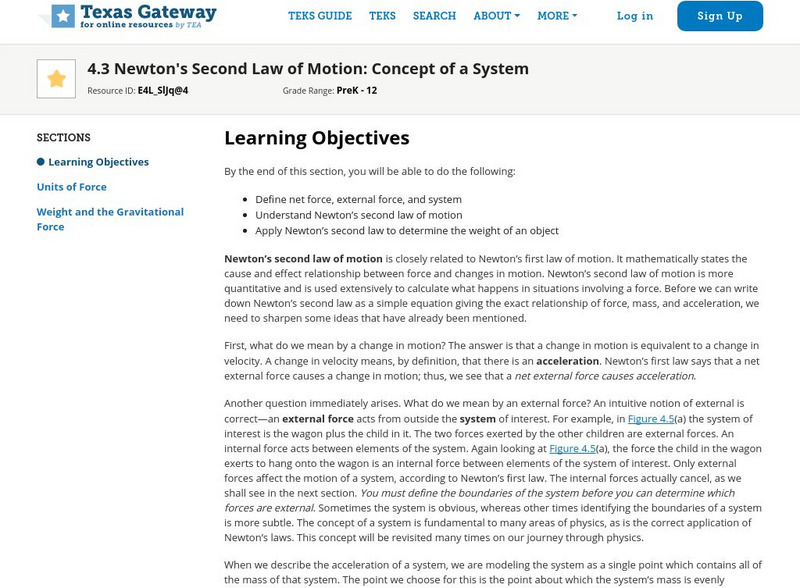
Texas Gateway: 4.3 Newton's Second Law of Motion: Concept of a System
By the end of this section, you will be able to define net force, external force, and system; understand Newton's second law of motion; and apply Newton's second law to determine the weight of an object.
OpenStax
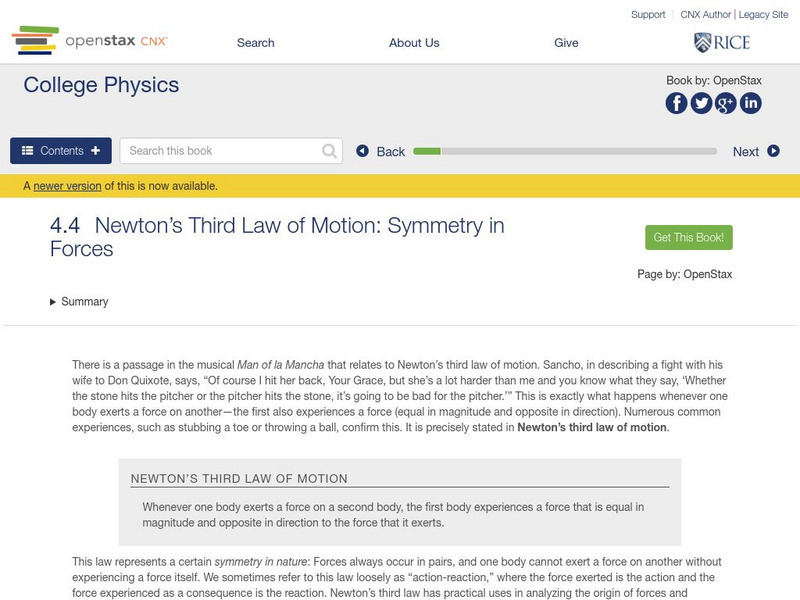
Open Stax: Newton's Third Law of Motion: Symmetry in Forces
In the following interactive students will begin to understand Newton's third law of motion and also apply it to define systems and solve problems of motion.
OpenStax
Open Stax: Newton's Second Law of Motion: Concept of a System
In the following interactive students will begin to define net force, external force, and system and understand Newton's second law of motion. They will also apply Newton's second law to determine the weight of an object.
Texas Education Agency
Texas Gateway: Problem Solving Strategies for Newton's Laws of Motion
By the end of this section, you will be able to apply a problem-solving procedure to solve problems using Newton's laws of motion.
CK-12 Foundation
Ck 12: Newton's Third Law of Motion
[Free Registration/Login may be required to access all resource tools.] Students find out about Newton's Third Law of Motion, and explore situations involving multiple objects.

Physics Classroom
The Physics Classroom: Newton's Laws of Motion
Use this outline to find out about Newton's Laws of Motion. Use the different lesson plans covering the laws of motion to learn more.
Georgia Department of Education
Ga Virtual Learning: Ap Physics 1: Applications of Newton's Laws of Motion
Students apply Newton's laws to more diverse physical settings where multiple forces from varying origins interact. To aid in condensing the physical setting into mathematical expressions, the free body diagram is used in this module...

Georgia Department of Education
Ga Virtual Learning: Physical Science: Force and Motion
In this student-paced module, students apply Newton's Laws of Motion to everyday life, calculate mathematical relationships involving force and motion using algebraic formulas, and understand the difference between mass and weight.
Texas Education Agency
Texas Gateway: 4.7 Further Applications of Newton's Laws of Motion
By the end of this section, you will be able to apply problem-solving techniques to solve for quantities in more complex systems of forces and to integrate concepts from kinematics to solve problems using Newton's laws of motion.
Texas Education Agency
Texas Gateway: 4.4 Newton's Third Law of Motion: Symmetry in Forces
By the end of this section, you will be able to understand Newton's third law of motion and apply Newton's third law to define systems and solve problems of motion.
Texas Education Agency
Texas Gateway: 4.2 Newton's First Law of Motion: Inertia
By the end of this section, you will be able to define mass and inertia and to understand Newton's First Law of Motion: There exists an inertial frame of reference such that a body at rest remains at rest, or, if in motion, remains in...
Texas Education Agency
Texas Gateway: Glossary for Forces and Newton's Laws
This is a glossary of terms and definitions used in Chapter 4: Force and Newton's Laws of Motion from the AP Physics online text.

Exploratorium
Exploratorium: Science Snacks: Physics/mechanics (Force and Motion)
A collection of mechanics activities. Many pertain to Newton's laws of motion. Step-by-step directions provided with illustrations. Great for teacher demos or student projects.
OpenStax
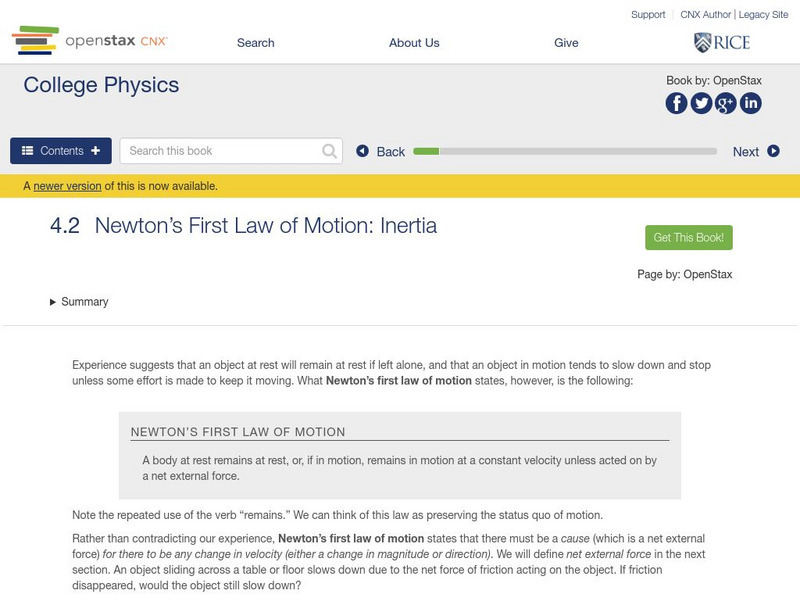
Open Stax: Newton's First Law of Motion: Inertia
In the following interactive students will begin to define mass and inertia and understand Newton's first law of motion.
Texas Education Agency
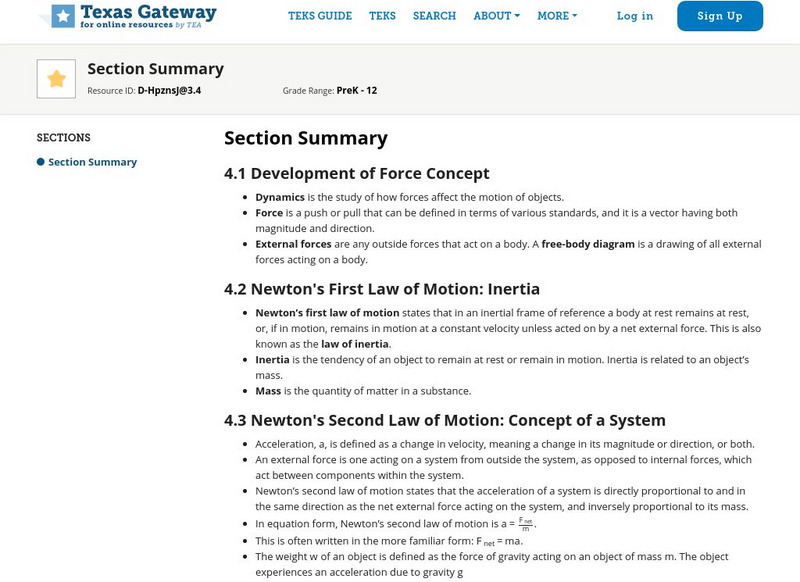
Texas Gateway: Force and Newton's Laws: Section Summary
This page summarizes each section of Chapter 4: Dynamics: Force and Newton's Laws of Motion in the AP Physics online text. These include Newton's three laws of motion and application of those and other forces.
Texas Education Agency
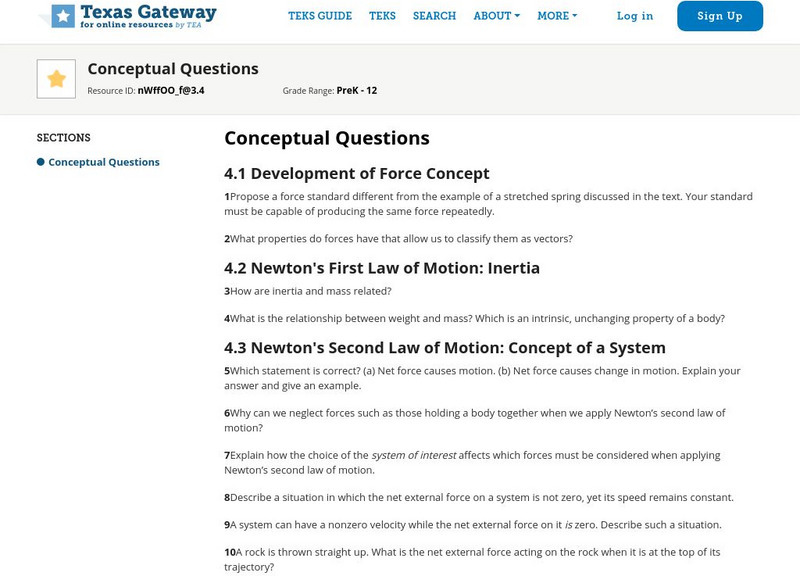
Texas Gateway: Force and Newton's Laws: Conceptual Questions
This page offers 27 questions to test students' knowledge of the major concepts in each section of Chapter 4: Dynamics: Force and Newton's Laws of Motion from the AP Physics online text.
Georgia Department of Education
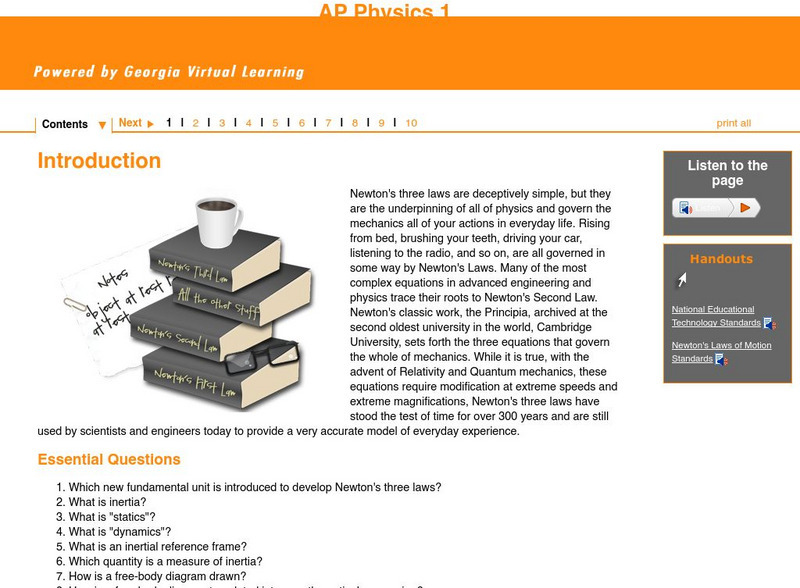
Ga Virtual Learning: Ap Physics 1: Newton's Laws of Motion
Newton's three laws are deceptively simple, but they are the underpinning of all of physics and govern the mechanics all of your actions in everyday life. Take an in-depth look at these laws in this learning module.