Hi, what do you want to do?





Other
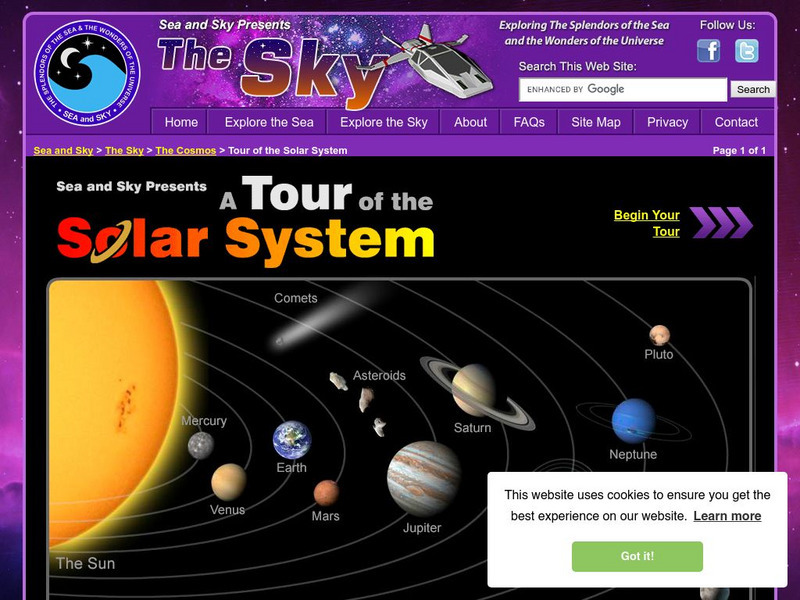
Sea and Sky: A Tour of the Solar System
Take a virtual tour of the solar system starting with detailed information about the sun.

PBS
Pbs Learning Media: Scaled Images of the Solar System
Use the following lithographs to envision the scale of our solar system. View different models of planets at different scales, an infographic about the relative sizes of the planets and distance from the sun, and images of the largest...
PBS
Pbs Learning Media: Solar System Scale Model
Teach the concept of scale models and the size of the solar system through this extensive lesson plan. Students will learn about scale models, estimate which objects to use to create a scale model of Earth and Sun, and figure out how far...
Views of the Solar System
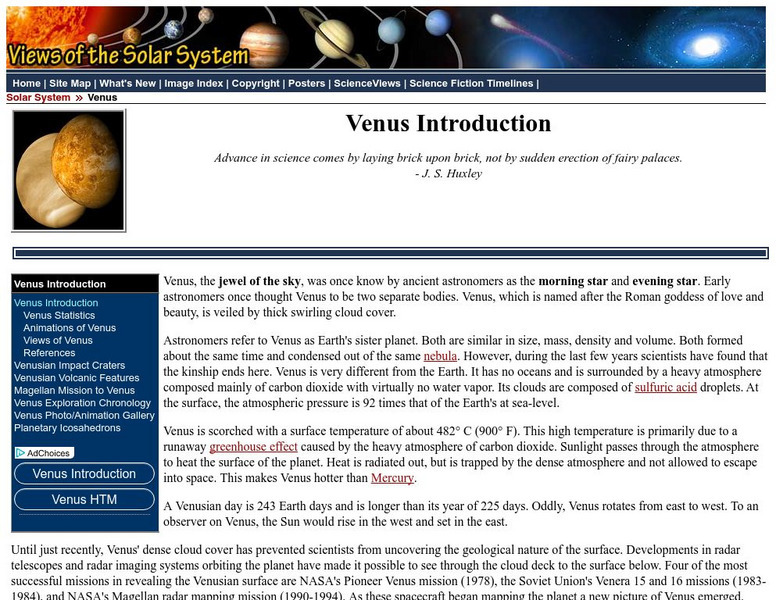
Views of the Solar System: Venus
Discover interesting information about the planet Venus through a vast archive of photographs and scientific facts.

Alabama Learning Exchange
Alex: Inner and Outer Planets of the Solar System
For this science lesson students will work collaboratively to learn and introduce the eight planets, sizes, characteristics, and their order. They will use size comparisons, research a planet, design a poster and create a PowerPoint...
NASA
Nasa: Solar System Exploration
Enter our solar system to interact with the planets, moons, asteroids, meteors, and more. Investigate with NASA scientists and explore missions related to space exploration. Read facts, compare statistics, look through resources, and...
Science Buddies
Science Buddies: How Big Are the Planets in Our Solar System?
This activity explores the relative size of the eight planets that circle around the Sun.
Harvard University
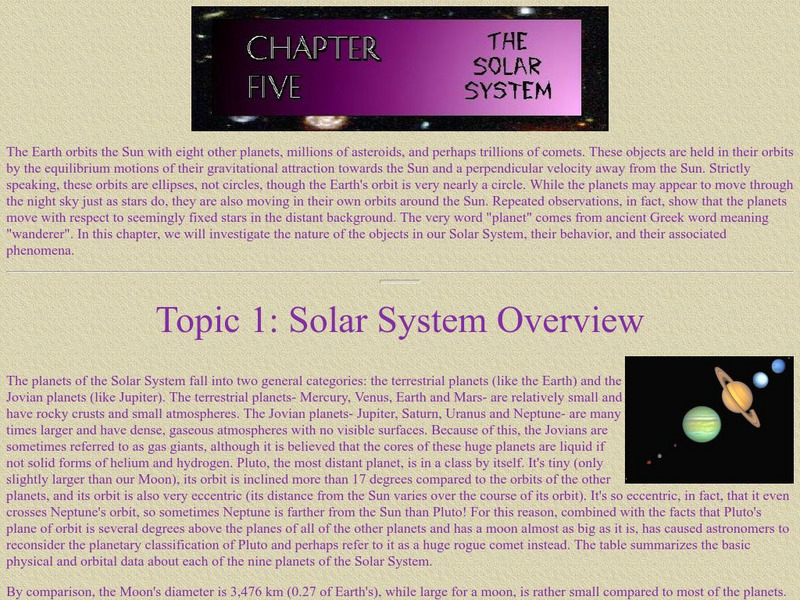
Harvard University: The Solar System
These hands-on activities are a great way for students to gain perspective on the relative sizes and distances of each planet, the relationship between the sun and Earth, and much more.
National Geographic
National Geographic: Extreme Weather on Other Planets
Examine the variety of weather found on all of the planets in the solar system with this classroom exercise. Students will see a video and observe differences and similarities among the planets.
University of Texas at Austin
The University of Texas Mc Donald Observatory: Jupiter
Discover interesting facts about Jupiter, the largest planet in the solar system.
University of Texas at Austin
The University of Texas Mc Donald Observatory: Saturn
Discover interesting facts about Saturn, the second-largest planet in the Solar System.
PBS
Pbs Learning Media: All Planet Sizes
This illustration from the Lunar and Planetary Laboratory shows the approximate sizes of the planets relative to each other. Note that the planets are not shown at appropriate distances from the Sun.

NASA
Nasa: Astronomy Picture of the Day: Titania, Uranus's Largest Moon
A brief overview of Titania, Uranus's largest moon. Includes a very good description of the moon's surface. A NASA picture of the day.
Other
Planetary Science Institute: Building Planets at Psi
An article about the Planetary Science Institutes's advanced computer software, which it uses to model the way the solar system may have formed. Includes some insights into the results already obtained.

NASA
Nasa: Jet Propulsion Laboratory: Planet Quest: Exoplanet Exploration
Constellation of articles, images, diagrams, posters, videos, and more on the subject of the search for planets, particularly Earth-like planets, outside our solar system.
Nine Planets
The Nine Planets: The Moon
Explore the mythology, structure, observational history, gravitational force, and orbit of Earth's Moon.
TeachEngineering
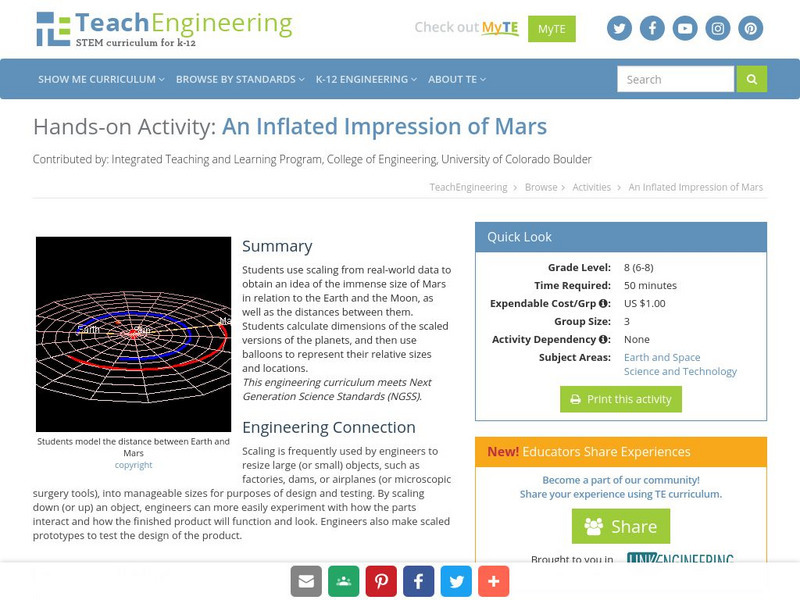
Teach Engineering: An Inflated Impression of Mars
The purpose of this activity is to use scaling in order to give students an idea of the size of Mars in relation to the Earth and the Moon as well as the distance between them. The students will have to calculate dimensions of the scaled...
American Museum of Natural History
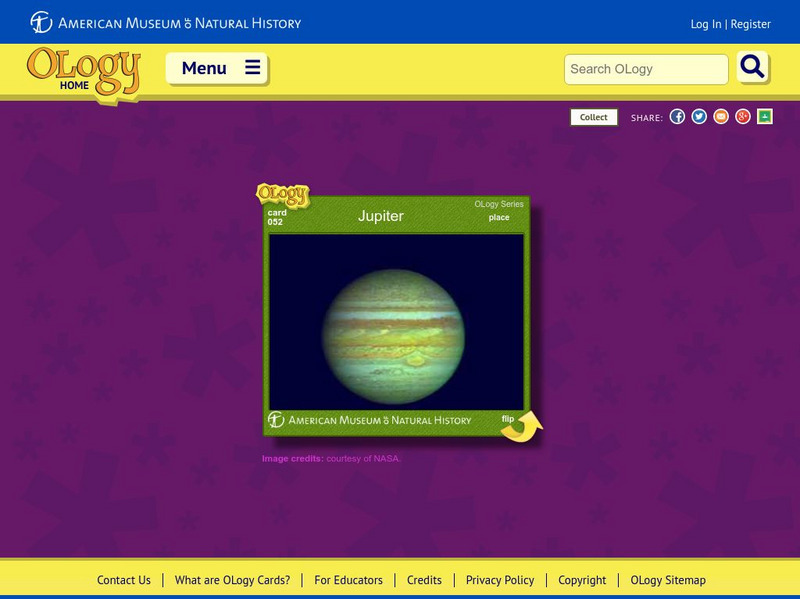
American Museum of Natural History: Jupiter O Logy Card
Flip this interactive card to start learning about Jupiter, the largest planet in our solar system. Answer multiple-choice and fact-or-fiction questions and review some fast facts about Jupiter.

TeachEngineering
Teach Engineering: The Outer Planets
Students explore the outermost planets of our solar system: Saturn, Uranus and Neptune. They also learn about characteristics of Pluto and its interactions with Neptune. Students learn a little about the history of space travel as well...
NASA
Nasa: Planets in a Bottle
In this simple lesson, students grow yeast to learn how the climates on each of the nine planets would affect life.
University of Texas at Austin
The University of Texas Mc Donald Observatory: Mars
Discover interesting facts about Mars, the furthest planet from the sun.
TeachEngineering
Teach Engineering: Our Big Blue Marble
Young scholars are introduced to the fabulous planet on which they live. Even though we spend our entire lives on Earth, we still do not always understand how it fits into the rest of the solar system. Students learn about the Earth's...
TeachEngineering
Teach Engineering: Not So Lost in Space
Students learn how engineers navigate satellites in orbit around the Earth and on their way to other planets in the solar system. In accompanying activities, they explore how ground-based tracking and onboard measurements are performed....

Ducksters
Ducksters: Astronomy for Kids: The Planet Earth
This site is astronomy for kids and teachers! Here students can learn about the planet Earth of the Solar System including fun facts, mass, day, year, and distance from the Sun.