Hi, what do you want to do?





Science Buddies
Science Buddies: Project Ideas: Rad Radishes: Irradiation on Seed Germination
In this plant biology science fair project, students will investigate effects of irradiation on seed germination. The Science Buddies project ideas are set up consistently beginning with an abstract, objective, and introduction, followed...
Science Buddies
Science Buddies: Project Ideas: Using Plants to Determine Direction
Don't get lost in the woods. In this plant biology science fair project, students will investigate whether the location of moss growth on trees is a good way to determine cardinal direction. The Science Buddies project ideas are set up...

Science Buddies
Science Buddies: One Bad Apple Spoils the Whole Bunch: Plant Hormone Ethylene
We have all heard the old saying, "One bad apple spoils the whole bunch." Due to the production of the plant hormone ethylene during the ripening process, this saying proves true. This experiment will investigate the role of ethylene in...
Science Buddies
Science Buddies: Hydrogen Peroxide on Plant Root Cuttings & Seed Germination
Hydrogen peroxide (often used as a disinfectant) has also been approved for use in pesticides. This science fair project investigates whether hydrogen peroxide has any effects on seed germination or on roots of plant cuttings.

Science Buddies
Science Buddies: Reveal the Red: Exploring the Chemistry of Red Flower Pigments
Are all reds the same? Find out in this science fair project. Investigate if the pigments in one type of red flower are different from those in another type of red flower. Flowers contain an assortment of amazing chemicals that produce...

Science Buddies
Science Buddies: It's Raining, It's Pouring: Chemical Analysis of Rainwater
Here is an interesting project that could be approached from several different scientific angles: Environmental Science, Weather & Atmosphere, Chemistry, or Plant Biology. You can probably think of your own variations to emphasize...
Science Buddies
Science Buddies: It's Crowded in Here! A Study of Plant Population Density
Like humans, plants can be negatively affected by overcrowding. Unlike humans, plants cannot get up and move to a new environment or explore how to utilize new resources. This experiment will explore the effects of crowding (population...

Science Buddies
Science Buddies: What Color Are the Leaves Really Turning?
Everyone loves the beautiful colors of fall, but where they come from and how they change color is a mystery. In this project, you will uncover the hidden colors of fall by separating plant pigments with paper chromatography.
Science Buddies
Science Buddies: Vines & Spines: Thigmotropism in Morning Glory Tendrils
We tend to think of plants as immobile, but the tendrils of a vine, such as the morning glory, actually move in response to touch. Tendrils wrap around structures, which give the plant something to grow on. In this science fair project,...
Science Buddies
Science Buddies: Weeds Be Gone! Experiment That Affect Roundup Weed Killer
Experiment with factors that affect the activity of the weed killer Roundup. The Science Buddies project ideas are set up consistently beginning with an abstract, objective, and introduction, followed by a section on terms, concepts, and...

BiologyWise
Biology Wise: Simple Steps on How to Build a Plant Cell Model
Describes the steps in how to make a model of a plant cell using simple materials and sweet foods like jello and candy.
Science Buddies
Science Buddies: Growing, Growing, Gone! An Experiment on Nitrogen Fertilizers
Plants need nitrogen to build proteins and nucleic acids to grow healthy stems and leaves. Though the Earth's atmosphere is made up of 79% nitrogen, the form of nitrogen found in the atmosphere cannot be used by plants. In this...
BiologyWise
Biology Wise: Tips on How to Make a 3 D Plant Cell Model
Describes the steps in how to make a model of a plant cell using clay and simple materials found at home. Suggestions for variations are also given.
Science Buddies
Science Buddies: Nitrogen Fixing Bacteria and Nitrogen Fertilizers
Plants need nitrogen to build proteins and nucleic acids to grow healthy stems and leaves. Though the Earth's atmosphere is made up of 79% nitrogen, the form of nitrogen found in the atmosphere cannot be used by plants. In this...
Other
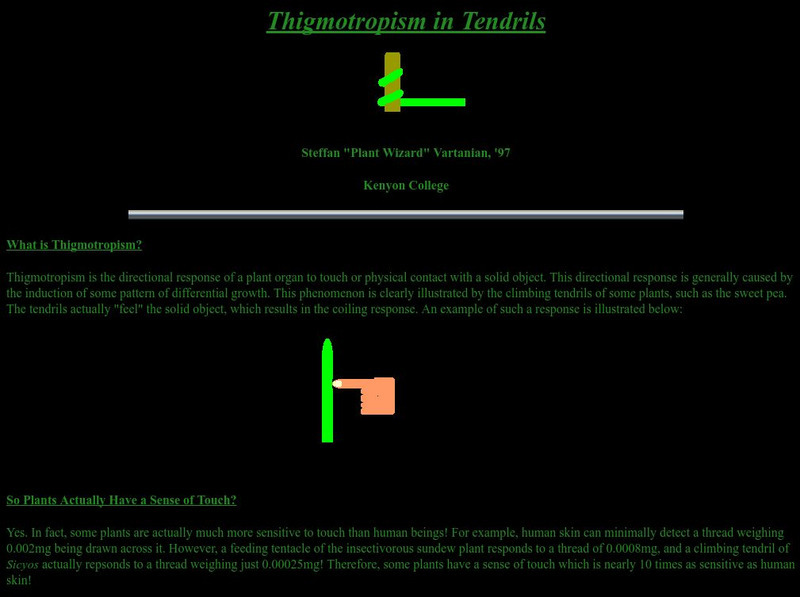
Kenyon College: Thigmotropism in Tendrils
What is thigmotropism? Do plants have a sense of touch? What causes plants to curve toward the stimulus? Animated illustrations help to provide these answers and more. Hint: highlighting the text makes it easier to read.