Hi, what do you want to do?






Curated OER
Obtaining Food -- The Impact of Over-fishing
Students play a fishing game. In this food supply lesson students regulate their fishing in a game about over-fishing. The students identify resources that could be extracted from that biome.

Curated OER
Cloze Passage: Destruction of the Earth
In this destruction of the earth cloze procedure worksheet, students fill in the 12 missing words in the passage to help identify their reading level.

Curated OER
Fossils: The Eras of the Earth's History
Learners research the four geologic eras of Earth's history. In this extension on a fossils lesson, students research the different eras of Earth's history. Learners use AppleWorks to create a bar graph containing information of the four...

Curated OER
Knowledge Quiz: Bacteria
In this bacteria quiz worksheet, students complete a set of 10 multiple choice questions covering a variety of concepts related to bacteria. A reference web site is included for additional resources.

Curated OER
Nature Quiz
In this nature worksheet, students complete a short answer quiz about the natural occurrences in nature. Students complete 10 questions.

Curated OER
Winter
Students examine how animals adapt to the harsh New England winter. They discuss articles they have read on the subject.

US Department of Energy
Your Own Greenhouse
Young science learners construct a greenhouse out of a plastic bottle. They use a nail to punch a hole through which a thermometer will be inserted to monitor the temperature. This simple experiment easily demonstrates the greenhouse...

Curated OER
Bat Facts
Student's demonstrate an understanding of basic facts about bats by creating a picture representation of bats in their habitat describing information they learned. The lesson is especially favorable for visual learners.

Curated OER
Exploring Bats
Third graders create a graphic organizer about bats in cooperative groups. The graphic organizer is used to illustrate the information that has been researched. The specific graphic organizer is the KWL.

Curated OER
Bacteria
In this bacteria worksheet, students fill in the blanks with the correct word. Students then label the structures found on a bacterium.

Curated OER
Landfills: A Solid Waste Management Plan
Learners are able to list the types of household waste that they produce daily. They are able to describe some other types of waste that are produced by industry or agriculture to help maintain their lifestyles. Students are able to...

Curated OER
Water Cycle in a Bottle
Students study the water cycle. In this water science lesson plan, students complete a water cycle experiment using soda bottles.

Curated OER
Graphic Organizers Aid Comprehension
Learners create story webs to aid comprehension of ecosystems. In this reading strategies lesson, students discover the importance of organizing information while reading a nonfiction text. Learners produce story webs to communicate...

Curated OER
The Rain Forest
Young scholars explain the basics of the tropical rain forest ecosystem. They list the four general layers of vegetation found in the tropical rain forest.

Curated OER
Forests of the World
In this forests worksheet, students read a one page informational excerpt on different forests throughout the world. They then use what they learned to answer the 20 questions on the worksheet. The answers are on the last page of the...

Curated OER
Earth Day
In this crossword puzzle worksheet, students identify the words that relate to Earth Day by reading the 14 clues. Students complete the crossword puzzle with the clues.

Curated OER
What's Hiding in the Air?
Fifth graders conduct experiments to study the effects of invisible air pollutants including one with a bean plant. They examine methods of invisible air pollutants.

Science Education Resource Center at Carleton College
Serc: Our Big Backyard: How Does Our Local Ecosystem Change During the Year?
Get students observing the environment around their school with this activity. In this lab experiment, students keep a journal containing written observations and digital pictures of how local flora and fauna change during the school year.
Environmental Education for Kids
Eek!: Activity: Trees and Air Quality
Site offers lessons and activities designed to supplement study of the environment and ecology. Concise explanations are presented on the importance of trees in our world. Also, problem solving and creative thinking is encouraged...

US Department of Agriculture
United States Department of Agriculture: Ozone Spells "Ouch" for Some Plants
Ozone can damage plants and harm our lungs as well. Find out how in this this informative and interesting site.
TeachEngineering
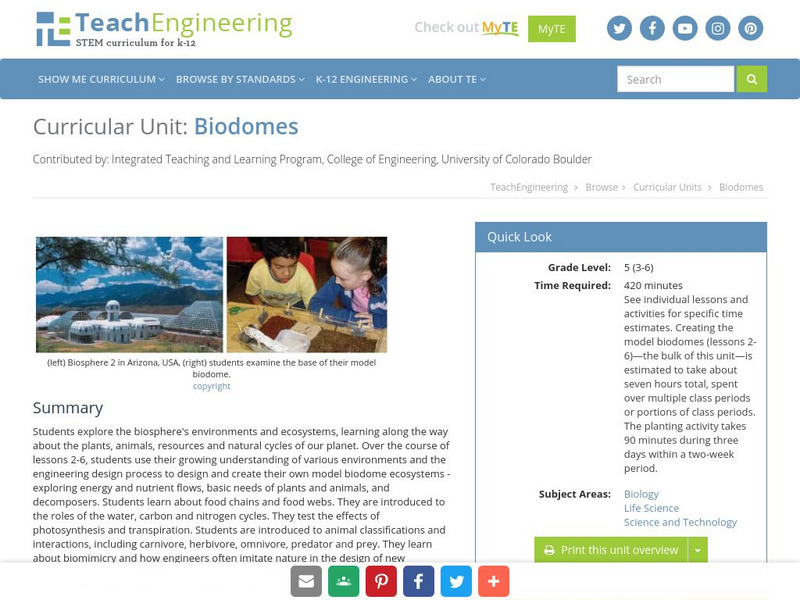
Teach Engineering: Biodomes
Students explore the biosphere's environments and ecosystems, learning along the way about the plants, animals, resources and natural cycles of our planet. Over the course of lessons 2-6, students use their growing understanding of...
National Institutes of Health
Nih: Reduce, Reuse, Recycle
Reduce, Reuse, Recycle - Three great ways YOU can eliminate waste and protect your environment!Waste, and how we choose to handle it, affects our world's environment-that's YOUR environment. The environment is everything around you...
Environmental Education for Kids
Eek!: Community Action & Citizen Science: Biomonitoring
Biomonitoring is the term scientists use to describe the use of plants, animals, or entire ecosystems to tell if our environment is polluted. Biomonitoring has been used by biologists and scientists to give us information about our...
Environmental Education for Kids
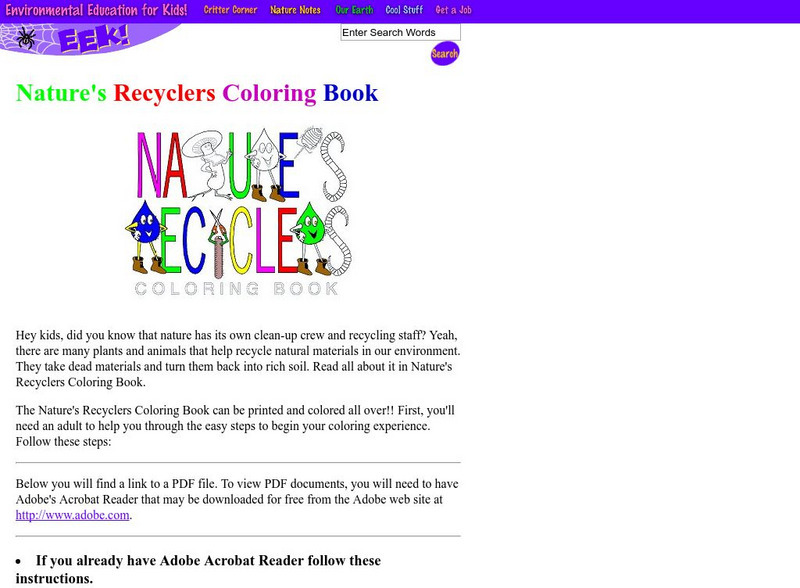
Eek!: Nature's Recyclers Coloring Book
Did you know that nature has its own clean-up crew and recycling staff? Yeah, there aremany plants and animals that help recycle natural materials in our environment. They take deadmaterials and turn them back into rich soil. Use this...