Hi, what do you want to do?






Curated OER
The Judiciary in American History
Learners investigate the influence of political and societal forces on judicial decisions. Among the topics they examine are the selection of judges and the cause and effect relationship between politics, society, and the law. to...

Curated OER
On the Other Side of the Color Barrier: Segregation and the Negro Leagues
Students study segregation that occurred in the past and that is currently occurring. In this equal rights lesson, students use primary source documents to student segregation of the past. In a culminating activity, students find or draw...

Curated OER
John Gary Evans and the Politics of Race
Students read letters written by Evans and Gunton regarding race relations. In this Progressive Movement instructional activity, students interpret the intentions and tone of the letters to understand contemporary racial beliefs....

Curated OER
New Kent School and the George W. Watkins School:
Students research the U.S. Supreme Court case that forced the integration of public schools and meet the individuals who experienced segregation, fought to dismantle the institution, and integrated the public school system of New Kent...

Curated OER
What Effect Does A Communities Attitudes/Values/And Beliefs Effect Student Behavior And Influence Curriculum
Learners examine how race relations effect the kinds and amount of educational resources individual schools receive within a school district.

Curated OER
The Living Constitution
Tenth graders explore the Constitution as a "living document." After reading three specific cases, learners consider characteristics that make up a living document. In groups, they conduct guided research on each case. Pupils write a...

Curated OER
Reconstruction
Students investigate the historical period of the Reconstruction and the events that surrounded the abolitionist movement. Students use guided questions to conduct research. Then they complete a venn diagram in order to compare two...
PBS
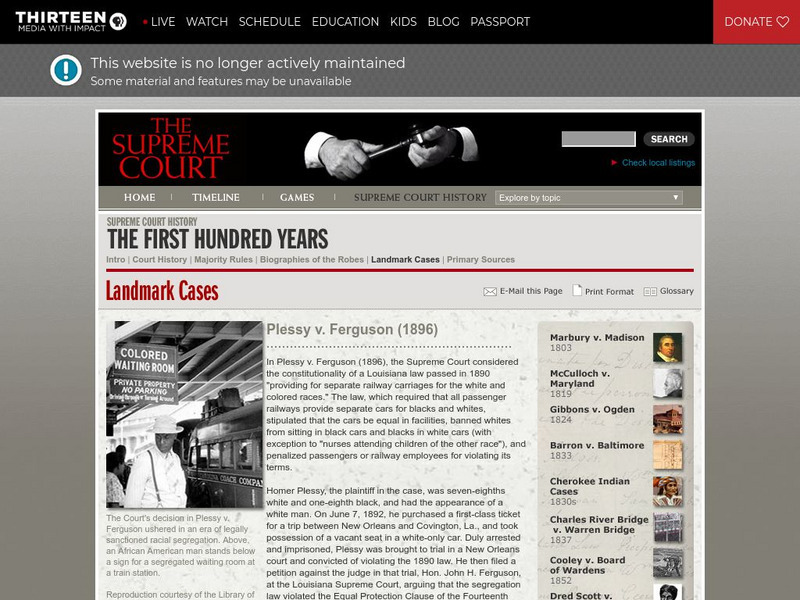
Wnet: Thirteen: Supreme Court Landmark Cases: Plessy v. Ferguson (1896)
From a PBS series about the Supreme Court, Plessy v. Ferguson is considered one of the landmark cases in the court's first 100 years. Read about the background of this important case, read about the thinking of the majority of the court...
Curated OER
History Matters: Separate but Equal: The Plessy v. Ferguson Case
Read the judgment of Supreme Court justice, Henry Billings Brown, who wrote for the majority in the Plessy v Ferguson decision that codified the idea of "separate but equal" in the American justice system until it was overturned by Brown...
Teaching American History
Teaching American History: Plessy v. Ferguson (Excerpts)
Find excerpts of the controverisal Supreme Court decision, Plessy v Ferguson along with the dissenting opinion by Supreme Court Justice, John Marshall Harlan.
This Nation
This nation.com: Plessy v. Ferguson (1896)
This site from ThisNation.com provides Justice Henry B. Brown's full text of the Supreme Court's decision in this landmark case, written by Henry B. Brown.
![National Humanities Center: Toolbox Library: u.s. Supreme Court Plessy v. Ferguson [Pdf] Primary](https://static.lp.lexp.cloud/images/attachment_defaults/resource/large/FPO-knovation.png "National Humanities Center: Toolbox Library: u.s. Supreme Court Plessy v. Ferguson [Pdf] Primary")
National Humanities Center
National Humanities Center: Toolbox Library: u.s. Supreme Court Plessy v. Ferguson [Pdf]
Read this concise discussion of the landmark Supreme Court decision, Plessy v Ferguson. Find a synopsis of the case, the majority opinion of the court, and the dissenting opinion by Justice Harlan.
Library of Congress
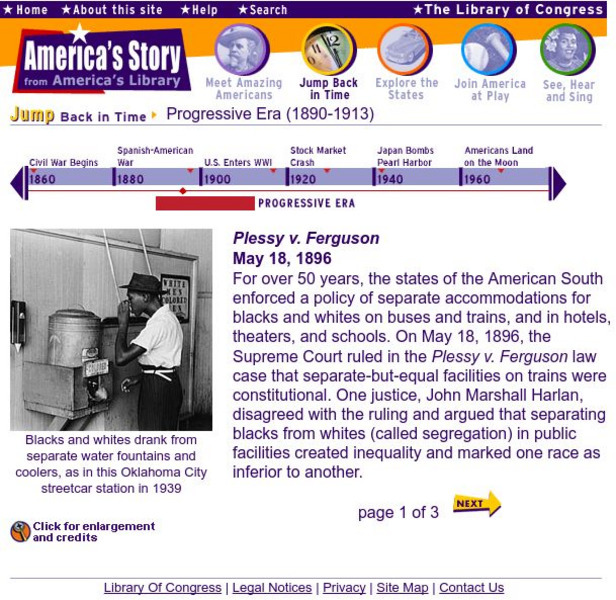
Loc: America's Story: Plessy v. Ferguson
The decision of the Supreme Court in Plessy v. Ferguson kept black and white people separate in all public areas for many years. To find out what that meant, and to see some actual photographs, visit this page.
Other
Landmark Cases: Plessy v. Ferguson (1896)
Everything you might want to know about this historic Supreme Court decision. Included are great teacher directed activities, background summary, and the text of the majority opinion.
Digital History
Digital History: Plessy v. Ferguson
A very thorough explanation of the famous Supreme Court decision about Plessy v. Ferguson. It upheld the idea of "separate but equal," which was in effect until Brown v Board of Education in 1954. See who opposed the decision, and read...
iCivics
I Civics: Plessy v. Ferguson (1896)
This mini-lesson covers the basics of the Supreme Court's decision that it was constitutional to keep black and white people segregated as long as the accommodations for each race were "equal." Students learn about the concept of...
University of Missouri
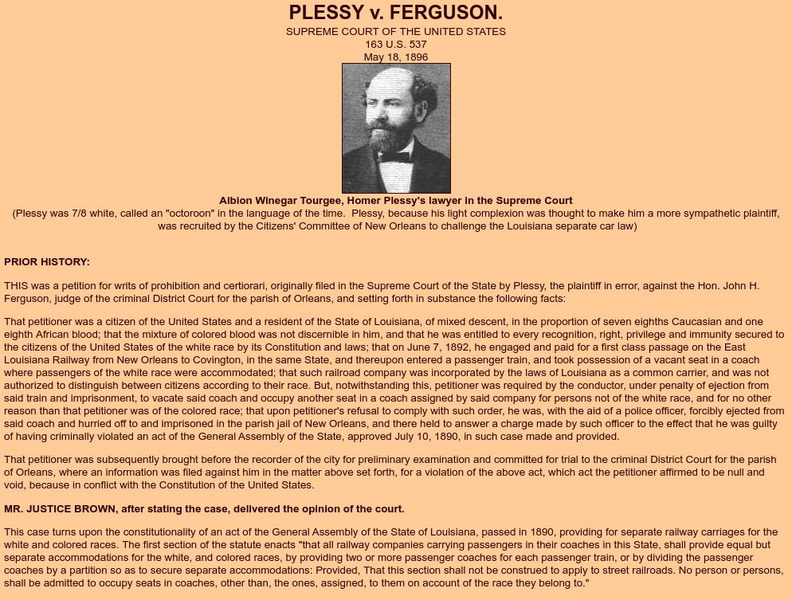
Exploring Constitutional Conflicts: Plessy v Ferguson
Read the Supreme Court opinion that solidified the concept of separate, but equal in American law. The dissenting opinion written by Justice John Harlan is also included.
National Humanities Center
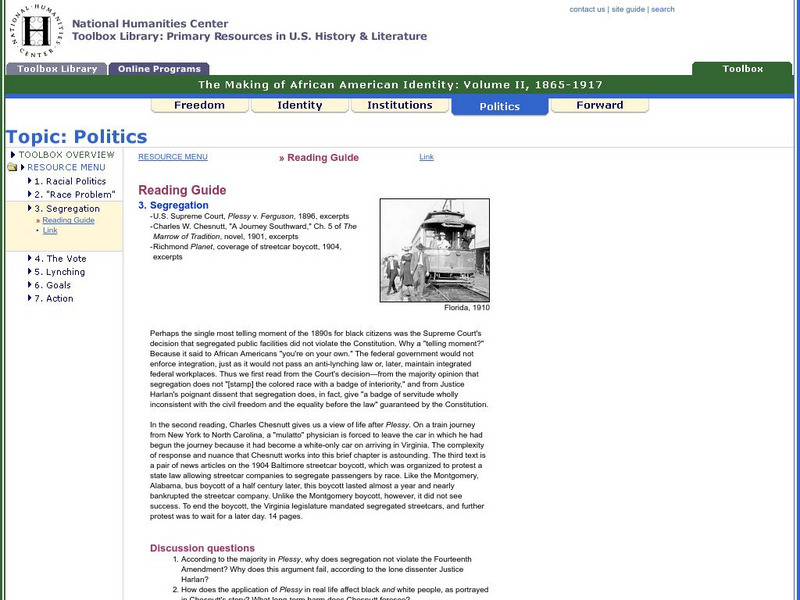
National Humanities Center: Toolbox Library: Making of African American Identity: Segregation
A Supreme Court decision, a chapter from a novel, and an editorial that explore segregation in late-nineteenth-century America. This resource focuses primarily on Plessy v. Ferguson, and the complexities that followed from this ruling.
Thomson Reuters
Find Law: Landmark Decisions
This site details the controversial issues regarding slavery and the effects they had on the Civil War amendments as well as on the fifth amendment. The site discusses events such as the Dred Scott case, the addition of the Civil War...

Yale University
Yale New Haven Teachers Institute: Supreme Court Rules on School Desegregation
This thoughtful unit explores the history of school desegregation legislation, including a discussion of the impact of the Plessy v. Ferguson and Brown v. Board of Education decisions. A six-week plan of lessons, along with other sample...
Thomson Reuters
Find Law: u.s. Supreme Court: Plessy vs. Ferguson
Transcript of the infamous Supreme Court decision that established the constitutionality of the principle of "Separate but equal," public facilities for members of different races. This was eventually overturned by the 1954 and 1955...
Siteseen
Siteseen: American Historama: Plessy vs. Ferguson Case
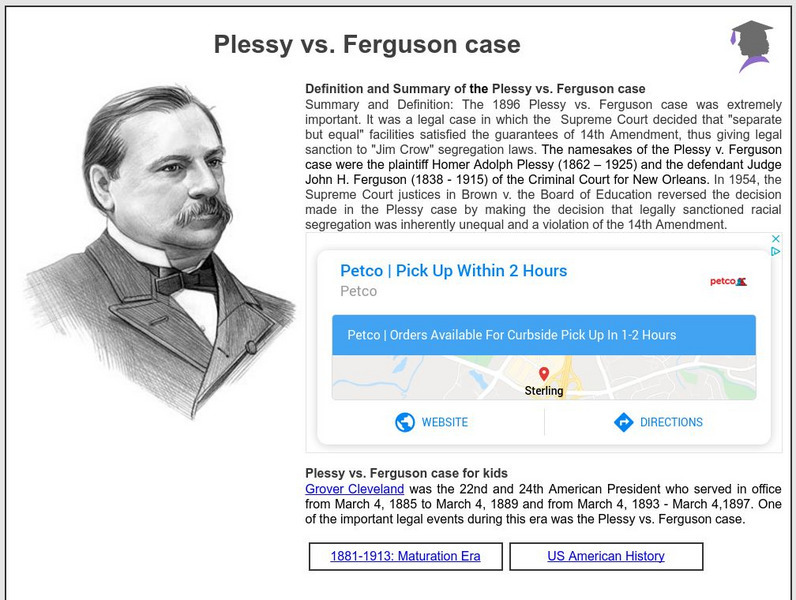
Article provides an overview and detailed facts about the impact of the 1896 Plessy vs. Ferguson case on racial segregation.

Illinois Institute of Technology
Oyez Project: Plessy v. Ferguson (1896)
The U.S. Supreme Court case that upheld the famous "separate but equal" doctrine by dealing with the issues of racial discrimination and equal protection. This resource provides an abstract containing a concise summary and a link to the...
Texas Education Agency
Texas Gateway: Separate but Equal: A Study of Segregation
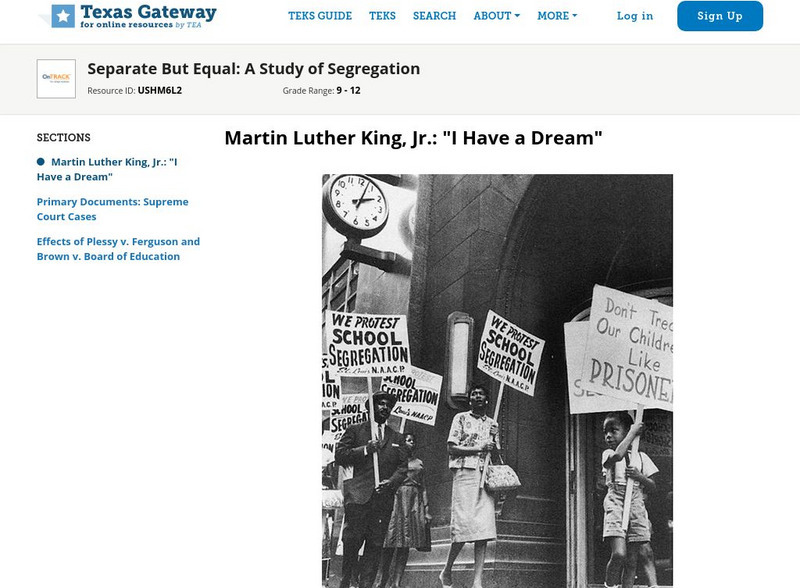
Given Supreme Court case summaries, students will compare and contrast the impact of the Plessy v. Ferguson and Brown v. Board of Education decisions.