Hi, what do you want to do?





University of California
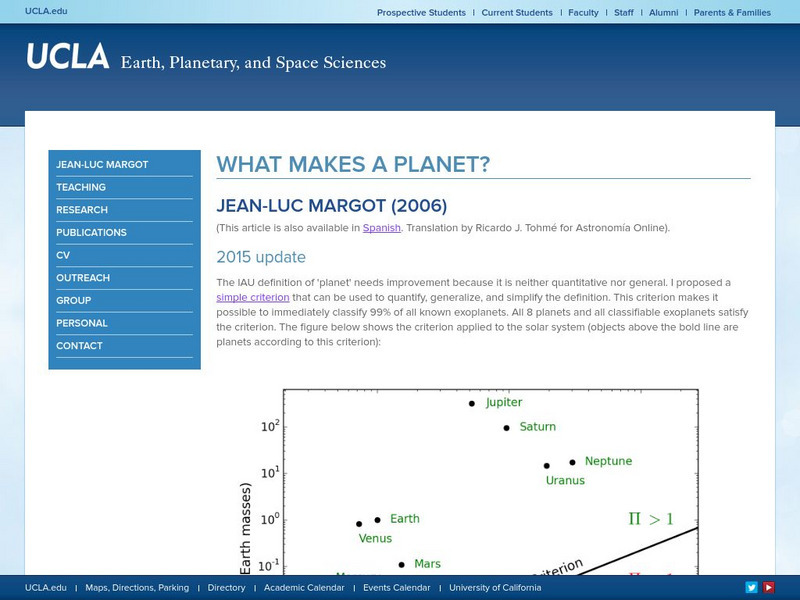
Ucla: What Makes a Planet
This detailed essay defines planets and compares the characteristics to those of Pluto. Orbital graphs and background information clarify the change in Pluto's categorization. A copy of IAU's Resolution 5 is also contained in this essay.
NPR: National Public Radio
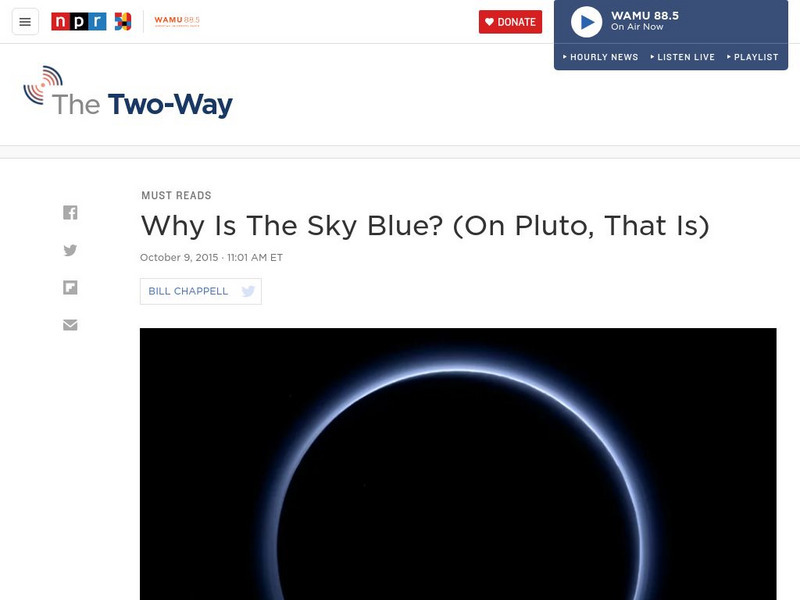
Npr: Why Is the Sky Blue? (On Pluto, That Is)
Read about the atmosphere of Pluto.
Nine Planets
The Nine Planets: Pluto
This site contains copious information about Pluto. The site contains descriptive and statistical information, as well as a detailed article about the search for trans-Plutonian planets and the "Nemesis" hypothesis.

NASA
Nasa: Mission Science: What Is a Planet?
Find out about how planets have been classified historically, and what scientists use to study them.
NASA
Nasa: Planets in a Bottle
In this simple lesson, students grow yeast to learn how the climates on each of the nine planets would affect life.
Science4Fun
Science4 Fun: Pluto
Learn fun facts and details about the atmosphere, geography, composition, and discovery of Pluto, a dwarf planet.
California Institute of Technology
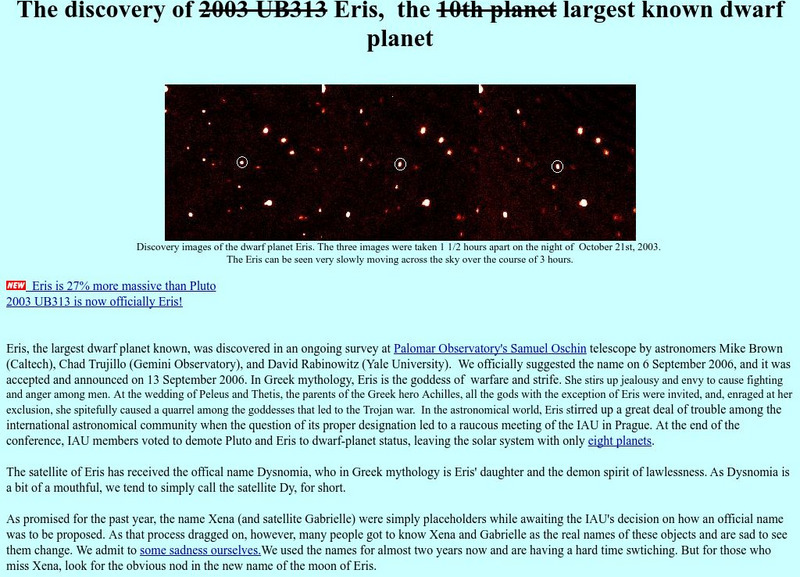
The Discovery of Eris, the Largest Known Dwarf Planet
Until the discovery of Eris, Pluto was known as the largest Keiper belt object. This dwarf planet has replaced Pluto in size and is accompanied by a satellite that has been given the name Dysnomia. Learn about this distant world here...

TeachEngineering
Teach Engineering: The Outer Planets
Students explore the outermost planets of our solar system: Saturn, Uranus and Neptune. They also learn about characteristics of Pluto and its interactions with Neptune. Students learn a little about the history of space travel as well...
Harvard University
Harvard University: The Solar System
These hands-on activities are a great way for students to gain perspective on the relative sizes and distances of each planet, the relationship between the sun and Earth, and much more.
Famous Scientists
Famous Scientists: Clyde Tombaugh
Find out about Clyde Tombaugh, the scientist who discovered the dwarf planet Pluto in 1930, and also discovered a number of asteroids.
Other
Simple Science: Planetary Gallery
The innovative resource examines images of the Sun, Moon, Pluto, and all eight planets in the Solar System. Learners calculate the diameter of each object and rank the objects in order of size. The activity has an interactive online...