Hi, what do you want to do?






American Chemical Society
Middle School Chemistry: Chapter 5: The Water Molecule and Dissolving
Nine exemplary chemistry lessons about the water molecule and dissolving complete with handouts and animations.
CK-12 Foundation
Ck 12: Polarity and Intermolecular Forces
[Free Registration/Login may be required to access all resource tools.] The following online tutorial describes how the electronegativity difference between two atoms in a covalent bond results in the formation of a nonpolar covalent,...
Concord Consortium
Concord Consortium: Comparing Attractive Forces Between Molecules
Simulations that explore different attractive forces between polar and non polar molecules.

Concord Consortium
Concord Consortium: Stem Resources: Electrons in Atoms and Molecules
A module with animations, explanations, and questions about the importance of electrons in the structure of an atom. Understand the definition and locations of electrons in the atom. Explore the role of electrons in bonding, polarity,...
University of Arizona
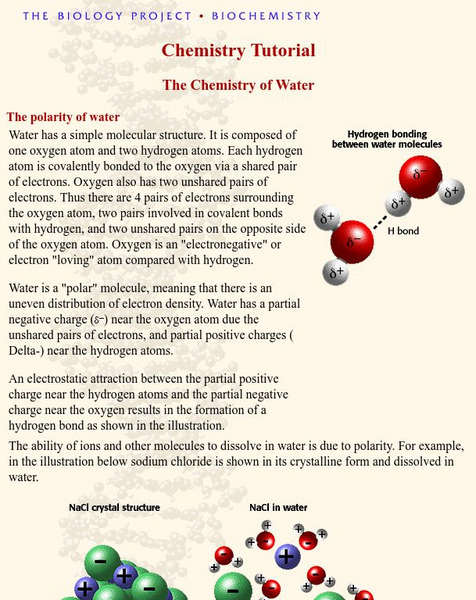
Ua: Chemistry Tutorial
This general tutorial begins with an explanation of the polarity of the water molecule and the effects this polarity has on the properties of water. Goes on to introduce organic molecules and has a thourough tutorial on the third page.
New York University
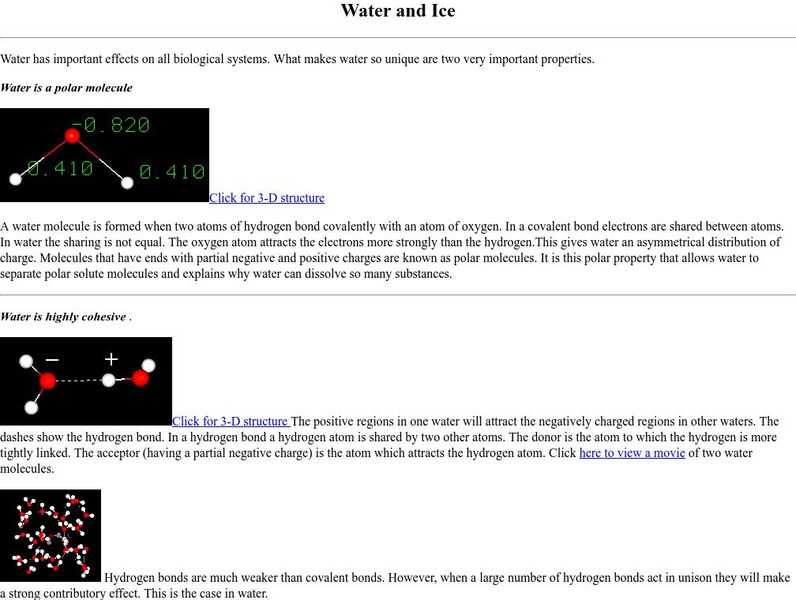
New York University: About Water and Ice
Page uses movies and 3D images to explain how properties of water relate to polarity and hydrogen bonding.
Texas Instruments
Texas Instruments: Geometries and Polarities of Compounds
In this StudyCard activity, students are asked to describe the geometry and polarity of several molecules and ions. Geometries covered include linear, bent, trigonal planar, trigonal pyramidal, and tetrahedral. Students will need to have...
Frostburg State University
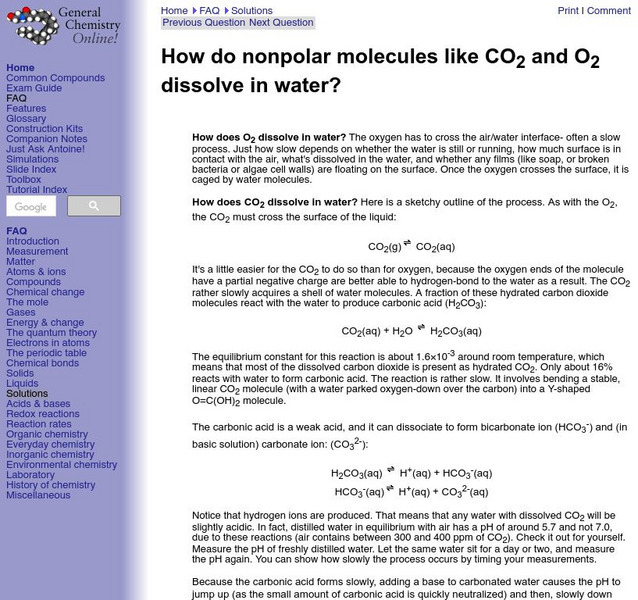
University of Frostburg: How Nonpolar Molecules Dissolve
This site from the University of Frostburg provides an explanation of the process by which nonpolar molecules dissolve in water.
Estrella Mountain Community College
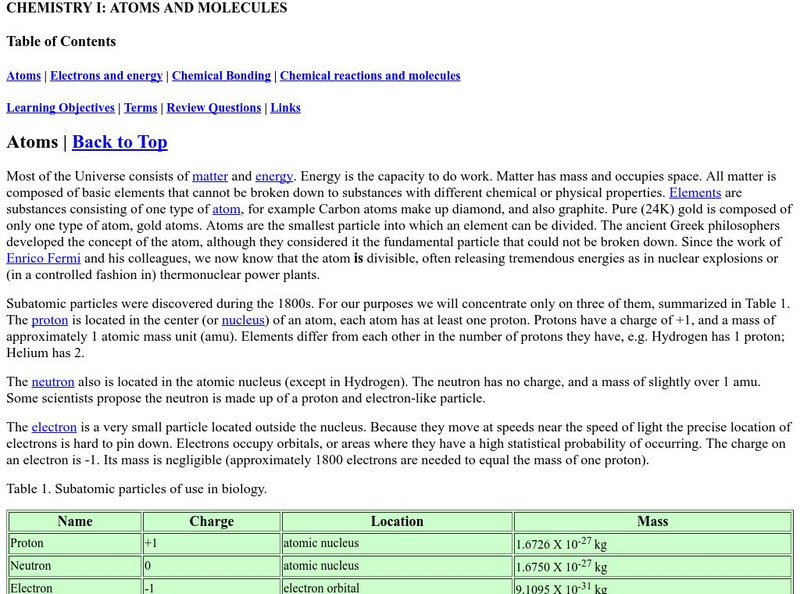
Online Biology Book: Chemistry I: Atoms and Molecules
In this online biology textbook, learn about atoms and molecules as they relate to life. Find out about topics such as electrons and energy, chemical bonding, and chemical reactions.
Concord Consortium
Concord Consortium: Science of Atoms and Molecules: Nucleic Acids and Proteins
Through this activity, students work with macromolecules, proteins and nucleic acids. The focus is on the atomic structure of proteins, how linear polymers are made, and the surface charges of the resulting polymers. . Multiple-choice...
CK-12 Foundation
Ck 12: Chemistry: Liquid Liquid Solutions
[Free Registration/Login may be required to access all resource tools.] Covers solubility in water and polar molecules.
Concord Consortium
Concord Consortium: Polar and Nonpolar Interface
Observe how molecules with hydrophilic and hydrophobic regions move in a mixture of oil and water, and pay attention to changes in potential energy over time. Move and rotate the molecules to see how they interact with their surrounding...
Concord Consortium
Concord Consortium: Elements and Polarity
Explore how polarity affects molecular shape and charge.
TeachEngineering
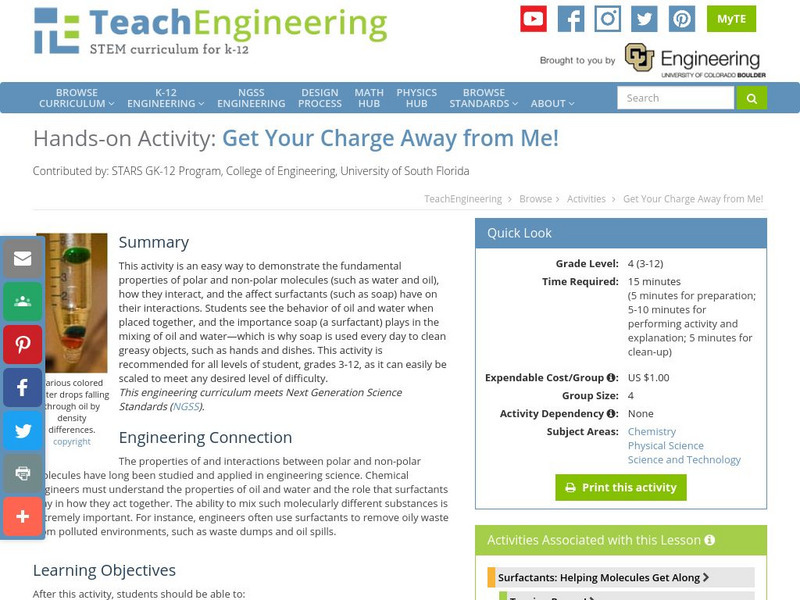
Teach Engineering: Get Your Charge Away From Me!
This activity is an easy way to demonstrate the fundamental properties of polar and non-polar molecules (such as water and oil), how they interact, and the affect surfactants (such as soap) have on their interactions. Students see the...
Frostburg State University
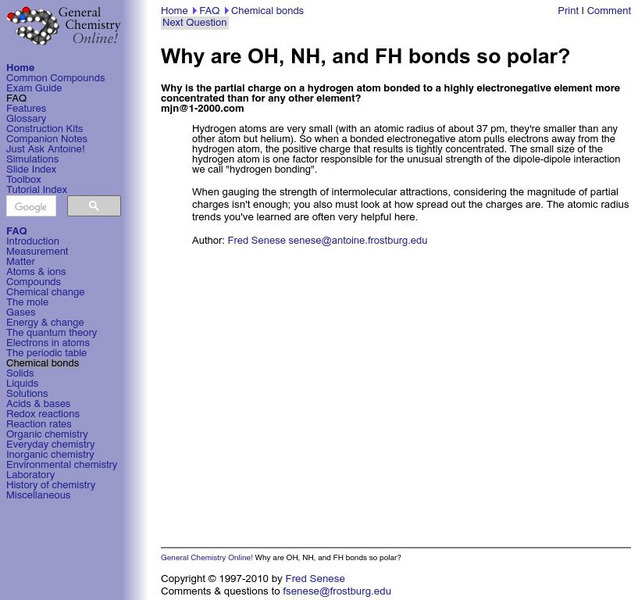
General Chemistry: Why Oh, Nh, and Fh Bonds Are Polar
Frostburg State University provides a brief explanation to the question of why small hydrogen molecules, such as OH, NH, and FH, are very polar.
Concord Consortium
The Concord Consortium: Can a Substance Dissolve in Both a Nonpolar and a Polar Liquid?
In this learning module from The Concord Consortium, students will investigate how polar and non-polar regions in big molecules interact to result in certain shapes and properties for those molecules.
Chiral Publishing
Chiral Publishing: An Introduction to Chemistry: Predicting Molecular Polarity
This section in the online textbook describes how to tell if a molecule is polar or non polar. Detailed steps and examples are good references. Also find links to presentations and chapter maps for other chemistry topics.
Concord Consortium
Concord Consortium: Molecular Workbench: Water and Polar Substances
Adjust amounts of ionic charges in this simulation to see how water molecules react to polar substances in solution.
Concord Consortium
Concord Consortium: Molecular Workbench: Electrons in Atoms and Molecules
A model that explores why electrons are so important in chemistry. Investigate electron clouds, what happens when two atoms come together, and chemical polarity.
American Chemical Society
Middle School Chemistry: Lesson Plans: Why Does Water Dissolve Salt?
Students use their own model of a salt crystal and water molecule to show how water dissolves salt. Then, they relate their observations to the structure of salt, water, and alcohol on the molecular level.
Georgia Department of Education
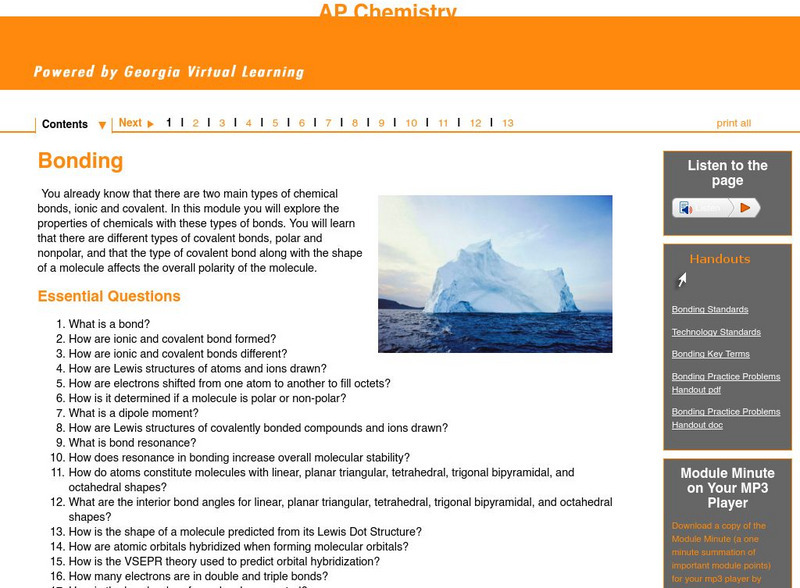
Ga Virtual Learning: Ap Chemistry: Bonding
In this module students explore the properties of chemicals with covalent and ionic bonds. Students learn that there are different types of covalent bonds, polar and nonpolar, and that the type of covalent bond along with the shape of a...
Concord Consortium
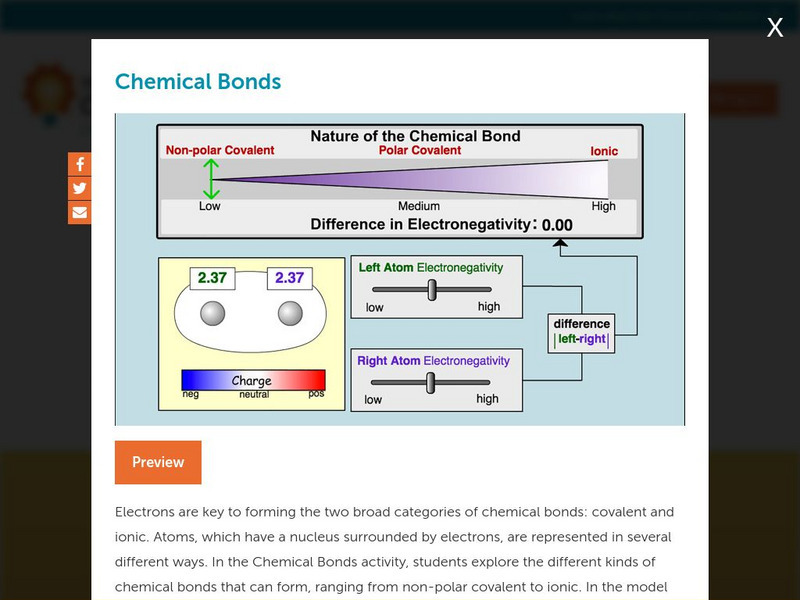
Concord Consortium: Stem Resources: Chemical Bonds
By working through this web-based activity, students differentiate between ionic, non-polar covalent, and polar covalent bonds. Specifically, distinctions are made between bonding types based on orbital shapes and electronegativity...
Sophia Learning
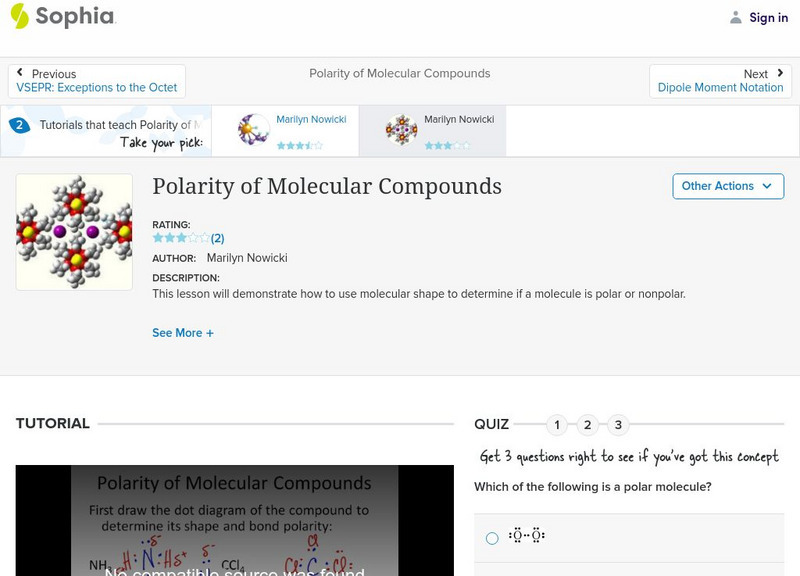
Sophia: Polarity of Molecular Compounds: Lesson 2
This lesson will demonstrate how to use molecular shape to determine if a molecule is polar or nonpolar. It is 2 of 2 in the series titled "Polarity of Molecular Compounds."