Hi, what do you want to do?






Concord Consortium
Concord Consortium: Stem Resources: Electrons in Atoms and Molecules
A module with animations, explanations, and questions about the importance of electrons in the structure of an atom. Understand the definition and locations of electrons in the atom. Explore the role of electrons in bonding, polarity,...
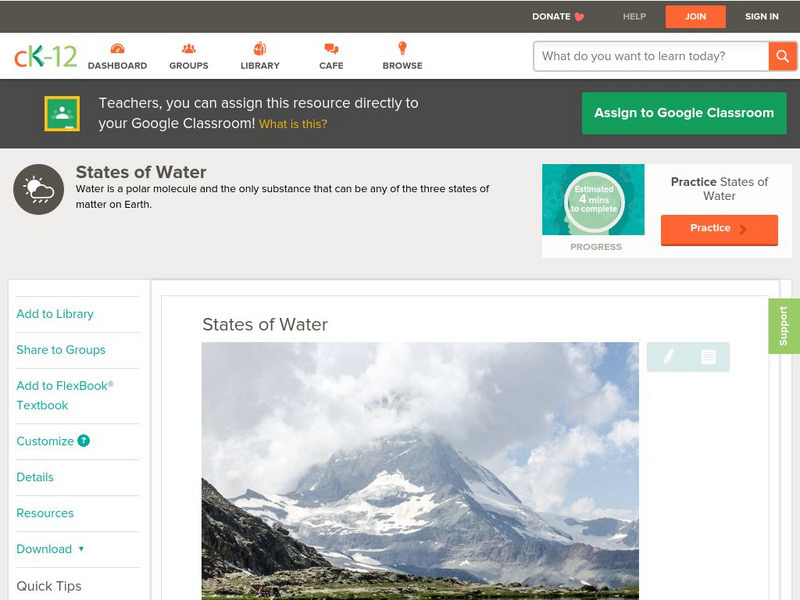
CK-12 Foundation
Ck 12: Earth Science: States of Water
[Free Registration/Login may be required to access all resource tools.] Describes the three states of water.
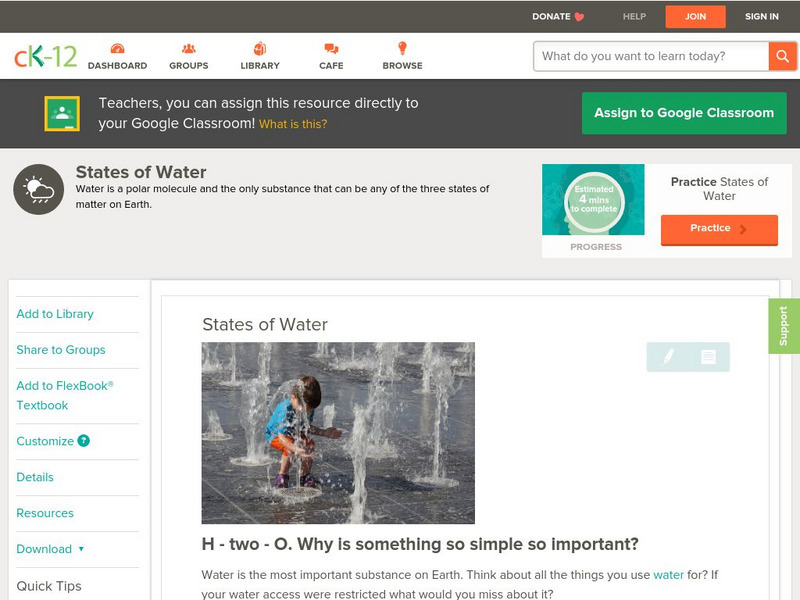
CK-12 Foundation
Ck 12: Earth Science: States of Water
[Free Registration/Login may be required to access all resource tools.] Describes the three states of matter of water.
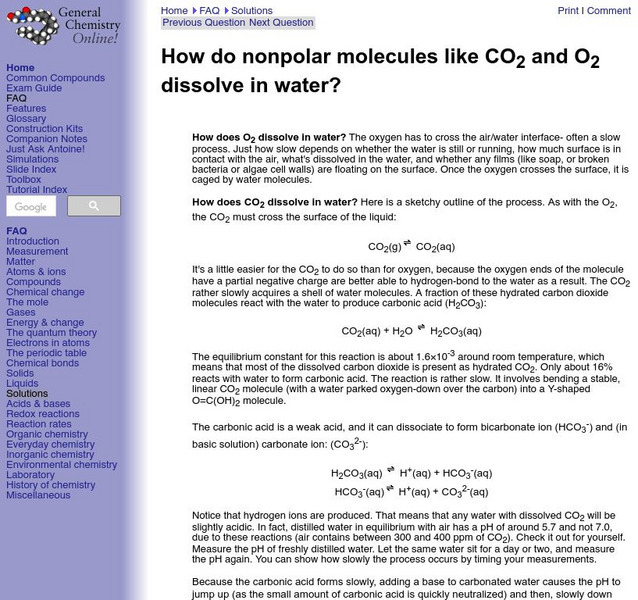
Frostburg State University
University of Frostburg: How Nonpolar Molecules Dissolve
This site from the University of Frostburg provides an explanation of the process by which nonpolar molecules dissolve in water.
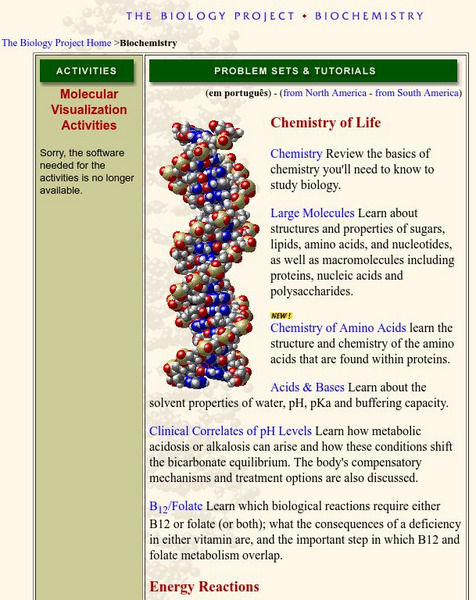
University of Arizona
University of Arizona: Biochemistry
Problem sets, tutorials, and activities related to biochemistry.
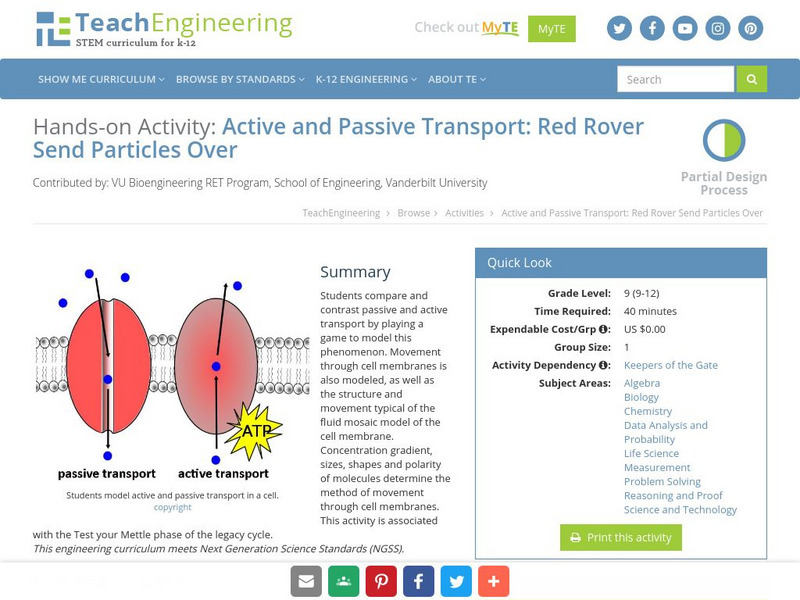
TeachEngineering
Teach Engineering: Active and Passive Transport: Red Rover Send Particles Over
Students compare and contrast passive and active transport by playing a game to model this phenomenon. Movement through cell membranes is also modeled, as well as the structure and movement typical of the fluid mosaic model of the cell...
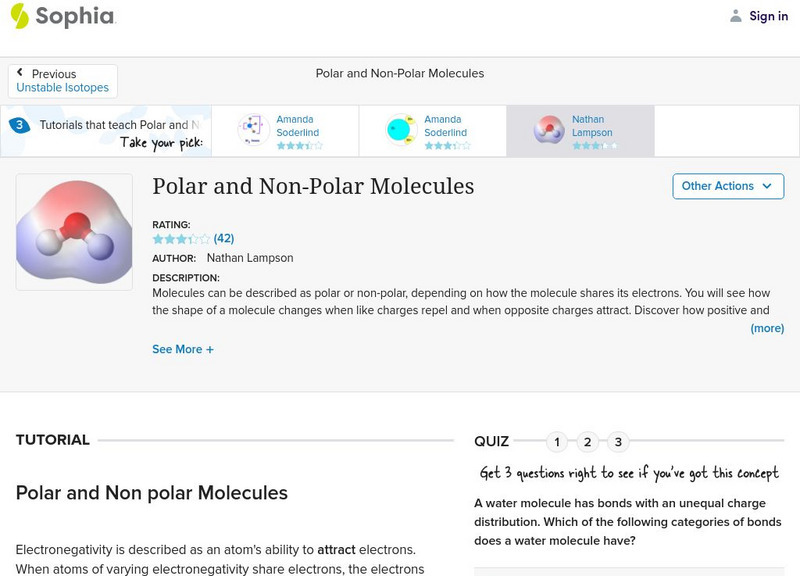
Sophia Learning
Sophia: Polar and Non Polar Molecules: Lesson 1
This lesson will introduce polar and non-polar molecules, explaining their location, charge, and mass. It is 1 of 3 in the series titled "Polar and Non polar Molecules."
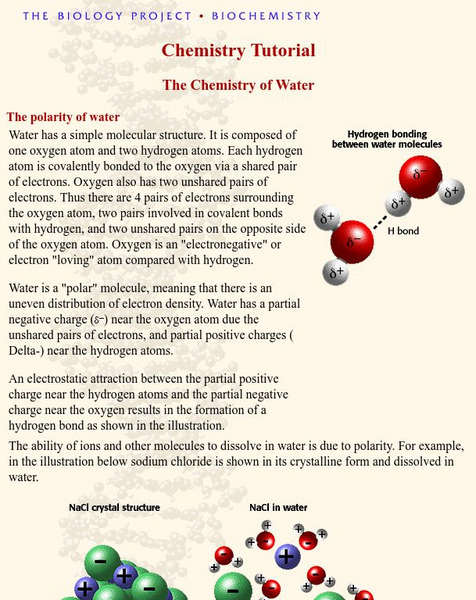
University of Arizona
Ua: Chemistry Tutorial
This general tutorial begins with an explanation of the polarity of the water molecule and the effects this polarity has on the properties of water. Goes on to introduce organic molecules and has a thourough tutorial on the third page.

Concord Consortium
Concord Consortium: Polar and Nonpolar Interface
Observe how molecules with hydrophilic and hydrophobic regions move in a mixture of oil and water, and pay attention to changes in potential energy over time. Move and rotate the molecules to see how they interact with their surrounding...
Concord Consortium
Concord Consortium: Comparing Potential Energy of Bond
Explore the change in potential energy when molecules are separated from each other or broken apart.
Frostburg State University
General Chemistry: Why Oh, Nh, and Fh Bonds Are Polar
Frostburg State University provides a brief explanation to the question of why small hydrogen molecules, such as OH, NH, and FH, are very polar.
Concord Consortium
Concord Consortium: Molecular Workbench: Water and Polar Substances
Adjust amounts of ionic charges in this simulation to see how water molecules react to polar substances in solution.
American Chemical Society
Middle School Chemistry: Lesson Plans: Temperature Changes in Dissolving
Media-rich lesson in which students discover that it takes energy to break bonds, and that energy is released when bonds are formed during the process of dissolving. They also determine whether dissolving is either exothermic or...
Concord Consortium
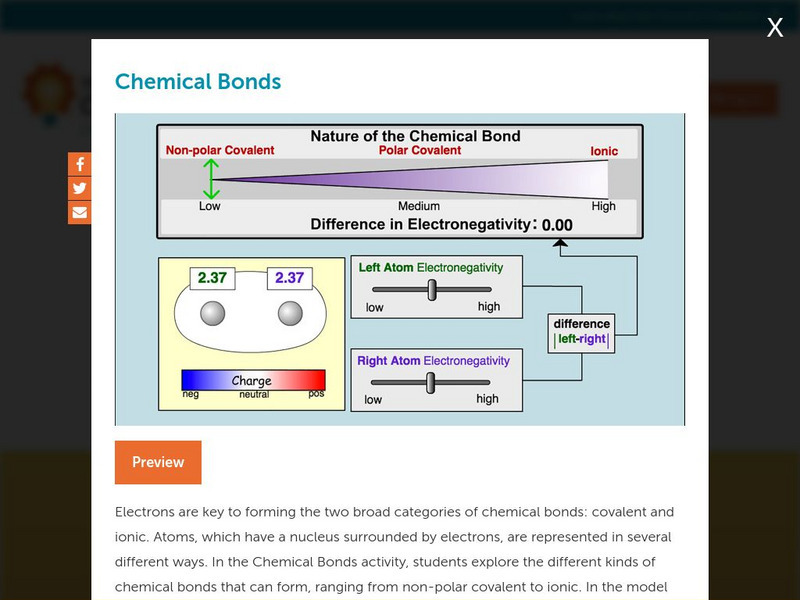
Concord Consortium: Stem Resources: Chemical Bonds
By working through this web-based activity, students differentiate between ionic, non-polar covalent, and polar covalent bonds. Specifically, distinctions are made between bonding types based on orbital shapes and electronegativity...

Khan Academy
Khan Academy: Test Prep: Mcat: Chemical Processes: Covalent Bonds: Intramolecular and Intermolecular Forces
Explains what intramolecular and intermolecular forces are and the different types for each. Includes lots of examples.
American Chemical Society
Middle School Chemistry: Lesson Plans: Surface Tension
Students observe and investigate why water has a strong surface tension.
Concord Consortium
Concord Consortium: What Makes Water Special?
Activity 4 investigates How does electron distribution impact our observations? Students have described how properties of molecules change depending on what atoms make up the molecule. In this activity students will use those ideas to...
Sophia Learning
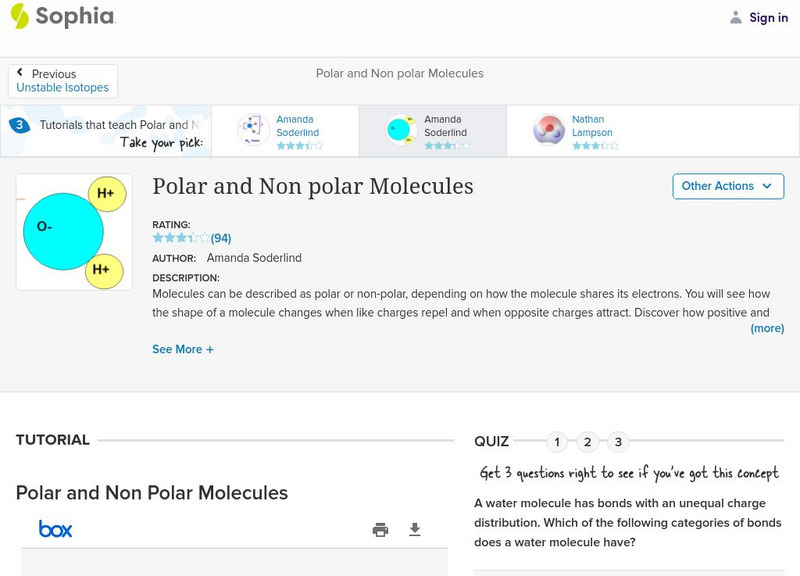
Sophia: Polar and Non Polar Molecules: Lesson 2
This lesson will introduce polar and non-polar molecules, explaining their location, charge, and mass. It is 2 of 3 in the series titled "Polar and Non polar Molecules."
Sophia Learning
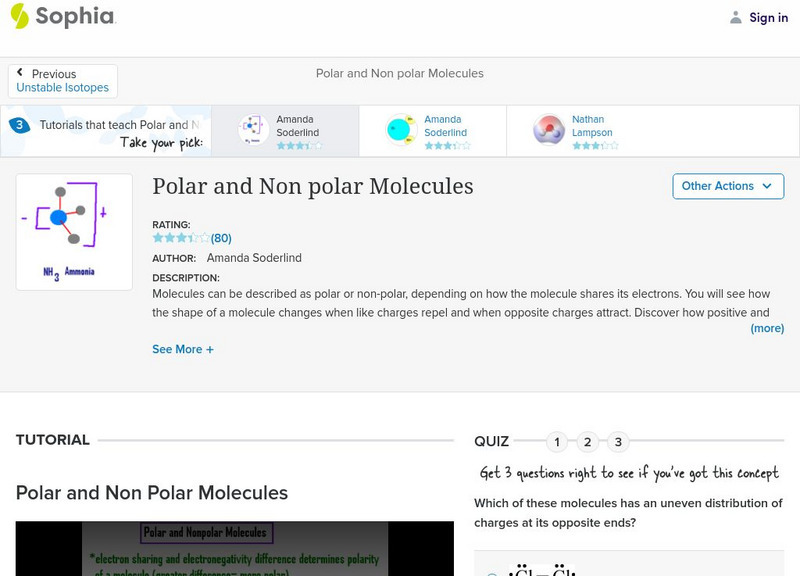
Sophia: Polar and Non Polar Molecules: Lesson 3
This lesson will introduce polar and non-polar molecules, explaining their location, charge, and mass. It is 3 of 3 in the series titled "Polar and Non polar Molecules."
Sophia Learning
Sophia: The Properties of Water: Lesson 3
This lesson will provide an understanding of the chemical and physical nature of water. It is 3 of 4 in the series titled "The Properties of Water."
Sophia Learning
Sophia: The Properties of Water: Lesson 4
This lesson will provide an understanding of the chemical and physical nature of water. It is 4 of 4 in the series titled "The Properties of Water."
Sophia Learning
Sophia: The Properties of Water: Lesson 1
This lesson will provide an understanding of the chemical and physical nature of water. It is 1 of 4 in the series titled "The Properties of Water."

State University of New York
State University of New York: Determining Molecular Polarity
The following module illustrates a method for determining if a molecule is polar or nonpolar.
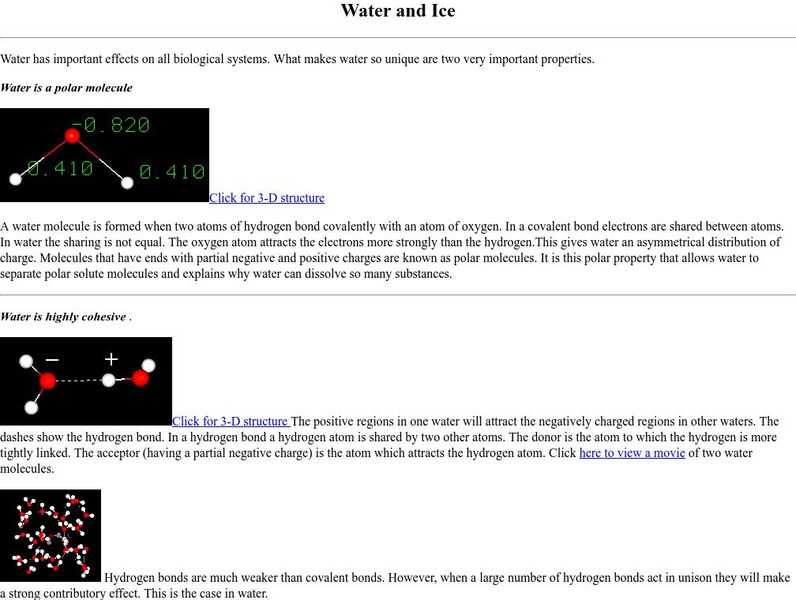
New York University
New York University: About Water and Ice
Page uses movies and 3D images to explain how properties of water relate to polarity and hydrogen bonding.