Hi, what do you want to do?





New York University
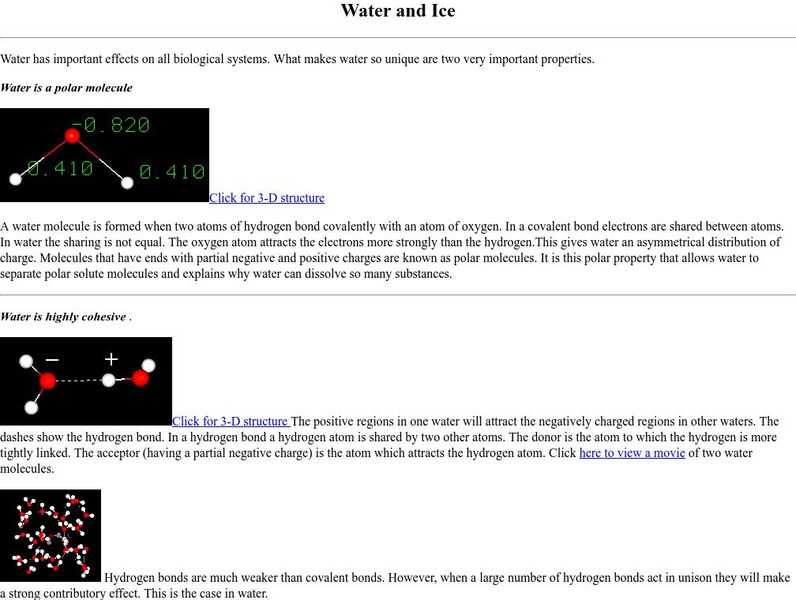
New York University: About Water and Ice
Page uses movies and 3D images to explain how properties of water relate to polarity and hydrogen bonding.
Other
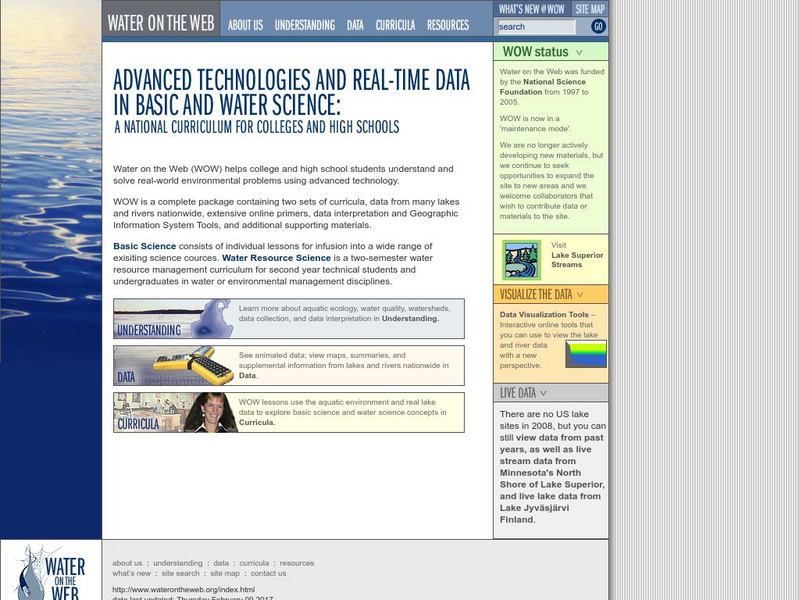
Water on the Web
Water on the Web (WOW) is an advanced site allowing students to actively participate in data analysis from real research sites. Lesson plans on a range of topics are provided. There is also a tutorial for using Excel to graph WOW data.

American Chemical Society
Middle School Chemistry: Lesson Plans: Temperature Changes in Dissolving
Media-rich lesson in which learners discover that it takes energy to break bonds, and that energy is released when bonds are formed during the process of dissolving. They also determine whether dissolving is either exothermic or...

American Museum of Natural History
American Museum of Natural History: O Logy: Arctic Story Puzzles
Construct a story about the Inuit or the polar bear from a series of pictures that can be put together in a sequence.
NASA
Nasa: Polar Ice and Its Possible Effects on the Earth
This article describes the effects of polar ice caps on the Earth and offers explanations as to the possible effects of polar ice melting on sea level and temperature.
Concord Consortium
Concord Consortium: What Makes Water Special?
Activity 2 investigates Why is water different from other liquids? This activity will investigate properties of different liquids. Students will explore what makes honey gooey and thicker than water. And why some liquids evaporate faster...
University of Oregon
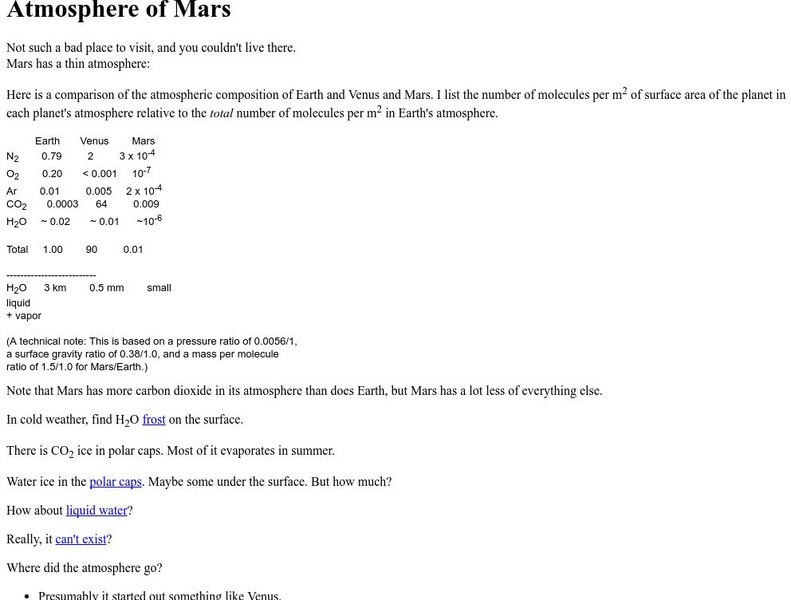
University of Oregon: Mars' Atmosphere
Here is a comparison of the atmospheric composition of Earth, Venus and Mars.
American Chemical Society
Middle School Chemistry: Lesson Plans: Why Does Water Dissolve Sugar?
Lesson plan in which students design an experiment to determine if different types of liquids affect the amount of dissolution of an M&M candy shell.
American Chemical Society
Middle School Chemistry: Lesson Plans: Why Does Water Dissolve Salt?
Students use their own model of a salt crystal and water molecule to show how water dissolves salt. Then, they relate their observations to the structure of salt, water, and alcohol on the molecular level.
TeachEngineering
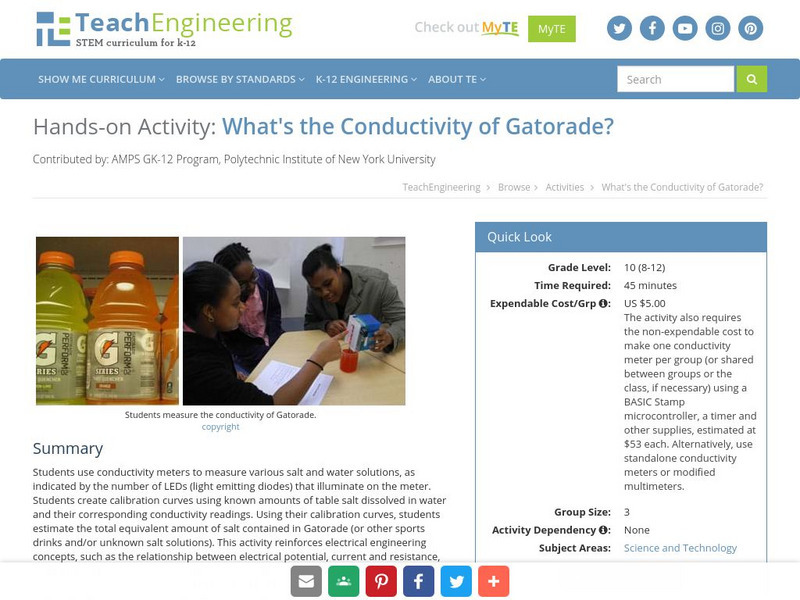
Teach Engineering: What's the Conductivity of Gatorade?
Students use conductivity meters to measure various salt and water solutions, as indicated by the number of LEDs (light emitting diodes) that illuminate on the meter. Students create calibration curves using known amounts of table salt...
University of Arizona
Ua: Chemistry Tutorial
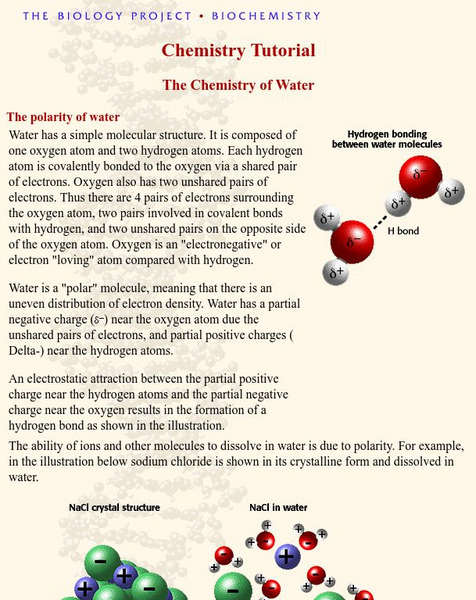
This general tutorial begins with an explanation of the polarity of the water molecule and the effects this polarity has on the properties of water. Goes on to introduce organic molecules and has a thourough tutorial on the third page.
Concord Consortium
Concord Consortium: Polar and Nonpolar Interface
Observe how molecules with hydrophilic and hydrophobic regions move in a mixture of oil and water, and pay attention to changes in potential energy over time. Move and rotate the molecules to see how they interact with their surrounding...
Exploratorium
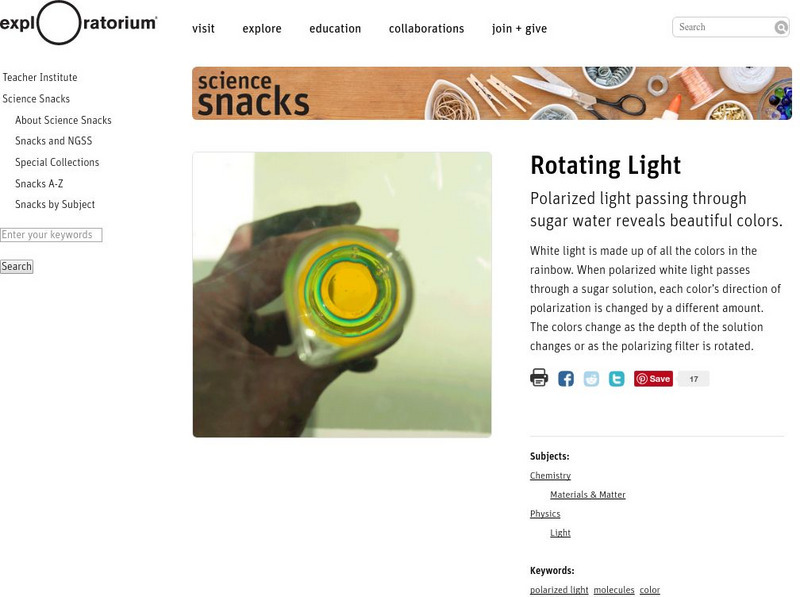
Exploratorium: Science Snacks: Rotating Light
An experiment where polarized light is shone into a solution of sugared water, causing each of the colors in white light to change direction in varying amounts.

Concord Consortium
Concord Consortium: Molecular Workbench: Water and Polar Substances
Adjust amounts of ionic charges in this simulation to see how water molecules react to polar substances in solution.
Concord Consortium
How Are Interactions With Water Important for Maintaining My Life?
An investigation of how polar and nonpolar interactions affect shapes of biological molecules and their function. Modules explore the following: 1. Why don't oil and water mix? 2. Can a substance dissolve in both a nonpolar and a polar...
Exploratorium
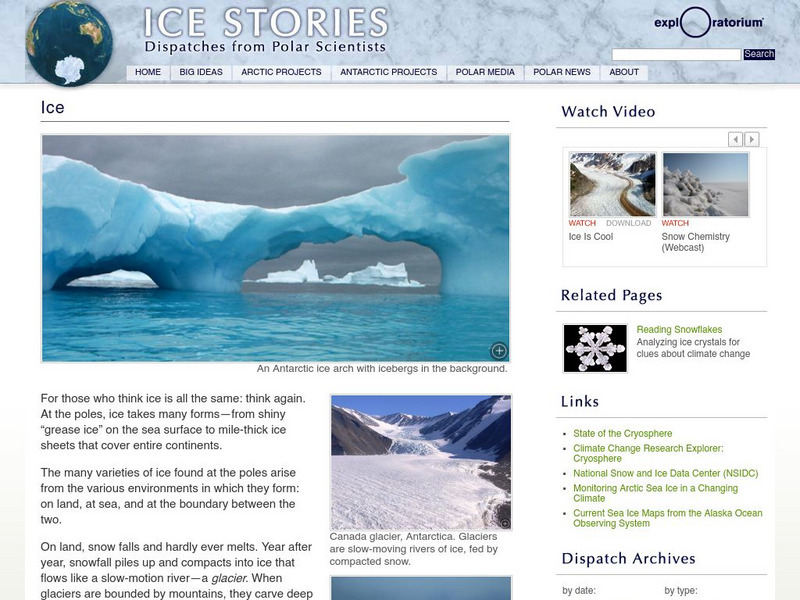
Exploratorium: Ice Stories: Dispatches From Polar Scientists: Ice
Water water everywhere. There are many types of ice found surrounding the poles of the earth. Get details on the varieties of ice studied by polar scientists.
Exploratorium
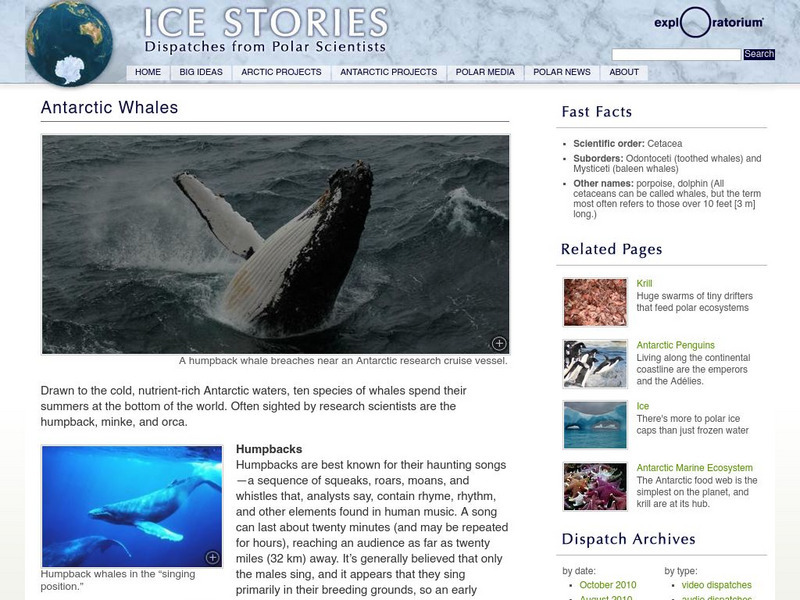
Exploratorium: Ice Stories: Dispatches From Polar Scientists: Antarctic Whales
An article featuring the whales that inhabit the waters of Antarctica and what the future holds for them.
American Chemical Society
Middle School Chemistry: Can Liquids Dissolve in Water?
Find out if liquids can dissolve in water.
Science Education Resource Center at Carleton College
Serc: Mn Step: Sinking Water: Glaciers, Ocean Currents and Weather Patterns
A lesson plan where students learn how warm water is less dense than cold water, and what this means for global climate change as ice from the polar regions melts. Students will do experiments in buoyancy and water density when hot or...
Concord Consortium
Concord Consortium: What Makes Water Special?
Activity 4 investigates How does electron distribution impact our observations? Students have described how properties of molecules change depending on what atoms make up the molecule. In this activity students will use those ideas to...
Other
Nrdc: Are the Effects of Global Warming Really That Bad?
The problems of global warming are examined from the following perspectives: climate pattern changes, health effects, and ecosystem disruption. You will also find a number of NRDC related webpages further amplifying the topic of global...
Frostburg State University
University of Frostburg: How Nonpolar Molecules Dissolve
This site from the University of Frostburg provides an explanation of the process by which nonpolar molecules dissolve in water.
Science Education Resource Center at Carleton College
Serc: Mn Step: Spotting Chromatography
A lab activity that introduces chromatography using markers, plus water and acetone as the solvents. Students will take measurements to compare the mobile and stationary phases of the inks, and find the polarity of the inks and solvents....
Smithsonian Institution
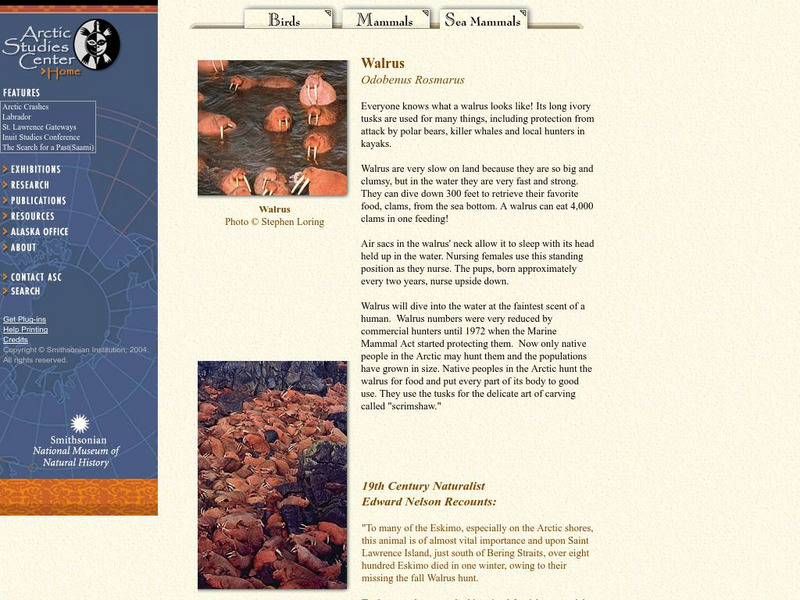
National Museum of Natural History: Walrus
This Smithsonian website has a brief, but thorough, article on the Walrus that also includes pictures and an extensive quote from naturalist Edward Nelson.