Hi, what do you want to do?






West Contra Costa Unified School District
Using Derivatives to Graph Polynomials
You can learn to graph as well as a calculator using calculus. The lesson introduces using derivatives to find critical points needed to graph polynomials. Pupils learn to find local maximums and minimums and intervals of increase...

West Contra Costa Unified School District
Polynomial Division
Multiply the ways your scholars can find the quotient with polynomial division. A lesson plan introduces polynomial division via long division, synthetic division, generic area model, and using the definition of division. Learners...

Del Mar College
Finding the Domain
Domain to a math teacher makes perfect sense, but it can seem like gibberish to high schoolers. As it is laid out in clear terms, domain is introduced and explained among all types of functions throughout the handout. The first three...

West Contra Costa Unified School District
The Extreme Value Theorem
Finding the critical numbers of a function can be extreme. The lesson introduces the Extreme Value Theorem to the class with a graph. Pupils then have an opportunity to practice determining the values using an algebraic function.

University of California
Student Workbook: Algebra I
Need a helping hand in Algebra I? How about a giant, super-sized worksheet packet? Here is a resource that has worksheets for virtually every concept with some accompanying examples.

Curated OER
Math Handbook: Calculus
If only there was a reference that listed all the formulas covered in calculus. Luckily, there is. This comprehensive 197-page handbook provides formulas and explanations for all topics in AP Calculus or in a standard college calculus...

Chapman University
Fundamental Theorems of Mathematics
There are four fundamental theorems of mathematics: arithmetic, algebra, calculus, and linear algebra listed here. Each one is described on this poster or handout. The challenge for a student of math is to figure out why they are...
University of Saskatchewan (Canada)
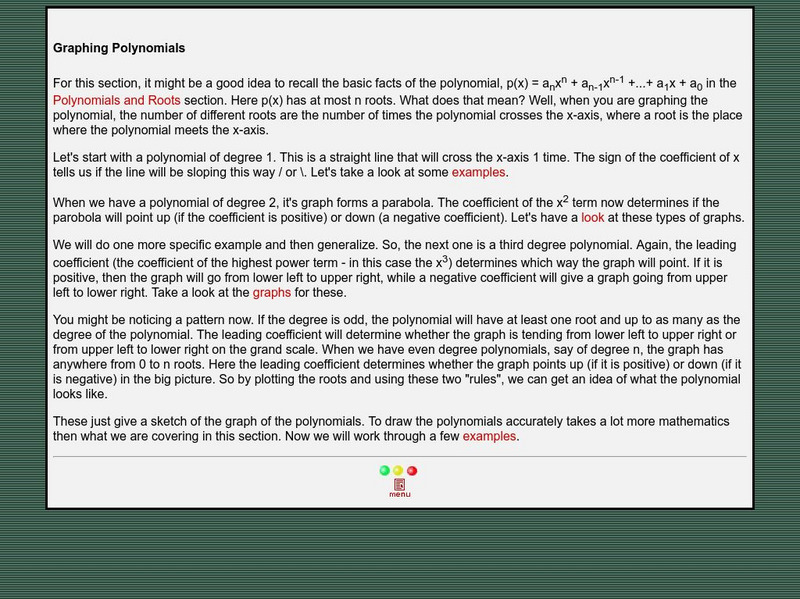
University of Saskatchewan: Graphing Polynomials
An introduction to the graphs of polynomial functions by looking at the roots of the polynomials, or where it crosses the x-axis. Includes links to pictures of graphs and detailed explanations.

Curated OER
Definition of a Polynomial Function
This page gives the basic definition and several concrete examples of polynomial functions

Curated OER
Real Roots of Polynomial Functions
A thorough abstract treatment of how to find the roots of a polynomial function. The site explains how to divide polynomials and the remainder theorem. The language is a bit technical, but the examples are good.

Richland Community College
Richland Community College: Steps to Graphing Rational Functions
This site describes the steps to follow when graphing a rational function.
Richland Community College
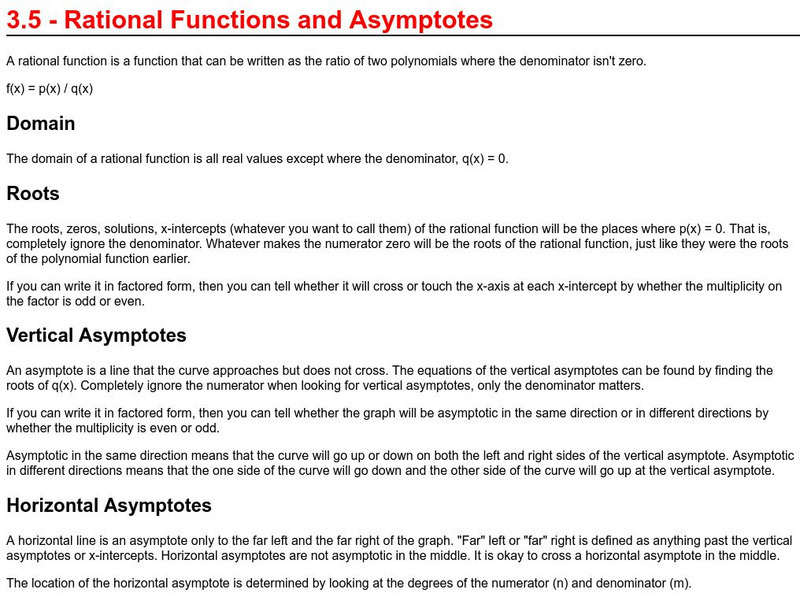
Richland Community College: Rational Functions and Asymptotes
This site contains basic information on rational functions. Gives definition, how to find domain and roots, and how rational functions apply to asymptotes and holes in the graph.
Purple Math
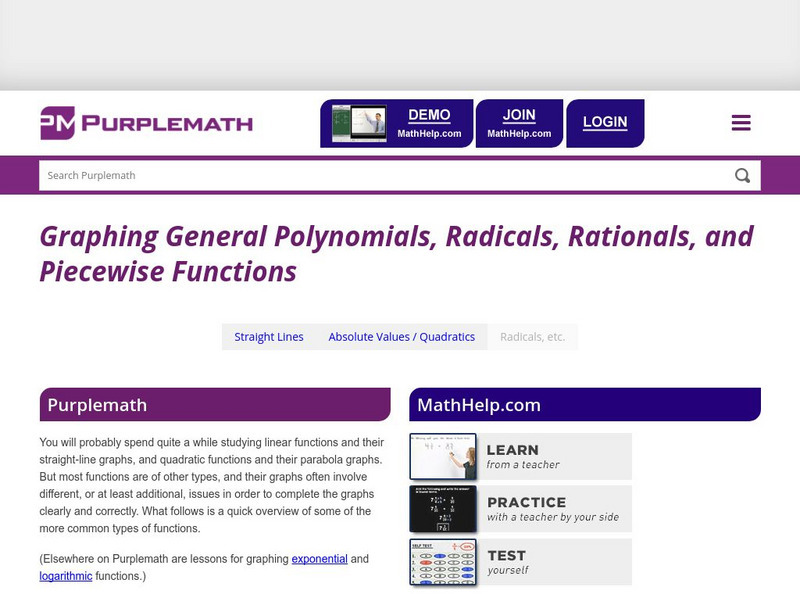
Purplemath: Graphing General Polynomials, Radicals, Rationals, and Piecewise Fun
This resource provides an overview of graphing, giving examples of general polynomial, radical, rational, and piecewise functions. Also includes advice on common mistakes made by students.

Oregon State University
Calculus Quest: Exponential Functions
This CalculusQuest site provides a basic introduction to exponential functions, covering the laws of exponents and exponential growth and decay. At the bottom of the page are links to exponential equations, exercises, and the...
Purple Math
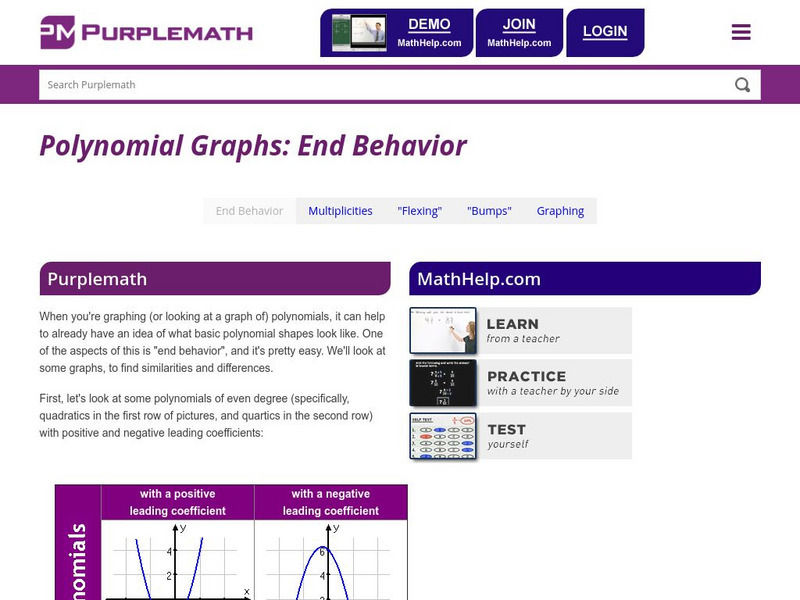
Purplemath: Polynomial Graphs: End Behavior
Explains how to recognize the end behavior of polynomials and their graphs. Points out the differences between even-degree and odd-degree polynomials, and between polynomials with negative versus positive leading terms.
Purple Math
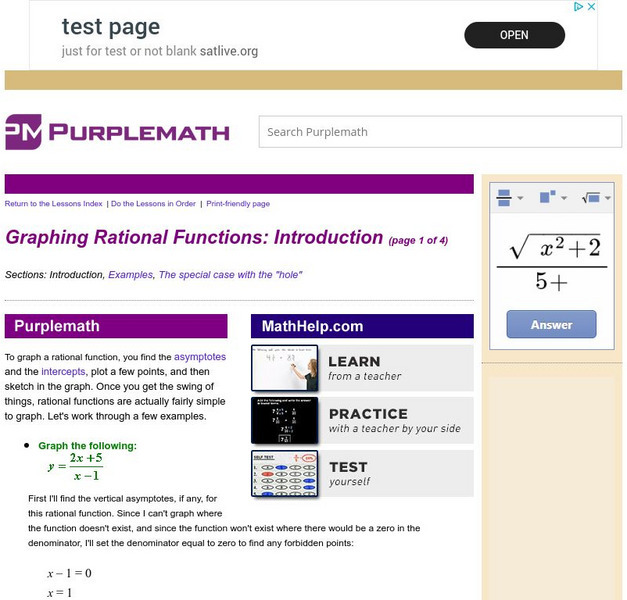
Purplemath: Graphing Rational Functions: Introduction
To graph a rational function, you find the asymptotes and the intercepts, plot a few points, and then sketch in the graph. Once you get the swing of things, rational functions are actually fairly simple to graph. This resources provides...
Other
If Only Every Function Were a Polynomial
This site explains why not every function is a polynomial and discusses infinite series.
Wolfram Research
Wolfram Math World: Calculus and Analysis
Over two dozen links are provided at this MathWorld site. From Polynomials and Series to Dynamical Systems and Catastrophe Theory, each link provides in-depth explanations and relevant diagrams of the topics at hand.
Savvas Learning
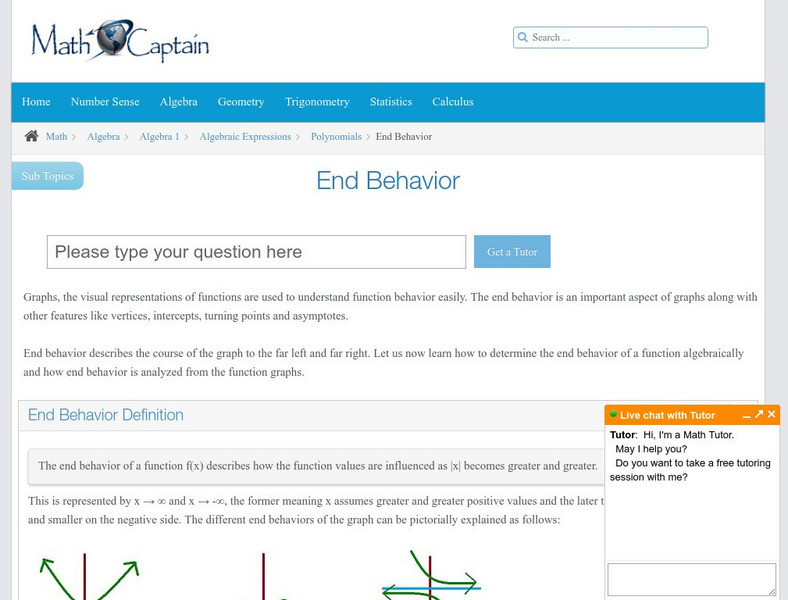
Math Captain: End Behavior
This site provides an explanation of the end behavior of functions. Covers end behavior as it relates to function models, rules, polynomials, asymptote, functions, and graphs.
Curated OER
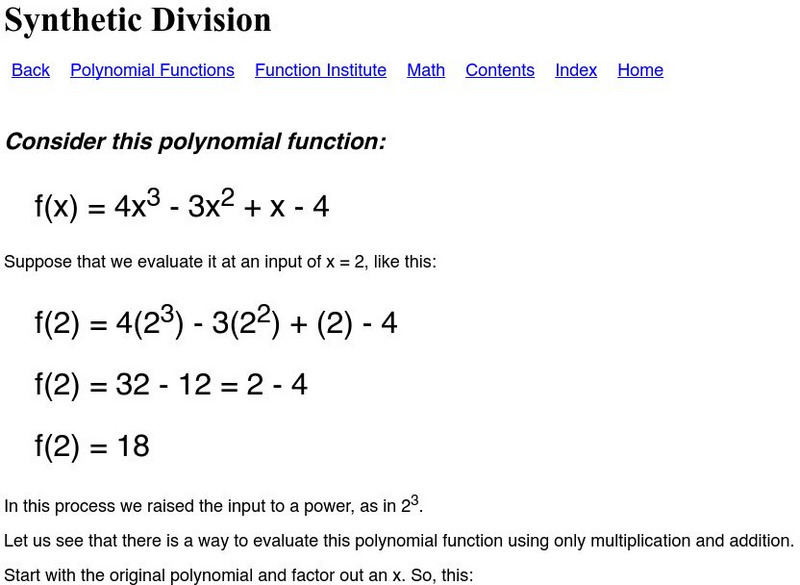
Synthetic Division
A step-by-step example problem and explanation of synthetic division is provided.
Purple Math
Purplemath: Graphing Overview: Straight Lines
This resource provides an overview of graphing for various types of functions, instruction on graphing straight lines and also, includes advice on common mistakes made by students.
Science Struck
Science Struck: Guide on Interpolation vs. Extrapolation
Explains what interpolation and extrapolation are and methods used for them in statistics. Gives real-world examples of their applications in telecommunications, engineering, thermodynamics etc.
Other popular searches
- Graphing Polynomial Functions
- Simple Polynomial Functions
- Polynomial Functions Test
- Solving Polynomial Functions
- Graph Polynomial Functions